The best credit underwriting software is the one that can explain every decision it makes, connects to data that actually covers your borrowers, lets your credit team change policy without waiting on engineers, and costs something sensible at your volume. Which product that is depends on what you lend, where, and to whom.
This guide doesn't rank vendors, and that's deliberate. Most platforms quote prices privately, based on volume, market and modules. Features change with every release. A platform that suits a card issuer in one country can be wrong for a small-business lender in another. A ranked list with prices and star ratings would be guesswork. Instead, here's a checklist and a scoring method you can apply to any shortlist.
What an underwriting stack is made of
Whatever you buy or build, a working credit decision needs these parts.
| Component | What it does | What to check |
|---|---|---|
| Data connectors | Pull credit bureau files, bank-account data (with consent), identity and fraud checks, and documents | Which sources are already connected in your market, and what happens when one is down |
| Decision or rules engine | Runs policy rules, calls models, and returns approve, decline or refer with a limit and price | Whether your credit team can edit rules themselves, test them and roll them back |
| Scorecards and models | Estimate the probability of default | Whether you can bring your own model, and whether each score comes with reasons |
| Case management | A queue where underwriters review referred applications and record their decision | Whether the reviewer sees all the data and the reasons in one screen |
| Audit trail | Records the inputs, rule and model versions, and outcome for every decision | Whether you can replay a past decision exactly as it was made |
The kinds of products you'll come across
Vendors fall into a few broad categories, and they aren't always comparable:
- Loan origination systems cover the whole journey, from application form to funding, with decisioning built in.
- Standalone decision engines handle rules, models and workflow, and expect you to bring the front end and loan servicing.
- Data and scoring providers sell bureau data, bank-transaction analysis or their own risk scores, which plug into one of the above.
- Model-building platforms help your data team develop and monitor models, without running live decisions.
Many lenders combine several. Work out which category you're shopping in before comparing anything.
Build or buy?
Buying gets you bureau connections, a rules engine, case management and an audit trail in months rather than a year. That suits most new lenders and most new products.
Building makes sense when underwriting is your advantage: an unusual segment, data nobody else uses, or a product the platforms handle badly. Even then, many teams buy the engine and build the models inside it.
Either way, regulators and borrowers hold you responsible for the decision, not your software supplier.
Questions to ask every vendor
Explainability and adverse-action reasons
- For any single decision, can I see which rules fired and the top factors behind the score, ranked?
- Do those factors map to the reason codes or plain-language notices my market requires? In some jurisdictions, including the US, lenders must tell declined applicants the principal reasons. The rules vary by country, so check locally.
- For machine-learning models, how are reasons produced, and are they stable when an input changes slightly?
Model governance
- Who owns the model? If it's the vendor's pooled model trained on other lenders' data, can you validate it on your own applicants?
- Is every rule and model change versioned, with who changed it and when?
- Can you run a new rule set in "shadow mode", or as a challenger on a share of traffic, before it goes live?
- What monitoring comes built in: score drift, approval rates by segment, outcome testing across groups?
Data coverage
- Which bureaus and bank-data providers are already integrated for the countries you lend in? Our explainer on open banking covers how consent-based bank data sharing works.
- How does it handle thin-file applicants, no-hit bureau responses, and a data source timing out?
- For small-business lending, can it read accounting or payment-processor data?
- Will the data provider run a back-test on your own past applications? Our guide to credit underwriting data sources works through one.
Integration
- Is there a documented API, a sandbox with realistic test data, and webhooks for status changes?
- What's the typical response time per decision, and what uptime does the contract commit to?
- If you leave, can you export your rules, decision history and data in a usable format?
Pricing
You'll rarely see a price list, but most quotes are built from the same pieces.
| Pricing element | How it works | Watch for |
|---|---|---|
| Implementation fee | One-off charge for setup and integration | What's included, and what's billed later as extra services |
| Platform fee | Monthly or annual subscription, often tiered | Minimum commitments that rise faster than your volume |
| Per-decision or per-loan fee | Charged per application decided or per loan funded | Whether a re-run or a referred case counts as a second decision |
| Data costs | Bureau and bank-data calls | Whether they're passed through at cost or marked up |
| Change requests | Vendor staff editing rules or workflows for you | Hourly rates that make every policy change slow and costly |
Worked example: scoring three options and checking the cost
Every figure below is made up to show the method. Use your own weights, scores and quotes.
Step 1: weight the criteria and score each option
A lender decides what matters and gives each criterion a weight, totalling 100%. It then scores three shortlisted products from 1 (poor) to 5 (excellent) after demos and a sandbox trial.
| Criterion | Weight | Option A | Option B | Option C |
|---|---|---|---|---|
| Explainability and reasons | 25% | 4 | 5 | 2 |
| Data coverage for the lender's market | 20% | 4 | 3 | 5 |
| Integration effort | 15% | 4 | 3 | 4 |
| Model governance and audit trail | 15% | 4 | 4 | 2 |
| Rule flexibility for the credit team | 10% | 3 | 5 | 2 |
| Three-year cost | 15% | 2 | 4 | 3 |
| Weighted score | 100% | 3.60 | 4.00 | 3.05 |
Each weighted score is the sum of score × weight. For Option B: 5 × 0.25 + 3 × 0.20 + 3 × 0.15 + 4 × 0.15 + 5 × 0.10 + 4 × 0.15 = 1.25 + 0.60 + 0.45 + 0.60 + 0.50 + 0.60 = 4.00.
Option A: 1.00 + 0.80 + 0.60 + 0.60 + 0.30 + 0.30 = 3.60. Option C: 0.50 + 1.00 + 0.60 + 0.30 + 0.20 + 0.45 = 3.05.
Step 2: apply must-have gates
Totals can hide a deal-breaker. This lender rules out anything scoring below 3 on explainability or governance, whatever its total. Option C fails both, so its excellent data coverage doesn't save it.
Step 3: test whether the winner depends on the weights
Swap the weights for explainability (now 20%) and data coverage (now 25%). Option A stays at 3.60, Option B drops to 3.90 and Option C rises to 3.20. Option B still wins. If a small change in weights flips the result, there's no clear winner yet.
Step 4: compare buying Option B with building
The lender expects 24,000 decisions in year 1, 36,000 in year 2 and 48,000 in year 3: 108,000 in total. Data costs are similar either way, so they're left out.
Buy (Option B): a 40,000 implementation fee, a 36,000 yearly platform fee, 0.50 per decision, and 30,000 a year of internal engineering time to integrate and maintain it.
Build: 225,000 in year 1 for a small team to build the engine, then 150,000 a year to maintain it, plus 12,000 a year for hosting and tools.
| Year | Buy | Build |
|---|---|---|
| 1 | 40,000 + 36,000 + 12,000 + 30,000 = 118,000 | 225,000 + 12,000 = 237,000 |
| 2 | 36,000 + 18,000 + 30,000 = 84,000 | 150,000 + 12,000 = 162,000 |
| 3 | 36,000 + 24,000 + 30,000 = 90,000 | 150,000 + 12,000 = 162,000 |
| Total | 292,000 | 561,000 |
| Per decision | 2.70 | 5.19 |
Per-decision fees are 24,000 × 0.50 = 12,000, then 18,000 and 24,000. Cost per decision is the total ÷ 108,000. Building costs 269,000 more over three years.
When would building break even? Buying's fixed costs over three years are 40,000 + (3 × 36,000) + (3 × 30,000) = 238,000. The gap to building is 561,000 − 238,000 = 323,000, which the 0.50 fee would only cover at 323,000 ÷ 0.50 = 646,000 decisions. That's about six times this lender's volume, or roughly 18,000 decisions a month. Below that, buying is cheaper on these assumptions, even before counting the months a build takes to launch.
Red flags
- "Our AI is proprietary, so we can't show reasons." You can't send a declined applicant a notice that says that.
- Big promises of higher approvals with lower losses. Ask for a test on your own past applications, and check the results yourself.
- Every rule change goes through the vendor's services team. Policy changes will be slow and billed by the hour.
- No export route. If your decision history and rules can't leave, switching gets expensive.
- Inputs you couldn't justify to a borrower, such as social media activity or browsing behaviour. These can act as stand-ins for protected characteristics and are restricted in many places.
Mistakes buyers make
- Choosing on the demo. Demos use clean data. Run your own messy applications through a sandbox before signing.
- Comparing headline prices only. Model three years of costs at your expected volume, including minimums and change fees.
- Treating the vendor's model as validated for you. Performance on other lenders' customers doesn't prove it works on yours.
Next step
Weighing bank-data scores against bureau scores? See FICO score vs cash flow underwriting: which lenders use it.
Write down your must-have gates and weights before the first demo, so the shortlist is judged on your needs rather than the best sales pitch. Then score each option and model three years of cost at your own volume. For the process the software has to support, read our credit underwriting guide, and for how bank data gets shared with consent, see what open banking is.
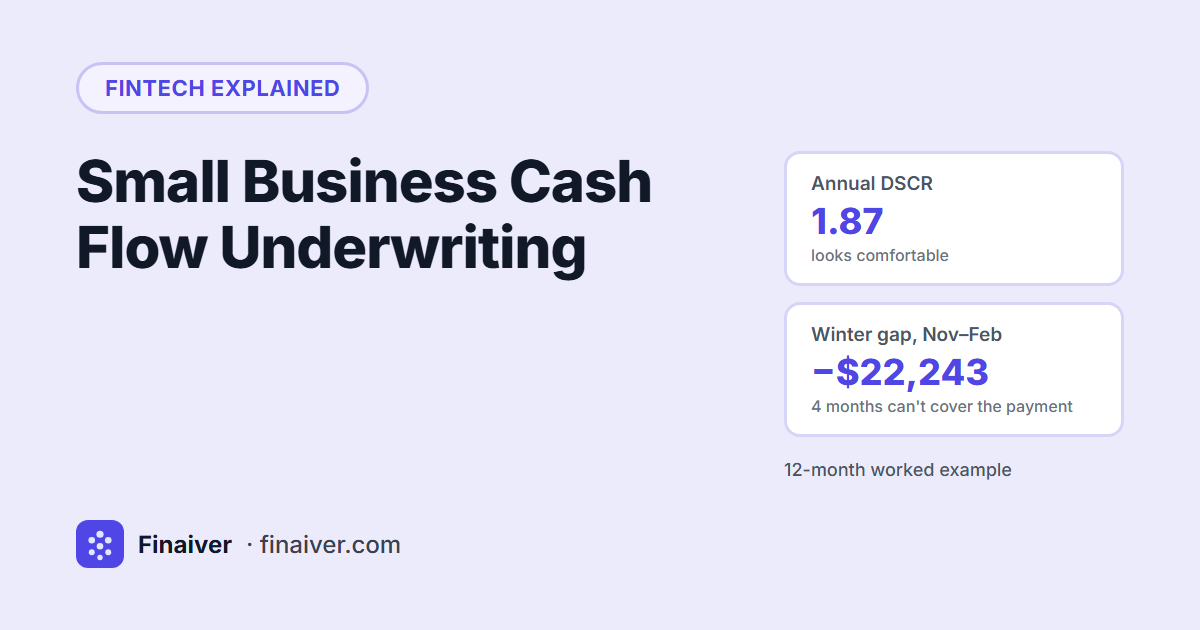
If bank-account data will feed your decisions, cash-flow underwriting explained walks through the metrics the software should calculate.
This article is general information, not financial advice.