The Shift to Agentic Infrastructure: Top 5 AI Breakthroughs and News Stories This Week
The hype cycle around artificial intelligence has officially cracked. For the past few years, the corporate world treated generative AI as an advanced novelty—a collection of high-performing text summarizers, image engines, and writing assistants. But over the last 24 to 48 hours, a massive structural shift has crystallized across the global technology market.
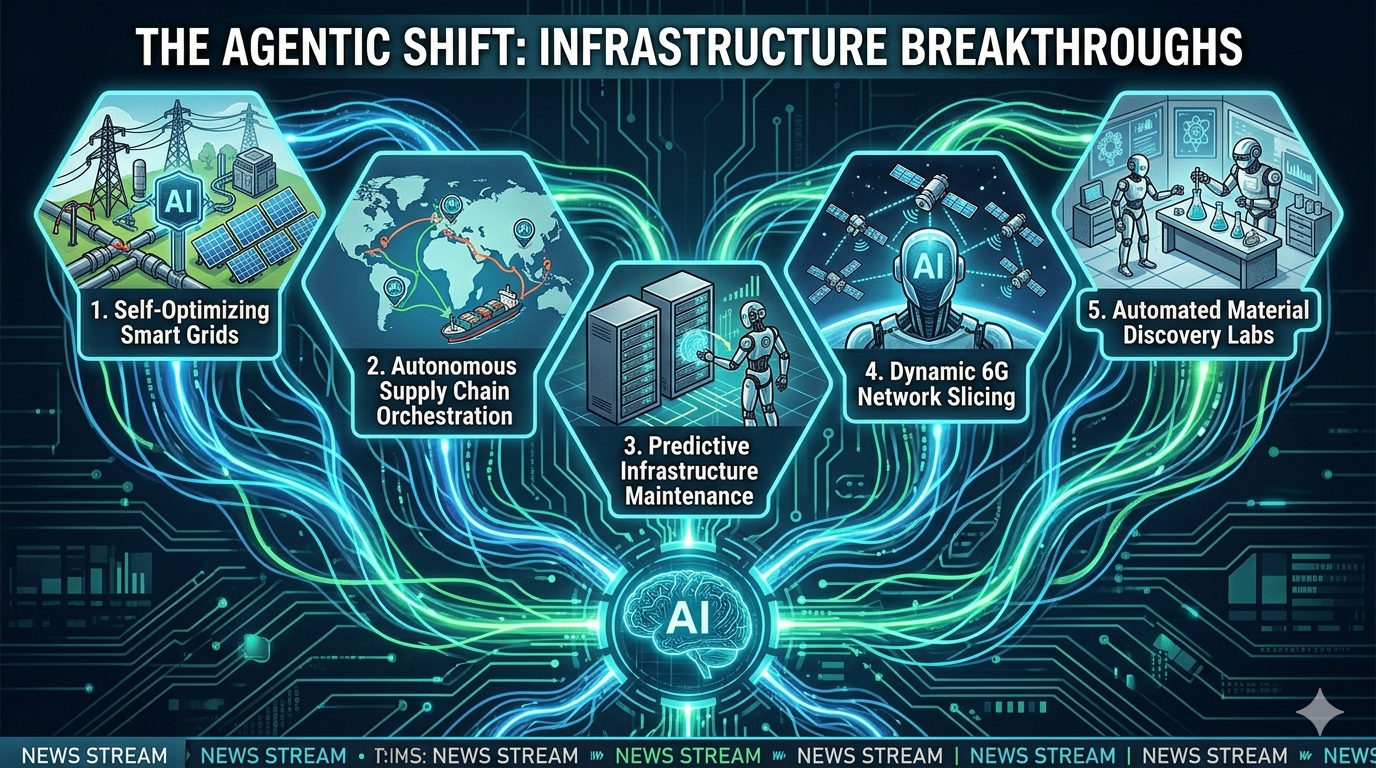
We are moving away from isolated "copilots" and entering the era of Agentic Infrastructure.
Instead of software that simply recommends actions or drafts emails, the industry is aggressively pivoting toward autonomous AI agents that can seamlessly execute workflows across multiple applications, databases, and third-party APIs. However, with massive autonomy comes massive risk. The breaking tech headlines from the past 24 hours reflect a unified theme: the global race to build security, identity verification, and strict governance frameworks for an economy run by AI agents.
From historic multi-billion dollar enterprise software acquisitions to breakthroughs in simulating human brain behavior, here is the essential analysis of the top AI stories trending globally.
1. Snowflake to Acquire Natoma: The Battle for Model Context Protocol (MCP)
In one of the most strategically significant data security moves of the year, cloud data giant Snowflake (NYSE: SNOW) officially announced its definitive agreement to acquire Natoma, a cutting-edge platform explicitly built to handle Model Context Protocol (MCP) security for AI agents.
Why This is a Massive Big Deal
To understand why this acquisition is sending shockwaves through enterprise tech, you have to understand the core problem with autonomous AI systems. Traditional APIs were built for humans using specific software configurations. When you unleash an AI agent to crawl through an enterprise environment—connecting your CRM, internal Slack history, private financial ledgers, and customer databases—it creates an incredibly messy security perimeter.
Without a centralized authorization layer, these agents can trigger accidental data leaks, execute unauthorized transactions, or expose confidential information (a phenomenon known as "shadow AI workflows").
[Enterprise Apps / APIs] <---> [Natoma MCP Gateway] <---> [Snowflake Cortex Agents]
                                      |
                     (Identity, Trust & Compliance Layer)
Natoma built an institutional gateway that acts as a secure control plane. By absorbing Natoma into its AI Data Cloud, Snowflake is building a native identity and compliance layer for autonomous workloads.
The Operational Viewpoint: Sridhar Ramaswamy, CEO of Snowflake, summarized the enterprise bottleneck perfectly: "AI agents are quickly becoming part of how enterprises operate, but intelligence without governance creates immense systemic risk."
When the deal closes, Snowflake users will be able to securely connect their Cortex Agents and analytical architectures directly into live workflows across internal SaaS infrastructures with end-to-end audit trails. This establishes Snowflake not just as a data repository, but as the trusted command center for autonomous business execution.
2. Zscaler Launches "Project AI-Guardian" Alongside Global System Integrators
As autonomous agents scale across corporate tech stacks, the cybersecurity sector is mounting a massive defense. Zscaler, a global pioneer in Zero Trust network architectures, has officially launched Project AI-Guardian.
                       PROJECT AI-GUARDIAN SECURE ENVELOPE
  ┌──────────────────────────────────────────────────────────────────────────┐
  │                                                                          │
  │   [Corporate Endpoints] ───►  (Zero Trust Inspection)  ───► [AI Models]   │
  │                                                                          │
  │   [Shadow AI Discovery] ───►   (Lineage Mapping)      ───► [Autonomous]  │
  │                                                            [Workloads]   │
  │                                                                          │
  └──────────────────────────────────────────────────────────────────────────┘
This massive enterprise campaign is a joint initiative alongside the world’s leading Global System Integrators (GSIs), including Cognizant, EY, HCLTech, Infosys, TCS, and Wipro. The goal is simple: to stop the unmonitored spread of shadow AI installations while mapping the hidden infrastructure lineage of automated corporate systems.
Addressing the Vulnerability Epidemic
Recent market studies show that nearly 64% of vendors utilizing internal AI software fail to fully disclose their third-party subprocessors. This exposes enterprises to massive liabilities under evolving global compliance acts.
Project AI-Guardian steps in by applying a permanent Zero Trust wrapper around every inbound and outbound data packet touching an enterprise AI model. The system provides real-time telemetry to:
Instantly detect unauthorized AI integrations on company networks.
Track the data lineage of how models train on corporate IP.
Defend infrastructure from automated, AI-driven malware attacks and zero-day exploits.
This massive cross-industry alliance proves that cybersecurity is no longer about just securing human passwords—it’s about monitoring the behaviors, data pipelines, and operational limits of automated software agents.
3. OpenAI Unveils 2026 Global Election Safeguards and Public Verification Frameworks
As major democratic cycles approach globally, OpenAI released its comprehensive 2026 core election policy framework and transparency roadmap. With generative media becoming virtually indistinguishable from reality, the focus has shifted toward building strict defensive cyber-infrastructure and multi-layered data provenance tools.
Key Framework Implementations
Public Asset Verification Systems: OpenAI is previewing a public verification platform that allows everyday users to upload off-platform media assets to instantly scan for invisible cryptographic tracking signatures, such as SynthID watermarks and C2PA metadata.
Deployment of Codex Security (Project Daybreak): Part of a broader software fortification initiative, this framework automatically isolates, tests, and patches systemic script vulnerabilities within public administrative web structures to mitigate targeted digital disruptions.
Aggressive Usage Enforcements: The organization has updated its terms of service to strictly ban any deployment of its foundational models for scaled campaign operations, micro-targeted behavioral messaging, or automated political outreach tools.
By introducing open provenance standards, the goal is to shift public platforms from a reactive state of guessing what is real to a proactive framework of digital verification.
4. Meta Open-Sources TRIBE v2: The Predictive Foundation Brain Twin
While enterprise software providers focus heavily on risk and operational governance, Meta AI has delivered a stunning technical leap forward at the intersection of neuroscience and artificial intelligence by releasing the complete weights and codebase for TRIBE v2.
  [Complex Media Inputs] ───► [TRIBE v2 Neural Twin] ───► [Predicted Brain Activity]
  (Video, Audio, Text)        (Zero-Shot In-Silico)       (70x Resolution Boost)
TRIBE v2 is a predictive foundation model designed to act as a hyper-accurate, digital in-silico twin of human neural activity. Trained on massive fMRI datasets from human volunteers exposed to multi-modal stimuli (including podcasts, high-definition videos, and written prose), the architecture can accurately forecast how a human brain will neurally respond to complex sensory stimuli.
Closing the Loop Between Biological and Artificial Intelligence
What makes TRIBE v2 a massive milestone is its zero-shot generalization capability. The model can predict sensory processing activity for completely unique subjects, regional dialects, and abstract cognitive tasks it never encountered during its initial training rounds.
By open-sourcing the model on Hugging Face under a CC BY-NC license, Meta is allowing global biomedical labs to execute rapid, virtual neuroscientific experiments without needing active human cohorts. This development drastically accelerates research into neurodegenerative conditions like Alzheimer's while providing computer engineers with biological blueprinted loops to build incredibly efficient, human-aligned neural networks.
5. C-Suite Realities: The Shift from Productivity Hype to "Tech Debt" Extraction
At the TIME100 AI Leadership Forum in New York, top enterprise tech executives gathered to confront a sobering operational reality: the corporate gap between AI experimentation and tangible fiscal returns is widening.
Panelists including top technology officers from American Express and New York Life Insurance Company noted that while minor tools have driven short-term team productivity gains, they are not yet redefining business models.
Metric Category | The Hype Approach (Legacy) | The Strategic Approach (Next-Gen) |
Primary Goal | Minor individual task time reduction | Deep operational automation & workflow transformation |
Infrastructure Focus | Off-the-shelf chatbot integration | Native data clean rooms & unified MCP architecture |
Primary Bottleneck | Employee user adoption friction | Accumulated legacy software "tech debt" |
Value Metric | Model speed and conversational charm | Exact compute-cost per fully completed business task |
Many established legacy firms are currently struggling under massive amounts of technical debt—outdated database systems, disconnected APIs, and unorganized text files that prevent cutting-edge model systems from working properly.
The consensus from global business leaders is clear: the corporate winners of this era will not be the companies that buy thousands of disconnected chatbot licenses. The real winners will be the organizations that completely rebuild their underlying data architecture to let autonomous agent software securely handle deep business operations.
Summary and Key Tactical Takeaways
The events of the last 24 hours signal a clear trajectory for developers, enterprise architects, and technology startup founders:
Prioritize Context Over Raw Model Power: As shown by Snowflake's acquisition of Natoma, the commercial value is shifting away from raw LLM size toward secure context integration. Focus on building clean, structured, and auditable pipelines.
Build for Multi-Agent Governance: Treat agent safety, identity management, and tool-access boundaries as essential requirements from day one. Look into emerging Model Context Protocol (MCP) standards.
Focus on Task Economics: Move beyond simple productivity features. Measure your technology solutions based on total cost-per-completed-task, system integration reliability, and how well they reduce long-term operational friction.
The market has outgrown basic text prompt engines. The future bel