The rule of 72 is a shortcut for compound growth: divide 72 by the annual rate, and the answer is roughly how many years it takes for something to double. At 8% a year, 72 ÷ 8 = 9, so money doubles in about 9 years. The exact answer is 9.0 years.
It works for anything that compounds at a steady rate: savings, investments, prices rising with inflation, or a debt you aren't paying down. It's an estimate, and this article shows exactly how good an estimate it is.
How to use the rule of 72
There are two ways to use it.
To find the doubling time: years to double ≈ 72 ÷ annual rate (as a percentage, not a decimal).
To find the rate you need: rate needed ≈ 72 ÷ years you have.
Some examples (the maths works in any currency):
- At 6%, 72 ÷ 6 = 12 years to double. Exact: 11.9 years.
- At 9%, 72 ÷ 9 = 8 years. Exact: 8.0 years.
- You want to double your money in 6 years. 72 ÷ 6 = 12% a year needed. Exact: 12.25%.
A worked example
You invest 10,000 at 7% a year, compounded yearly.
- Rule of 72: 72 ÷ 7 = 10.3 years to double.
- Check: 10,000 × 1.07^10 = 19,672 after 10 years. Just short of 20,000, which fits an estimate a little over 10 years.
You can also chain doublings. At 8%, money doubles about every 9 years. In 36 years that's four doublings: 2 × 2 × 2 × 2 = 16 times the original. The exact figure is 1.08^36 = 15.97, so 10,000 becomes about 159,682. The rule got you within a fraction of a percent with mental arithmetic.
How accurate is it? Rule of 72 vs exact doubling time
The exact doubling time for annual compounding at rate r is ln(2) ÷ ln(1 + r). Here's how the rule of 72, and its cousins the rule of 70 and the rule of 69.3, compare.
| Annual rate | Rule of 72 | Rule of 70 | Rule of 69.3 | Exact (years) |
|---|---|---|---|---|
| 2% | 36.0 | 35.0 | 34.6 | 35.0 |
| 3% | 24.0 | 23.3 | 23.1 | 23.4 |
| 4% | 18.0 | 17.5 | 17.3 | 17.7 |
| 5% | 14.4 | 14.0 | 13.9 | 14.2 |
| 6% | 12.0 | 11.7 | 11.5 | 11.9 |
| 7% | 10.3 | 10.0 | 9.9 | 10.2 |
| 8% | 9.0 | 8.8 | 8.7 | 9.0 |
| 9% | 8.0 | 7.8 | 7.7 | 8.0 |
| 10% | 7.2 | 7.0 | 6.9 | 7.3 |
| 11% | 6.5 | 6.4 | 6.3 | 6.6 |
| 12% | 6.0 | 5.8 | 5.8 | 6.1 |
| 13% | 5.5 | 5.4 | 5.3 | 5.7 |
| 14% | 5.1 | 5.0 | 5.0 | 5.3 |
| 15% | 4.8 | 4.7 | 4.6 | 5.0 |
What the table shows:
- Between about 6% and 10%, the rule of 72 is almost exact. It's off by a tenth of a year or less. That's the range where it's most often used, and it's why 72 became the popular version.
- Below about 5%, the rule of 72 overestimates. At 2% it says 36 years; the real answer is 35. The rule of 70 is closer at low rates.
- Above about 10%, it underestimates. At 15% it says 4.8 years; the real answer is 5.0.
Across the whole 2% to 15% range, the rule of 72 is never more than one year out, and above 3% it's within about half a year. For a mental shortcut, that's good enough for most decisions.
Using it for inflation
Inflation compounds too, but it works in the other direction: it halves what your money buys. The rule of 72 tells you roughly how long that takes.
- At 3% inflation, 72 ÷ 3 = 24 years for prices to double, which means a fixed amount of money buys about half as much. Exact: 23.4 years. 100 held as cash for 24 years at 3% inflation buys what about 49.20 buys now.
- At 6% inflation, 72 ÷ 6 = 12 years. Exact: 11.9 years.
This is useful for anything with a fixed value: cash under the mattress, a savings account paying less than inflation, or a pension or income that doesn't rise with prices. Inflation rates change over time and differ between countries, so use a figure that reflects your own situation. Inflation and real returns explains how to adjust growth for it.
You can also apply the rule to a real return, meaning the return after inflation. If savings earn 5% while inflation runs at 3%, the real return is roughly 2%, and 72 ÷ 2 = 36 years to double your purchasing power. That's a sobering number to see next to "14.4 years" for the nominal balance.
Using it for debt
Debt you aren't paying off grows exactly like an investment, just for the lender.
- A balance at 18% a year, compounded yearly, doubles in about 72 ÷ 18 = 4 years. Exact: 4.19 years. If the 18% is charged as 1.5% a month, it doubles in about 3.88 years, slightly faster.
- A debt charging 2% a month doubles in about 72 ÷ 2 = 36 months. Exact: 35.0 months. The rule works with any period, as long as the rate and the answer use the same one.
For most people, this is the strongest argument for clearing high-interest debt before investing. Debt at 18% doubles in about 4 years; investments at a hoped-for 7% take about 10. Paying the debt is the guaranteed return.
Note that amortizing loans, where you make fixed payments, don't double: the payments cover the interest and chip away at the balance. The rule applies to debt that's left to grow. For how fees and compounding change what a loan really costs, see APR vs interest rate.
Where the rule of 72 breaks down
High rates. The approximation drifts as rates rise.
| Rate | Rule of 72 | Exact |
|---|---|---|
| 20% | 3.6 | 3.8 |
| 25% | 2.9 | 3.1 |
| 30% | 2.4 | 2.6 |
| 50% | 1.4 | 1.7 |
At 50%, the estimate is about 16% too short.
Variable returns. The rule assumes the same rate every year. Investments don't behave like that. If a portfolio averages 8% but swings up and down, the actual doubling time can be noticeably longer than 9 years, because losses hurt compounding more than equal gains help it. Treat the result as "about this long if returns average out", not a promise.
Contributions and withdrawals. The rule describes a single sum left alone. If you're adding money every month or drawing it down, use a calculator instead.
Fees and taxes. Use the rate after fees, and after tax where tax applies each year. A 7% return with a 1% annual fee doubles at the 6% pace: 12 years, not 10.
The rule of 70 and the rule of 69.3
These are the same idea with a different number.
- Rule of 69.3 is the mathematically exact version for continuous compounding, because ln(2) = 0.693. At 5% continuous, 69.3 ÷ 5 = 13.86 years, which is exact. For yearly compounding it slightly underestimates, as the table shows.
- Rule of 70 sits in between. It's more accurate than 72 at low rates (roughly 1% to 4%), which is why it's often used for inflation and economic growth figures. It's easy to divide too.
- Rule of 72 is the most practical for typical savings and investment returns, and 72 divides cleanly by 2, 3, 4, 6, 8, 9 and 12.
Pick whichever number is easiest to divide by the rate in front of you. The differences are small compared with the uncertainty in the rate itself.
There are related shortcuts for bigger multiples. Dividing 114 by the rate estimates tripling time (at 8%: 14.2 years, exact 14.3), and 144 estimates quadrupling time, which is simply two doublings.
Next step: check the estimate with real numbers
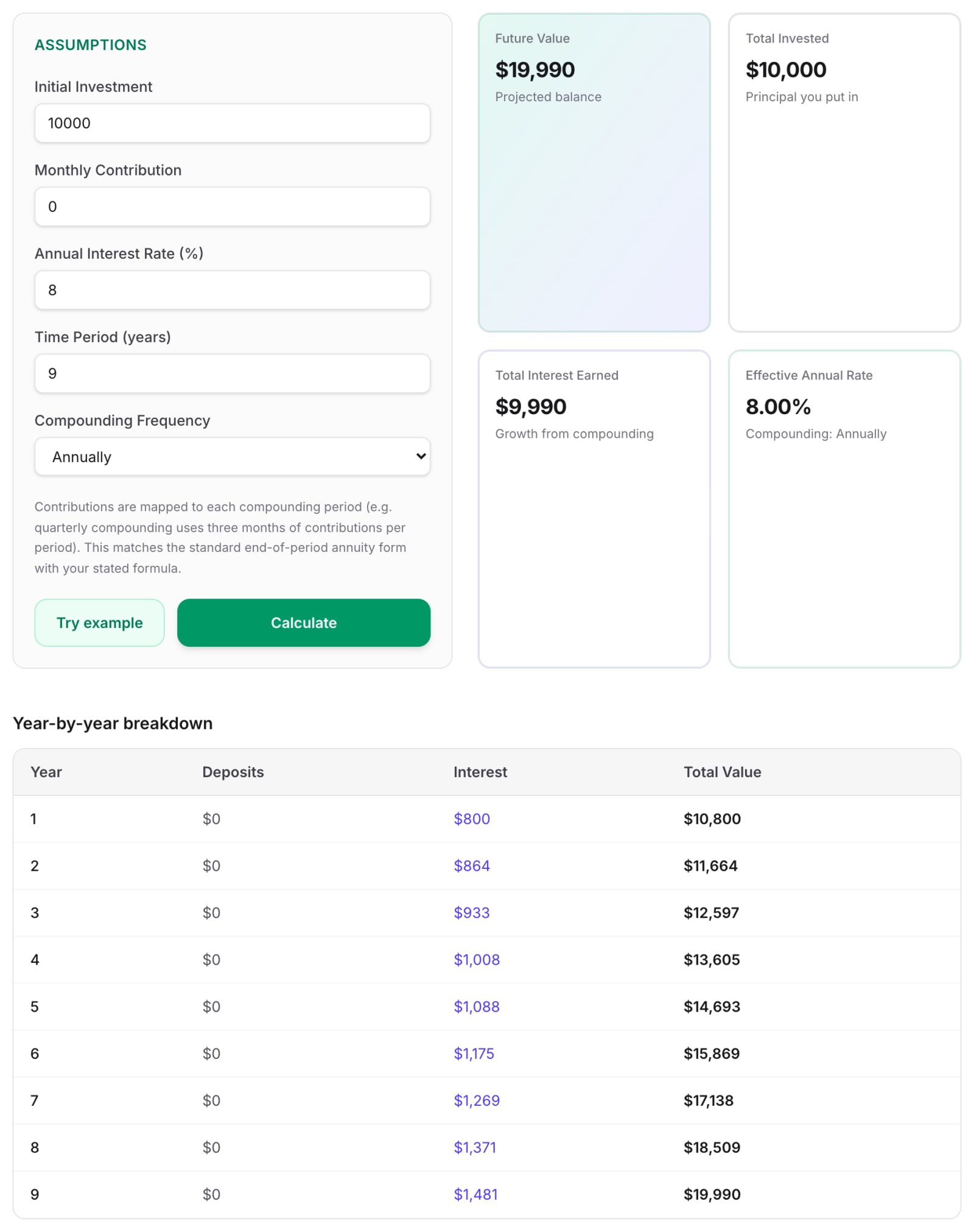
The rule of 72 is for quick checks. For a precise answer, use the Compound Interest Calculator. Set Initial Investment to 10,000, Monthly Contribution to 0, Annual Interest Rate to 8, Time Period to 9 years and Compounding Frequency to Annually; the Future Value lands at about 19,990, just short of double. Change the compounding to Monthly and you'll see an Effective Annual Rate of 8.30% and a balance that doubles a little sooner.
For the full picture of how compounding works, read compound interest explained with examples, and for how the compounding schedule changes results, compounding frequency: does it matter?
This article is general information, not financial advice.