When a small business applies for a loan, the lender's real question is simple: after the business pays its costs, is there enough cash left, every month, to make the new payment? Cash flow underwriting answers it from the business bank account rather than from the owner's credit score alone. The lender strips out money that isn't revenue, measures what's left after operating costs, and compares that with all the debt payments the business would carry.
The annual numbers are only half of it. A business can look comfortable over a full year and still run out of cash in its slow months. Below is one seasonal business worked through month by month, the way an underwriter would do it.
What lenders pull from business bank statements
Most lenders ask for somewhere between three and twelve months of statements for the main operating account, either as PDFs or through a direct, consent-based bank connection. Larger loans and government-backed programmes usually add tax returns and financial statements on top. From the transactions, an underwriter builds a handful of figures:
- True revenue. Deposits minus anything that isn't sales: transfers from the owner's other accounts, money the owner puts in, loan proceeds, refunds and reversed payments. Total deposits almost always overstate revenue.
- Operating costs. Payroll, materials, fuel, rent, insurance, software and the owner's regular salary.
- Cash available for debt service. True revenue minus operating costs. This is the money that can actually pay lenders.
- Existing debt payments. Equipment loans, vehicle loans, credit lines, and any daily or weekly debits from merchant cash advances.
- Balances and overdrafts. How low the account gets, how often it goes negative, and whether payments bounce.
- Seasonality and concentration. Whether revenue swings by season, and whether one or two customers make up most of the deposits.
The headline ratio is the debt service coverage ratio (DSCR):
DSCR = cash available for debt service ÷ total debt payments (existing plus the new loan)
A DSCR of 1.00 means every dollar of spare cash goes to lenders, with nothing left over. Lenders want a cushion above that. Minimums vary by lender and loan programme, and are often somewhere around 1.15 to 1.35 on annual figures, so ask the lender what they use.
The business and the loan
The example is illustrative. It's not based on a real company or on any one lender's policy.
A landscaping company with two crews wants to add a third. It applies for $50,000 over 36 months at an illustrative 12% a year to buy a truck and equipment. It already pays $1,150 a month on an existing truck loan.
Using the standard loan payment formula, the new loan costs $1,660.72 a month, with $9,785.76 of total interest over the three years. You can check this in the Loan EMI Calculator with a loan amount of 50000, a rate of 12 and a tenure of 36 months.
So total debt payments with the new loan would be $1,150 + $1,660.72 = $2,810.72 a month, or $33,728.64 a year.
Twelve months of bank data
The account opened the year with $6,000. Operating costs include the owner's regular salary. In October the owner also took a one-off $30,000 distribution at the end of the busy season, which is shown in the balance but not counted as an operating cost.
| Month | Total deposits | Not revenue | True revenue | Operating costs | Cash for debt service | Month-end balance |
|---|---|---|---|---|---|---|
| Jan | $20,000 | $6,000 | $14,000 | $19,000 | −$5,000 | $5,850 |
| Feb | $23,500 | $8,000 | $15,500 | $18,500 | −$3,000 | $9,700 |
| Mar | $28,000 | $0 | $28,000 | $25,000 | $3,000 | $11,550 |
| Apr | $46,000 | $0 | $46,000 | $38,000 | $8,000 | $18,400 |
| May | $58,000 | $0 | $58,000 | $46,000 | $12,000 | $29,250 |
| Jun | $62,000 | $0 | $62,000 | $49,000 | $13,000 | $41,100 |
| Jul | $60,000 | $0 | $60,000 | $48,000 | $12,000 | $51,950 |
| Aug | $57,000 | $0 | $57,000 | $46,000 | $11,000 | $61,800 |
| Sep | $49,000 | $0 | $49,000 | $40,000 | $9,000 | $69,650 |
| Oct | $38,000 | $0 | $38,000 | $32,000 | $6,000 | $44,500 |
| Nov | $22,000 | $0 | $22,000 | $21,500 | $500 | $43,850 |
| Dec | $17,000 | $0 | $17,000 | $20,500 | −$3,500 | $39,200 |
| Total | $480,500 | $14,000 | $466,500 | $403,500 | $63,000 |
The "not revenue" lines are a $6,000 transfer from the business savings account in January and an $8,000 cash injection from the owner in February, both made to get through winter. Month-end balances also reflect the existing truck payment.
Step 1: find true revenue
Deposits came to $480,500, but $14,000 of that was the owner moving money around. True revenue is $466,500.
That difference matters more than it looks. If you used deposits instead of revenue, cash for debt service would be $77,000 instead of $63,000, and the DSCR in the next step would come out at 2.28 instead of 1.87. An underwriter who misses owner injections overstates the business by about a fifth here.
Step 2: calculate the annual DSCR
- Cash available for debt service: $63,000
- Debt payments with the new loan: $33,728.64
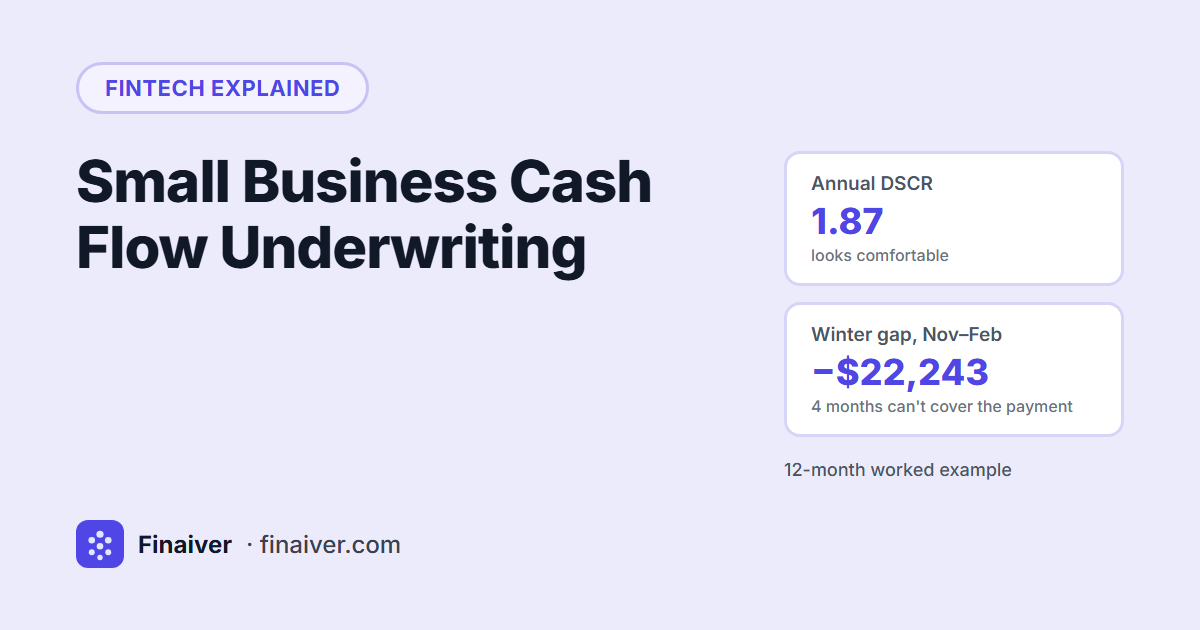
- DSCR = 63,000 ÷ 33,728.64 = 1.87
With only the existing truck loan, the DSCR is 63,000 ÷ 13,800 = 4.57.
On an annual view this is a comfortable application. In fact, if you solve for the largest loan that keeps the annual DSCR at 1.25 on the same terms, you get about $91,800. The annual numbers say the business could borrow almost twice what it asked for.
Step 3: look at the seasons
Now split the year into quarters. Each quarter carries $8,432.16 of debt payments (three months of $2,810.72).
| Quarter | Cash for debt service | Debt payments | DSCR | Surplus or shortfall |
|---|---|---|---|---|
| Jan–Mar | −$5,000 | $8,432.16 | Negative | −$13,432.16 |
| Apr–Jun | $33,000 | $8,432.16 | 3.91 | $24,567.84 |
| Jul–Sep | $32,000 | $8,432.16 | 3.80 | $23,567.84 |
| Oct–Dec | $3,000 | $8,432.16 | 0.36 | −$5,432.16 |
Month by month, four months can't cover the payments on their own:
- November: $500 − $2,810.72 = −$2,310.72
- December: −$3,500 − $2,810.72 = −$6,310.72
- January: −$5,000 − $2,810.72 = −$7,810.72
- February: −$3,000 − $2,810.72 = −$5,810.72
Together that's a winter gap of $22,242.88. The business has to carry it out of cash saved during the summer. This year it needed a savings transfer and an owner injection to get through January and February, and that was before the new loan.
Step 4: test whether the cash buffer is enough
The account went into November with $44,500 and finished December at $39,200. If next year looks like this one, with the new loan payments starting in January and no money put in by the owner, the month-end balance would bottom out at about $25,580 at the end of February. That covers the winter gap with room to spare.
The weak point is the October distribution. Had the owner taken $55,000 out instead of $30,000, the same calculation leaves the account at about $580 at the end of February. That's one late customer payment away from an overdraft. So the loan is affordable only as long as the owner leaves enough summer cash in the business.
The decision
Here's how an underwriter would likely sum it up:
| Test | Result |
|---|---|
| True revenue | $466,500 (deposits overstated by $14,000) |
| Annual DSCR with new loan | 1.87 |
| Revenue swing | Best month $62,000, worst $14,000 |
| Months that can't cover the payment | 4 (Nov–Feb) |
| Winter shortfall | $22,242.88 |
| Lowest projected balance with the loan | About $25,580 |
| Likely outcome | Approve, with conditions |
Reasonable conditions would be a minimum cash balance going into winter, a covenant or a conversation about large owner distributions, or a seasonal repayment schedule with higher payments from April to October and lower ones in winter. Some lenders offer that structure for seasonal trades, though not all do. A working capital line of credit to cover winter is another option the lender might suggest alongside the term loan.
What the lender wouldn't do is look at the 1.87 DSCR and lend $90,000 because the annual maths allows it.
What a merchant cash advance does to the picture
Suppose that instead of the owner's $8,000 injection, the business had covered last winter with a merchant cash advance: $20,000 up front, a factor rate of 1.35, repaid at $300 every business day.
The business repays $20,000 × 1.35 = $27,000. At $300 a day, that takes 90 business days, or a little over four months, and pulls about $6,500 a month out of the account. The $7,000 cost over roughly four months works out to an annual percentage rate somewhere around 175%.
Lenders spot these quickly because the daily debits are easy to see on a statement. They count them as debt payments, and they tend to read them as a sign that the business was short of cash. In this example the advance would land on exactly the four months when the business already can't cover its payments. Two or more advances running at once (often called stacking) is a common reason for a decline.
Mistakes that distort the numbers
- Counting transfers as revenue. Moves between the owner's accounts, owner injections and loan proceeds all inflate deposits. Exclude them before anything else.
- Using only the annual figure. Seasonal businesses need a month-by-month view. The annual DSCR in this example hides a four-month gap.
- Too short a window. Three months of summer statements from a landscaper would make it look like a much bigger business. Twelve months captures a full season.
- Missing a second account. If revenue comes into one account and payroll leaves from another, statements for one account alone tell you nothing useful.
- Ignoring cash sales. Businesses that take a lot of cash may deposit only part of it, so the bank data understates revenue. Lenders will usually want tax returns to reconcile.
- Treating owner distributions as costs, or ignoring them. They aren't operating costs, but large ones drain the cash that carries the business through slow months.
If you're the business owner
You can make your statements easier to underwrite before you apply:
- Run everything through one operating account for at least a year, so revenue and costs are all in one place.
- Apply after your strong season, when the balance shows the buffer you've built, and be ready to explain the seasonal pattern rather than hope nobody notices it.
- Explain owner injections and transfers up front, so the lender doesn't have to guess which deposits are sales.
- Pay off cash advances first if you can. Daily debits weigh heavily against an application.
- Work out the payment yourself and check it against your weakest months, not your average.
Next step
Put your own loan into the Loan EMI Calculator to get the monthly payment, then compare it with your cash for debt service in each of your four slowest months. For how lenders use bank data for personal loans, read cash flow underwriting explained, and for how it sits alongside credit scores, see FICO vs cash flow underwriting.
This article is general information, not financial advice.