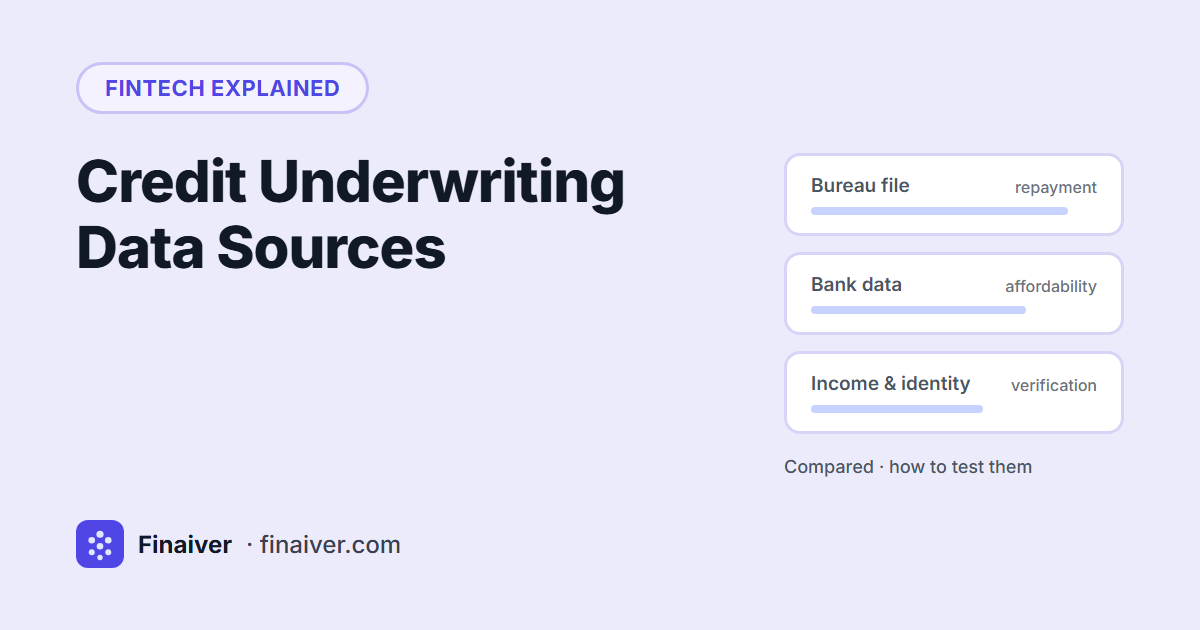
No single data source makes the best underwriting decision. Credit bureau files are still the backbone, because they show how someone has repaid credit before. Bank account data adds what bureaus can't see: actual income and whether a new payment is affordable. Income verification confirms what the applicant says they earn, and identity and fraud data stops you lending to someone who isn't who they claim to be. Small business lenders add commercial bureau data and business bank statements.
Which ones you need depends on who applies to you. The useful question isn't "which provider has the best reviews?" It's "which source changes my decisions on my applicants, and does it pay for itself?" This guide covers what each source tells you, then works through a back-test that answers exactly that.
The main data sources at a glance
| Source | What it tells you | Where it falls short | How you get it |
|---|---|---|---|
| Consumer credit bureau file | Past repayment, current debts, limits, defaults, recent applications | Thin or empty for young, new-to-country and credit-averse people; no income | Pulled from a credit bureau with a permissible purpose |
| Credit scores (bureau-based) | A single ranking of repayment risk built from the bureau file | Inherits the file's gaps; says nothing about affordability | Usually bought alongside the bureau file |
| Bank transaction data | Real income, regular bills, balances, overdrafts, existing debt payments | Short history windows, categorisation errors, applicants with several accounts | Consent-based account connection, or uploaded statements |
| Income and employment verification | Employer, pay and job tenure | Coverage gaps for self-employed and gig workers | Payroll databases or payroll-account connections, with consent |
| Identity and fraud data | Whether the person is real and the application is genuine | Doesn't predict willingness or ability to repay | Identity verification and fraud-screening services |
| Rent, utility and phone payments | A record of paying regular bills, useful for thin files | Patchy coverage; not every landlord or provider reports | Specialist rent-reporting data, some bureaus, or bank data |
| Commercial bureau and business data | A business's trade payments, filings and public records | Thin for very young and very small businesses | Commercial credit bureaus and business data providers |
| Application data | What the applicant tells you: income, housing, purpose | Self-declared, so it needs checking | Your own application form |
In the US, the consumer bureaus are Experian, Equifax and TransUnion, and most consumer scores come from FICO or VantageScore. Bank data typically arrives through account-connection providers such as Plaid, MX or Finicity. Payroll data comes from employer-reported databases such as Equifax's The Work Number, or payroll-connection providers such as Argyle, Pinwheel or Truv. On the business side, Dun & Bradstreet and the business arms of the big bureaus hold commercial files. Other countries have their own bureaus and providers, and naming these doesn't mean we endorse any of them.
What each source is actually good for
Bureau files: willingness to repay
The bureau file is the best single record of how someone has handled credit. Missed payments, defaults and heavy use of existing limits all predict future trouble, and decades of performance data sit behind the scores built from them. That's why almost every lender keeps it, even lenders known for using alternative data.
The weakness is coverage. Someone who has always paid in cash, recently arrived, or is just starting out may have a file too thin to score. A bureau-only policy declines many of them by default, not because they're risky but because there's nothing to measure.
Bank data: ability to repay
Bank transactions show what's actually happening now: what comes in, what goes out, and how close the account runs to zero. It's the most direct evidence of affordability, and it works for people with no credit history at all. Our guide to cash flow underwriting works through the metrics with two applicants.
Its limits are practical. Many lenders look at only a few months of history, transactions have to be categorised correctly before any metric means anything, and not every applicant will agree to connect an account. Your approval funnel needs a path for people who decline.
Income verification: confirming the number
Self-declared income is the figure most often inflated on applications. Payroll data confirms it directly for salaried workers, and is faster for the applicant than uploading payslips. It's much weaker for the self-employed, where bank data usually does a better job.
Identity and fraud data: who you're lending to
This doesn't help you predict repayment, but it can matter more than any of the other sources. Synthetic identities, stolen identities and people who borrow with no intention of repaying all look like ordinary applicants. A model that predicts default well is useless if a fraud ring is feeding it fake profiles.
Business data: the company behind the owner
For small business lending, the owner's personal file is only part of it. Commercial bureau data shows how the business pays its suppliers, and business bank statements show revenue, seasonality and existing debt. We work through a full set of business statements in small business cash flow underwriting.
Which mix fits which lender
| Lender type | Core sources | Worth adding |
|---|---|---|
| Prime personal loans | Bureau file and score, identity checks | Income verification for larger loans |
| Thin-file or new-to-country lending | Bank data, identity checks | Bureau file where one exists; rent and utility history |
| Self-employed and gig-worker lending | Bank data, bureau file | Longer bank history to catch seasonal swings |
| Buy now, pay later and small-ticket credit | Identity and fraud checks, bureau data where allowed | Bank data for larger baskets |
| Credit unions and community lenders | Bureau file, own member account history | Bank data for members who bank elsewhere |
| Small business loans | Business bank statements, owner's bureau file | Commercial bureau data, accounting software data |
Worked example: back-testing a new data source
The only reliable way to know if a source is worth paying for is to test it on your own past applications. Everything below is illustrative. It isn't drawn from any real lender or provider.
The setup. A personal loan lender takes 2,000 applications from a past period whose outcomes are now known. Its current policy, based on bureau data alone, approved 1,200 (60%). Of those, 96 defaulted, a bad rate of 8.0%. It's considering adding bank data at $3 per application.
For simplicity, assume each good loan earns $450 over its life and each default loses $3,500.
The current policy's result:
- Good loans: 1,200 − 96 = 1,104, earning 1,104 × $450 = $496,800
- Losses: 96 × $3,500 = $336,000
- Net: $160,800
Step 1: who the new data would decline
Running the bank data over the 1,200 approved loans, the lender's draft cash flow rules flag 150 as weak: high debt payments against income and repeated overdrafts. Looking up what happened, 33 of those 150 defaulted, a bad rate of 22%. The other 1,050 loans had 63 defaults, a bad rate of 6.0%.
Declining the 150 gives up 117 good loans (117 × $450 = $52,650 of profit) but avoids 33 defaults (33 × $3,500 = $115,500 of losses). That's a net gain of $62,850.
Step 2: who the new data would approve
Among the 800 declined applicants, the bank data identifies 220 with steady income and low existing debt. Here's the catch: they were declined, so you don't know how they would have repaid.
There are two honest ways to estimate it. One is to ask the bureau for a retrospective study, which shows how those people performed on credit they got from other lenders after you declined them. Most bureaus and many data providers will run one. The other is to approve a small test group under the new rules and watch how it performs. Either way, the result is an estimate, not a known outcome.
Say the retrospective study suggests a bad rate of about 7% for this group, or 15.4 expected defaults.
Step 3: the new policy's result
- Approved: 1,050 + 220 = 1,270 (63.5%)
- Expected defaults: 63 + 15.4 = 78.4, a bad rate of 6.2%
- Good loans: 1,270 − 78.4 = 1,191.6, earning $536,220
- Losses: 78.4 × $3,500 = $274,400
- Data cost: 2,000 × $3 = $6,000
- Net: $255,820
That's $95,020 more than the current policy, with more people approved and a lower bad rate.
Step 4: check what happens if the estimate is wrong
The 7% figure for the newly approved group is the weakest number here, so stress it. If those 220 actually defaulted at 14%, double the estimate:
- Expected defaults: 63 + 30.8 = 93.8 (a bad rate of 7.4%)
- Net: $194,990, still $34,190 ahead of the current policy
You can also work out the break-even point directly. Each newly approved loan adds money as long as its default rate stays below $450 ÷ ($450 + $3,500) = 11.4%. Above that, the swap-ins lose money, and only the declines from Step 1 keep the new policy ahead.
Two lessons sit in those numbers. First, most of the value came from the bad loans the new data caught, which you can measure exactly, rather than the new approvals, which you can only estimate. Second, at $3 per application the data cost barely registers. The gain before data costs was $101,020, so the source would pay for itself up to about $50 per application. Price matters less than whether the data changes decisions.
How to judge a data provider
Use these questions instead of review scores:
- Match rate on your applicants. What share of your applicants does the provider actually return data for? A source with great data on 40% of your applicants may be worth less than average data on 90%.
- Lift in a back-test. Will they run a retrospective study or a test on your own past applications, as in the example above?
- Freshness. How old is the data when you receive it? Bureau data can lag by weeks, while bank data can be close to real time.
- Consumer reporting rules. In the US, data used for credit decisions often falls under the Fair Credit Reporting Act, which brings duties around accuracy, disputes and adverse action notices. Ask how the provider is treated under the FCRA and other local rules, and confirm it with your own counsel.
- Reason codes. Can every decision the data drives be explained to a declined applicant in plain terms?
- Consent and retention. For bank and payroll data, how is consent captured and logged, and how long is the data kept?
- Pricing model. Per pull, per decision, per funded loan or a platform fee? Model it on your real volumes, including applicants who drop out.
- Integration. Does it fit your decision engine, or does it need a separate workflow? Our credit underwriting software checklist covers the platform side.
Mistakes to avoid
- Testing only on approved loans. If you measure only the people you already approved, you'll see the value of extra declines but miss the people the new source would have let in.
- Using data from after the decision. A back-test must use only the data that would have existed at the time of the application. Information from later makes any source look better than it is.
- Assuming everyone will connect their bank. In the example, every applicant shared bank data. In practice some won't, and you need a policy for them.
- Adding sources that overlap. Three products repackaging the same bureau data don't give you three times the insight.
- Ignoring fairness. Some data can act as a stand-in for protected characteristics. Test approval rates and outcomes across groups before going live, and keep testing after.
Next step
Before you test any new source, write down your current approval rate, bad rate, and the profit on a good loan and the loss on a bad one. Those four figures are all you need to run the back-test above. For the full decision process, read our credit underwriting guide, and for the bank-data metrics in detail, see cash flow underwriting explained. If you're testing how payment size affects affordability, the Loan EMI Calculator gives you the monthly figure for any amount, rate and term.
This article is general information, not financial advice.