The $29 Million Pivot: Why April 21, 2026, is the Tipping Point for Global Finance
If 2024 was about curiosity and 2025 was about the "Chatbot" craze, then 2026 has officially become the Year of the Agent. Today, April 21, 2026, a series of massive global announcements has confirmed a fundamental truth: AI is no longer a sidekick or a "nice-to-have" feature. It has become the primary engine for transactions, validation, and the entire customer experience in the financial world.
The friction that defined personal and corporate finance for decades—waiting for settlements, manual invoice matching, and reactive budgeting—is dissolving in real-time. We are moving into an era of "Invisible Finance," where the most valuable asset you own isn't just the currency in your account, but the AI agent that knows exactly how to deploy it.
Part I: The "Lobster" Economy – Alipay’s 100 Million User Milestone
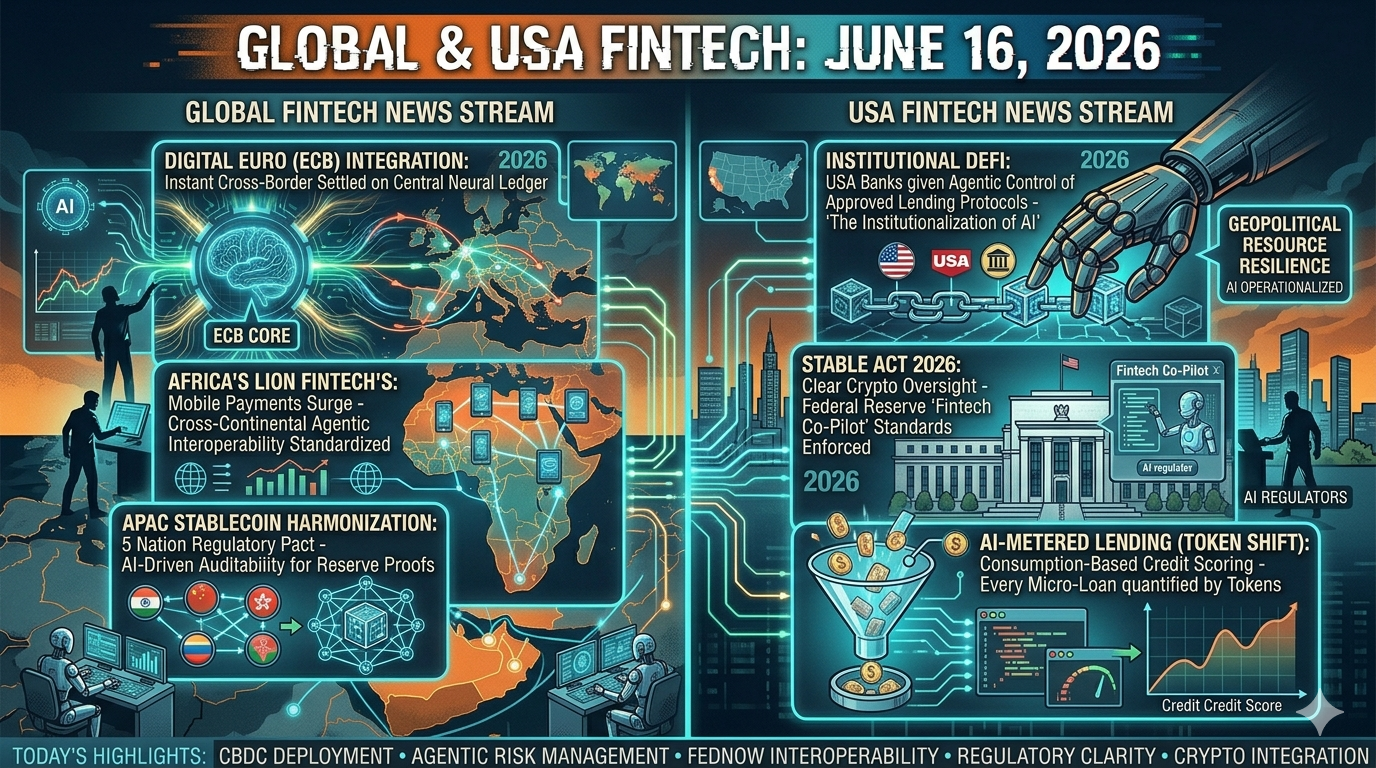
The biggest consumer news of the day comes from Asia, where Alipay AI Pay has shattered growth records. Since its native integration of agentic protocols, the service officially surpassed 100 million active users today.
The Rise of the "Lobsters"
In the Chinese tech ecosystem, autonomous AI agents have been affectionately nicknamed "lobsters"—tools that can "grab" tasks and complete them end-to-end. Today, Alipay announced a massive expansion of this capability. These agents no longer just suggest products; they execute the entire commerce loop.
OpenClaw Integration: Alipay released a new service today allowing "OpenClaw-type" agents to handle payments within any third-party interface. This means your AI assistant can pay your utility bills, renew your car insurance, and even negotiate a refund for a late delivery without you ever opening the Alipay app.
The Volume: In a single week this February, the system processed over 120 million autonomous transactions. This isn't just growth; it’s a total reimagining of consumer behavior.
The Death of the "Checkout"
For decades, the "Checkout Page" was the holy grail of e-commerce. Today, it’s a bottleneck. With the 100-million-user milestone, we are seeing the death of the manual transaction. When your AI agent knows your preferences, your budget constraints, and your biometric authorization, the concept of "clicking to buy" becomes obsolete.
Part II: IBM and Adobe – Decoding the $29 Million Intent Problem
In the corporate sector, a powerhouse partnership between IBM and Adobe has taken center stage today. They are tackling a specific, high-stakes issue: the "Intent Lag." #### The Cost of Hesitation
New research from the IBM Institute for Business Value reveals that global financial institutions are losing an average of $29 million annually simply because they cannot react fast enough to customer financial intent. If a customer is looking at mortgage rates on a banking app, the bank typically has a window of minutes to offer a competitive rate before that customer moves to a rival.
The Solution: Agent Orchestration
Today’s launch of the Adobe Experience Platform Agent Orchestrator, powered by IBM watsonx, aims to close that gap.
Decoding Intent: The system uses real-time behavioral data to predict what a customer needs before they type a query.
The Impact: Early pilot data released today shows a 13% reduction in customer acquisition costs and a staggering 38% lift in customer lifetime value.
By orchestrating AI agents across marketing, sales, and service, banks are moving from being "money storage units" to "proactive life partners."
Part III: BetaNXT and "Val" – The End of Manual Wealth Validation
Wealth management has long been plagued by the "Boring but Critical" problem: the need to manually validate thousands of documents, tax records, and compliance checks. Today, BetaNXT changed the game with the rollout of "Val."
A Source of Truth in a Deepfake Era
As generative AI makes it easier to forge documents, the need for a "Hard Source of Truth" has never been higher. Val is an intelligent validation platform designed for CFOs and wealth advisors that uses rules-based intelligence to:
Real-Time Cross-Referencing: Val checks complex financial datasets against global regulatory requirements in milliseconds.
Complementary Intelligence: Val follows the recent launch of InsightX, creating a dual-engine system where one AI (InsightX) finds the opportunities while the other (Val) ensures they are legal, compliant, and accurate.
For the first time, human advisors are being freed from the "paperwork prison," allowing them to focus 100% of their energy on human-centric strategy and relationship building.
Part IV: The 2026 AI in Finance Report – The "Internal" Explosion
Commissioned by Yooz, a landmark report released today confirms that the AI revolution isn't just happening on our phone screens—it’s happening in the "pipes" of the global economy.
The "Hidden" AI Two-Thirds
While the public focuses on ChatGPT-style interfaces, two-thirds of global finance teams are now using AI for "back-office" operations.
Anomaly Detection: AI is now the primary tool for catching fraud and accounting errors, operating with a speed that human auditors could never match.
The Confidence Gap: Interestingly, 43% of teams are now using AI for high-level reporting because the data is "clean" and easy to validate.
The Next Frontier: Forecasting
The report highlights that 27% of finance teams are now trusting AI for Predictive Forecasting. In a volatile 2026 market, the ability of AI to ingest millions of data points—from geopolitical shifts to weather patterns—gives these teams a "crystal ball" that traditional spreadsheets cannot provide.
Part V: Technical Deep Dive – The Math of Agentic Autonomy
To understand why this is happening now, we have to look at the shift from Probabilistic Chat to Deterministic Action. The agents discussed today (Alipay’s Lobsters, IBM’s Orchestrator, BetaNXT’s Val) rely on Multimodal Probability Matrices.
In 2024, an AI might "read" an invoice. In 2026, the AI "sees" the structure, the metadata, and the historical context simultaneously. The efficiency is driven by this core logic:
$$P(\text{Match}) = \prod_{i=1}^{n} P(\text{Field}_i | \text{Context})$$
This formula allows systems to verify a transaction's legitimacy by calculating the probability that every field (date, amount, vendor, tax ID) matches the expected context of that specific user or corporation. When the probability hits 99.9%, the transaction is cleared instantly. This reduces "operating waste" by billions of dollars globally.
Part VI: The Global Governance Shift – From KYC to KYA
As these agents take over, the world’s regulators are scrambling to keep up. Today in Singapore, the MetaComp group introduced the first global standards for KYA (Know Your Agent).
Just as banks must "Know Their Customer," they must now know which AI agent is knocking on their digital door.
Identity Verification: Is this agent actually authorized by Muhammad Haider, or is it a rogue script?
Liability: If an AI agent makes a bad trade, who is legally responsible? The developer? The user? The LLM provider?
The KYA framework is the "Digital Passport" that will allow agents to move money across borders, and its launch today is perhaps the most significant legal development of the decade.
Conclusion: The Bottom Line for 2026
The news from April 21, 2026, makes one thing abundantly clear: AI has graduated from a toy to a tool, and now, to an Agent. Whether it is a "Lobster" agent in China buying your groceries, an IBM orchestrator in New York predicting your next investment, or a BetaNXT validator in London securing your wealth, the "Financial Friction" of the past is gone.
We are living in a world where your wealth is no longer static. It is a living, breathing entity managed by intelligent agents that work for you while you sleep. The question is no longer if you will use an AI agent to manage your money—it’s how many agents you currently have working for you.
Which of today's updates excites you the most? Would you trust a "lobster" agent to handle your monthly renewals? Or is the "Intent Lag" something you'd rather keep private? Let’s discuss in the comments below!