The $6.3 Million Pivot: OpenAI’s Acquisition of Hiro Finance and the Dawn of the Autonomous CFO
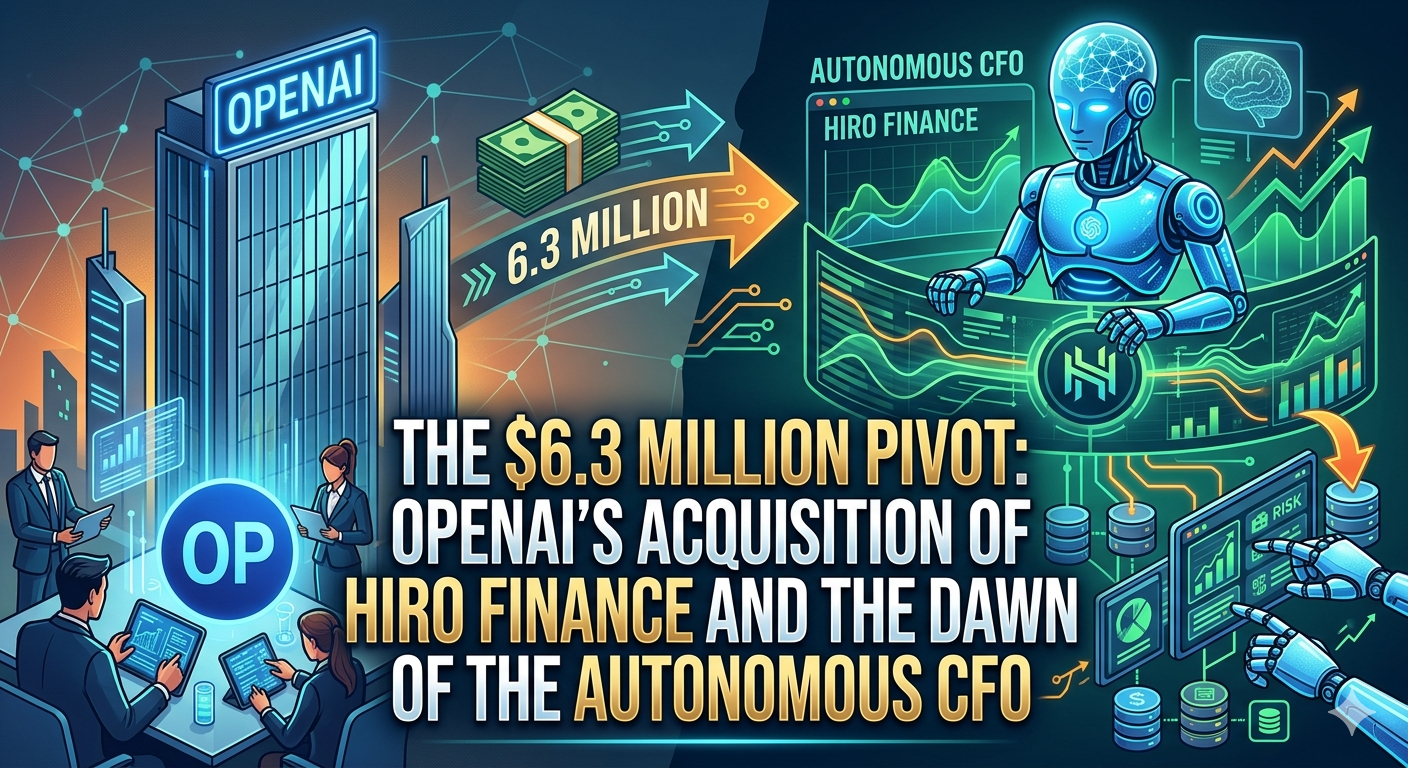
The tech world moves fast, but the intersection of Silicon Valley and Wall Street moves even faster. This week, the biggest story in the ecosystem isn't a new hardware release or a regulatory hearing—it’s OpenAI’s strategic acquisition of Hiro Finance.
Founded in 2024, Hiro was a lean, US-based startup that had only recently emerged from stealth with a $6.3 million seed round led by heavy hitters in the fintech space. But don't let the "seed stage" label fool you. Hiro’s mission was audacious: to replace the traditional financial advisor with an AI agent capable of managing a user’s entire economic life.
For readers of this blog, this news is the equivalent of a tectonic shift. For years, we’ve used ChatGPT to write emails or summarize articles. Now, OpenAI is signaling that it wants to manage your credit cards, optimize your savings, and plan your retirement.
This deep dive will explore who Hiro Finance is, why OpenAI bought them, the technical challenges of "Financial AI," and what this means for the future of your personal wealth.
Part I: Who Was Hiro Finance?
To understand the acquisition, we have to look at the pedigree of the company being absorbed. Hiro wasn't built by amateurs; it was the brainchild of Ethan Bloch, the founder of Digit (an early pioneer in automated savings).
The Product
Hiro was designed to solve "The Fragmented Wallet Problem." Most of us have money scattered across a checking account, two or three credit cards with different reward structures, a 401(k), and perhaps a brokerage account. Hiro functioned as a unified intelligence layer over these accounts.
Unlike Mint or YNAB (You Need A Budget), which are primarily retrospective—showing you what you already spent—Hiro was predictive and prescriptive. It used "Agentic AI" to look at your balances and tell you exactly what to do next.
The $6.3M Seed Success
Why did investors pour millions into such a young company? Because Hiro solved the "Math Gap." Large Language Models (LLMs) are notoriously shaky when it comes to complex arithmetic and long-term financial modeling. Hiro developed a proprietary way to bridge the gap between natural language interaction and "hard" financial logic. They weren't just building a chatbot; they were building a financial engine that happened to talk to you.
Part II: Why OpenAI Made the Move
OpenAI has trillions of parameters, but it doesn't have your bank password. This acquisition is less about "intelligence" and more about utility and integration.
1. From Chatbot to Personal Agent
Sam Altman has frequently stated that the future of AI lies in "Agents"—software that doesn't just talk, but does. If OpenAI wants ChatGPT to be your personal assistant, it cannot ignore the most stressful part of your life: your money. By acquiring Hiro, OpenAI gains the infrastructure to securely connect to thousands of financial institutions via APIs (like Plaid).
2. The Verticalization of AI
Generic AI is becoming a commodity. To remain the market leader, OpenAI must "verticalize"—creating specialized versions of GPT for high-value industries. Finance is the highest value vertical there is. Hiro’s specialized training data and logic frameworks allow OpenAI to bypass years of development in the fintech space.
3. Solving the Hallucination Problem
If ChatGPT hallucinates a historical fact, it’s annoying. If it hallucinates your bank balance or suggests an incorrect tax strategy, it’s a catastrophe. Hiro’s core tech included "guardrails" for financial calculations. Integrating this into ChatGPT ensures that when a user asks about their debt-to-income ratio, the answer is derived from actual ledger data, not a statistical guess.
Part III: The Technical Leap – How "HiroGPT" Will Work
Imagine opening ChatGPT in late 2026. Instead of just a text box, you see a "Financial Dashboard" tab. Because of the Hiro integration, the AI already knows:
You spent $200 more on groceries this month than average.
Your high-yield savings account (HYSA) is earning 4.2%, but a competitor is offering 5.1%.
You have a $500 credit card balance accruing 24% interest while $2,000 sits idle in a checking account.
The Mathematical Engine
Hiro utilized a specialized form of logic processing. In technical terms, while ChatGPT handles the Semantic Layer (understanding the words), Hiro handles the Deterministic Layer (the math).
Consider the following formula for Compound Interest:
$$A = P \left(1 + \frac{r}{n}\right)^{nt}$$
Where:
$A$ = the future value of the investment/loan, including interest
$P$ = the principal investment amount
$r$ = the annual interest rate (decimal)
$n$ = the number of times that interest is compounded per unit $t$
$t$ = the time the money is invested or borrowed for
Hiro’s tech ensures that when you ask ChatGPT, "If I add $500 a month to my savings for 10 years at 5% interest, what will I have?", the AI isn't just predicting the next word in a sentence; it is actually running the variables through this equation with 100% precision.
Part IV: The Privacy Elephant in the Room
This acquisition is not without controversy. Giving an AI company access to your financial "source of truth" is a massive leap of faith.
The Security Stack
Hiro was built on bank-level encryption (AES-256) and used "read-only" access. This means the AI could see your transactions but couldn't move your money. As this tech moves into OpenAI, we expect to see a "Financial Vault" feature within ChatGPT settings, likely requiring biometric authentication (FaceID/TouchID) every time financial data is accessed.
Data Privacy Concerns
Critics argue that OpenAI already knows what we think; now they will know what we buy. For users of this blog, the trade-off will be a personal choice: Is the convenience of automated wealth management worth the loss of financial anonymity?
Part V: What This Means for the Fintech Industry
The "Hiro-OpenAI" deal is a warning shot to legacy banks and budgeting apps.
Traditional Banks: Apps from Chase or BofA are often clunky. If ChatGPT can provide a better user experience and better advice, people will stop opening their bank apps entirely, using them only as "dumb pipes" for their money.
Financial Advisors: Human advisors who charge 1% of assets under management (AUM) for basic portfolio rebalancing are in trouble. OpenAI can now provide that same service for the cost of a $20/month Plus subscription.
Budgeting Apps: Apps like Rocket Money or YNAB now face an existential threat. Why pay for a separate subscription when your primary AI tool does it for free?
Part VI: The Roadmap – What to Expect Next
Based on the acquisition details and Hiro’s existing tech, here is the likely rollout schedule:
Phase 1: The "Financial Insight" Beta (Late 2025)
OpenAI will likely launch a "Connect My Accounts" feature for Plus and Enterprise users. This will allow ChatGPT to analyze your spending history and provide a "Year in Review" or monthly breakdown.
Phase 2: Active Advice (Early 2026)
The AI will begin offering proactive advice. "I noticed your auto insurance premium increased by 15%. Would you like me to find three cheaper quotes for you?"
Phase 3: The Autonomous Agent (2027 and Beyond)
This is the "Holy Grail." With Hiro’s logic fully integrated, you could give ChatGPT "Permission to Act."
"Every time my checking account goes over $5,000, move the excess to my brokerage account and buy an S&P 500 index fund."
"Negotiate my Comcast bill for me."
Conclusion: A New Era of Financial Literacy
The acquisition of Hiro Finance by OpenAI marks the end of the "Information Era" and the beginning of the "Implementation Era." We no longer need tools that just show us charts; we need tools that take the burden of financial decision-making off our plates.
For the readers of this blog, the goal remains the same: Financial Freedom. Whether that comes through a human advisor, a spreadsheet, or a Hiro-powered ChatGPT, the key is to stay informed. OpenAI just became the biggest player in your personal economy. It’s time to pay attention.