Compounding more often does earn you more, but usually not by much. On a 10,000 deposit at 5% for ten years, daily compounding beats annual compounding by about 198, and beats monthly compounding by less than 17. The interest rate itself, fees, and how long you leave the money alone all matter far more than how often the bank adds interest.
That said, the frequency isn't meaningless. It is the reason two accounts advertising the same headline rate can pay different amounts, and it's why you should compare savings products on their effective annual rate rather than the number in large print. Here is how it works.
All the examples below use plain numbers with no currency symbol. The maths is the same in any currency.
What compounding frequency actually means
Compounding is interest earning interest. The frequency is how often the bank calculates the interest due and adds it to your balance. Once it's added, the next round of interest is calculated on the bigger balance.
With annual compounding, interest is added once a year. With monthly compounding, the annual rate is split into twelve pieces and one piece is added each month. Quarterly uses four pieces, daily uses 365.
The formula for a single deposit is:
A = P × (1 + r/n)^(n × t)
- P is the amount you deposit
- r is the annual interest rate as a decimal (5% = 0.05)
- n is the number of times interest is added per year
- t is the number of years
If the formula is new to you, the walkthrough in compound interest explained with examples covers it from the ground up.
A worked example: 10,000 at 5% for 10 years, compounded monthly
Let's work through the monthly case by hand, so the table that follows doesn't feel like magic.
- Monthly rate: 0.05 ÷ 12 = 0.0041667, or about 0.417% a month.
- Number of periods: 12 months × 10 years = 120.
- Growth factor: 1.0041667 raised to the power of 120 = 1.64701.
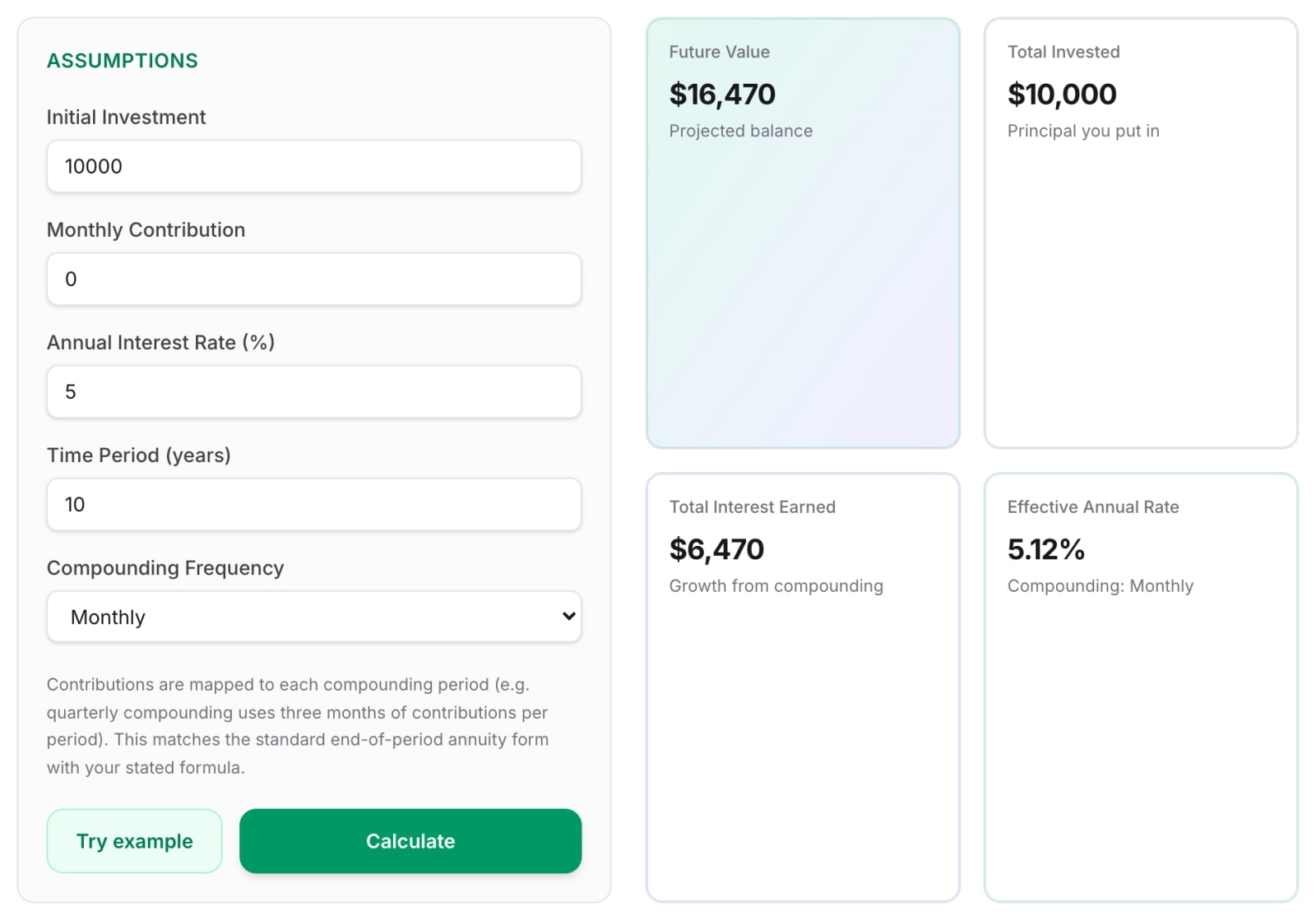
- Final balance: 10,000 × 1.64701 = 16,470.09.
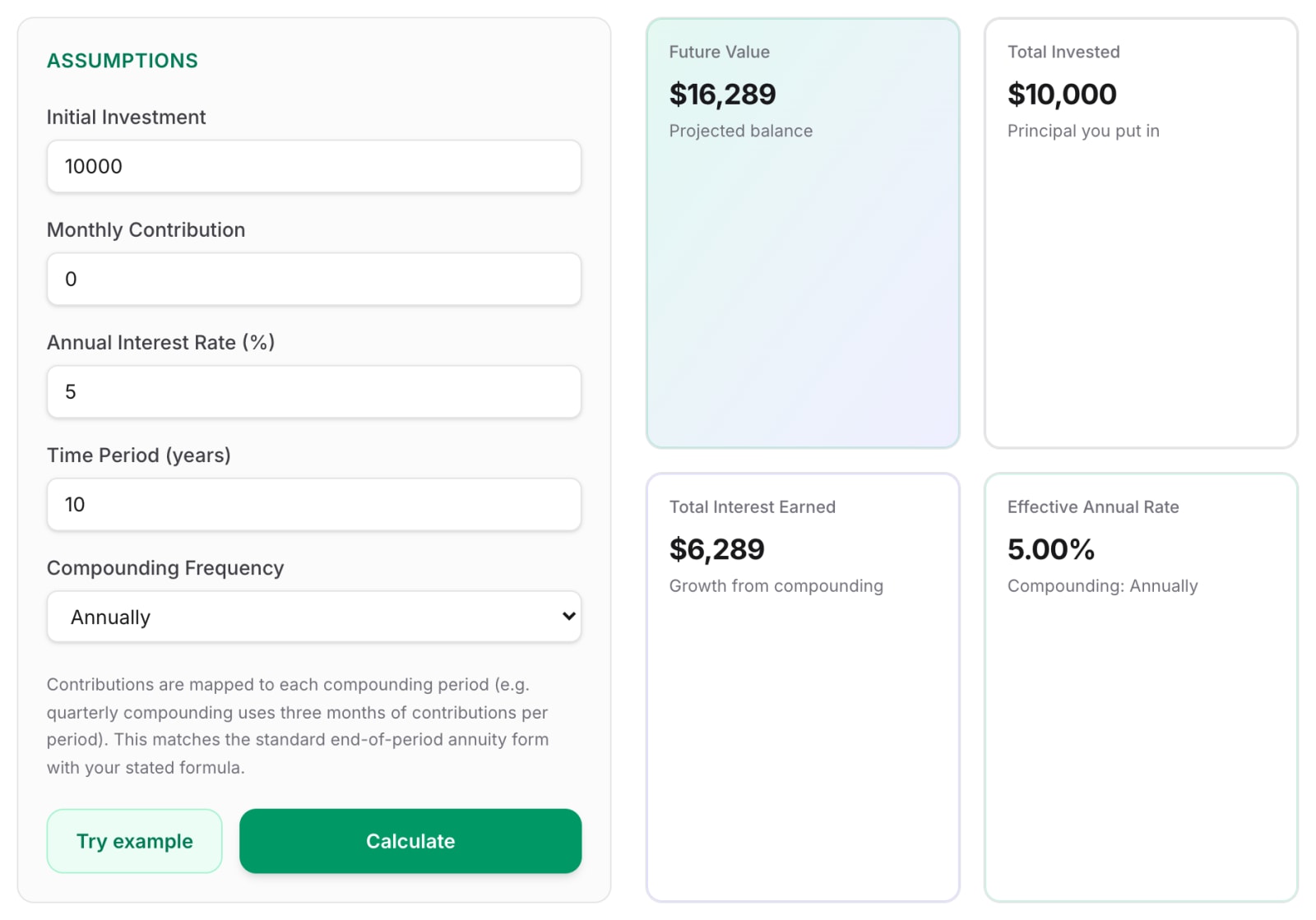
With annual compounding, step 3 becomes 1.05 to the power of 10, which is 1.62889, giving 16,288.95. The monthly version comes out 181.14 ahead after a decade.
The actual difference, side by side
Here is the same 10,000 deposit at a 5% annual rate, compounded at different frequencies. Continuous compounding is the mathematical limit, where interest is added infinitely often. No ordinary savings account does this, but it shows the ceiling.
| Compounding | Effective annual rate | After 10 years | After 20 years |
|---|---|---|---|
| Annually | 5.0000% | 16,288.95 | 26,532.98 |
| Quarterly | 5.0945% | 16,436.19 | 27,014.85 |
| Monthly | 5.1162% | 16,470.09 | 27,126.40 |
| Daily | 5.1267% | 16,486.65 | 27,180.96 |
| Continuous | 5.1271% | 16,487.21 | 27,182.82 |
Two things stand out.
The first jump, from annual to quarterly, is the biggest. After that the gains shrink quickly. Going from monthly to daily adds 16.56 over ten years on a 10,000 balance. Going from daily to continuous adds 0.56.
The gap also grows with time. Annual versus daily is about 198 after ten years and about 648 after twenty. Compounding frequency is a small effect that slowly gets bigger, the same way compounding itself does.
The effective annual rate: the number to compare
The effective annual rate (EAR, sometimes shown as AER or APY depending on where you live) answers one question: if this account compounded only once a year, what rate would give the same result?
EAR = (1 + r/n)^n − 1
For 5% compounded monthly: (1 + 0.05/12)^12 − 1 = 0.05116, or 5.116%.
This matters when you compare two products with different compounding. Say one account offers 5.00% compounded annually and another offers 4.90% compounded monthly. The headline rate makes the first look better. But:
- 5.00% compounded annually has an EAR of 5.000%
- 4.90% compounded monthly has an EAR of 5.012%
The second account pays slightly more. On 10,000 over ten years, it ends at 16,306.88 against 16,288.95. The difference is small, but it runs the opposite way to what the headline rates suggest.
In many countries, banks are required to publish an effective or annual-equivalent rate alongside the nominal rate, so you don't have to do this calculation yourself. The name and the rules vary by country, so check what your local banking regulator requires and look for that figure on the product page.
The Finaiver calculator shows this figure in its Effective Annual Rate card, so you can switch the compounding setting and watch it change.
Why the difference is usually small
The extra interest from more frequent compounding comes from earning interest on interest within the year. In the first year at 5% on 10,000:
| Compounding | Interest in year one |
|---|---|
| Annually | 500.00 |
| Quarterly | 509.45 |
| Monthly | 511.62 |
| Daily | 512.67 |
Moving from annual to daily compounding adds 12.67 in the first year. That extra comes from interest earned on interest that has only been in the account for a few months. At normal savings rates, a few months of interest on a few hundred is not much money.
The effect grows with the rate. At low rates it nearly vanishes: 10,000 at 2% for ten years ends at 12,189.94 compounded annually and 12,213.96 compounded daily, a gap of 24. At high rates it becomes noticeable, which is why it matters more for debt than for savings. A 20% annual rate on a credit card compounded monthly works out to an effective rate of about 21.94%; compounded daily, about 22.13%.
What matters more than compounding frequency
If you are choosing where to put savings, these things will move the result far more than the compounding setting.
The interest rate itself
Compare the frequency gap with a rate gap on the same 10,000, compounded annually:
| Annual rate | After 10 years | After 20 years |
|---|---|---|
| 5.0% | 16,288.95 | 26,532.98 |
| 5.5% | 17,081.44 | 29,177.57 |
| 6.0% | 17,908.48 | 32,071.35 |
Half a percentage point more, with plain annual compounding, adds about 792 over ten years. Switching from annual to daily at the same 5% adds about 198. If one account pays a higher rate with less frequent compounding, the higher rate almost always wins. Check the EAR to be sure.
Fees and charges
A fee works like a negative rate. If an investment returns 5% but charges 0.5% a year, you're closer to a 4.5% return. Over twenty years on 10,000 compounded monthly, that's 24,554.66 instead of 27,126.40, a difference of more than 2,500. That dwarfs anything compounding frequency can do.
Time and regular contributions
Leaving money invested for longer, and adding to it regularly, does most of the heavy lifting. Our guide to monthly investing vs a lump sum shows how much regular contributions add. The rule of 72 is a quick way to see how time and rate together drive doubling.
Introductory and bonus rates
Some savings accounts advertise a high rate that drops after a few months, or pay a bonus only if you make no withdrawals. The compounding frequency on these accounts is close to irrelevant next to what happens when the introductory period ends.
Mistakes and limits to keep in mind
Comparing nominal rates across different frequencies. This is the main trap. Always compare effective annual rates. The same issue shows up with loans, where the stated rate and the true cost can differ; see APR vs interest rate.
Confusing compounding with payout frequency. Some accounts calculate interest daily but credit it monthly or annually. What counts is when interest is added to the balance and starts earning interest itself. If you take interest out as income instead of leaving it in, it doesn't compound at all.
Assuming investments compound on a schedule. Shares and funds don't have a compounding frequency in this sense. Their value moves daily, and returns compound as gains build on earlier gains. Calculators that use a fixed rate and compounding schedule give a smooth estimate, not a prediction.
Forgetting about contributions in a calculator. When you add a monthly contribution in the Finaiver calculator, it groups contributions to match the compounding period. With quarterly compounding, three months of contributions go in at the end of each quarter; with annual compounding, twelve months go in at year end. So switching the setting changes when your deposits start earning, as well as how often interest is added. For 10,000 plus 200 a month at 5% over ten years, the calculator gives 46,476 with annual compounding and 47,527 with monthly. Part of that gap comes from deposits going in earlier, not from compounding alone.
Ignoring tax and inflation. Interest may be taxed, and inflation reduces what your balance can buy. Both have a much bigger effect than compounding frequency. Our guide to inflation and real returns covers this.
The short answer
Compounding frequency matters a little, and mostly at higher rates and over long periods. Use the effective annual rate to compare products fairly, then put your attention on the rate, the fees, and how long you can leave the money alone.
Try it yourself
Open the Finaiver Compound Interest Calculator, enter your deposit, rate and time period, and switch the Compounding Frequency between Annually, Quarterly and Monthly. Watch the Future Value and Effective Annual Rate cards change. Then try raising the rate by half a point instead, and compare the two effects.
For more on the basics, read compound interest explained with examples and the rule of 72.
This article is general information, not financial advice.