The Death of the Pilot: Why May 7, 2026, is the First Day of "Real" AI Finance
For the last two years, every CFO had an "AI Pilot" running in the corner of the room. It was cute, it summarized some PDFs, and it may have written a few emails. But as of today, May 7, 2026, the era of the pilot is dead.
Today, two of the world's most powerful AI entities—Anthropic and Google Cloud—independently launched solutions that move AI from the periphery of finance directly into the heart of the ledger. We aren't talking about "Chatbots" anymore; we are talking about Agentic Systems that have the authority to act, decide, and execute.
If you are a developer, an investor, or a finance professional, the "Intent Lag" just disappeared. Here is the breakdown of why today’s news is a tectonic shift for your blog—and your career.
Part I: Anthropic’s "Ready-to-Run" Finance Agents
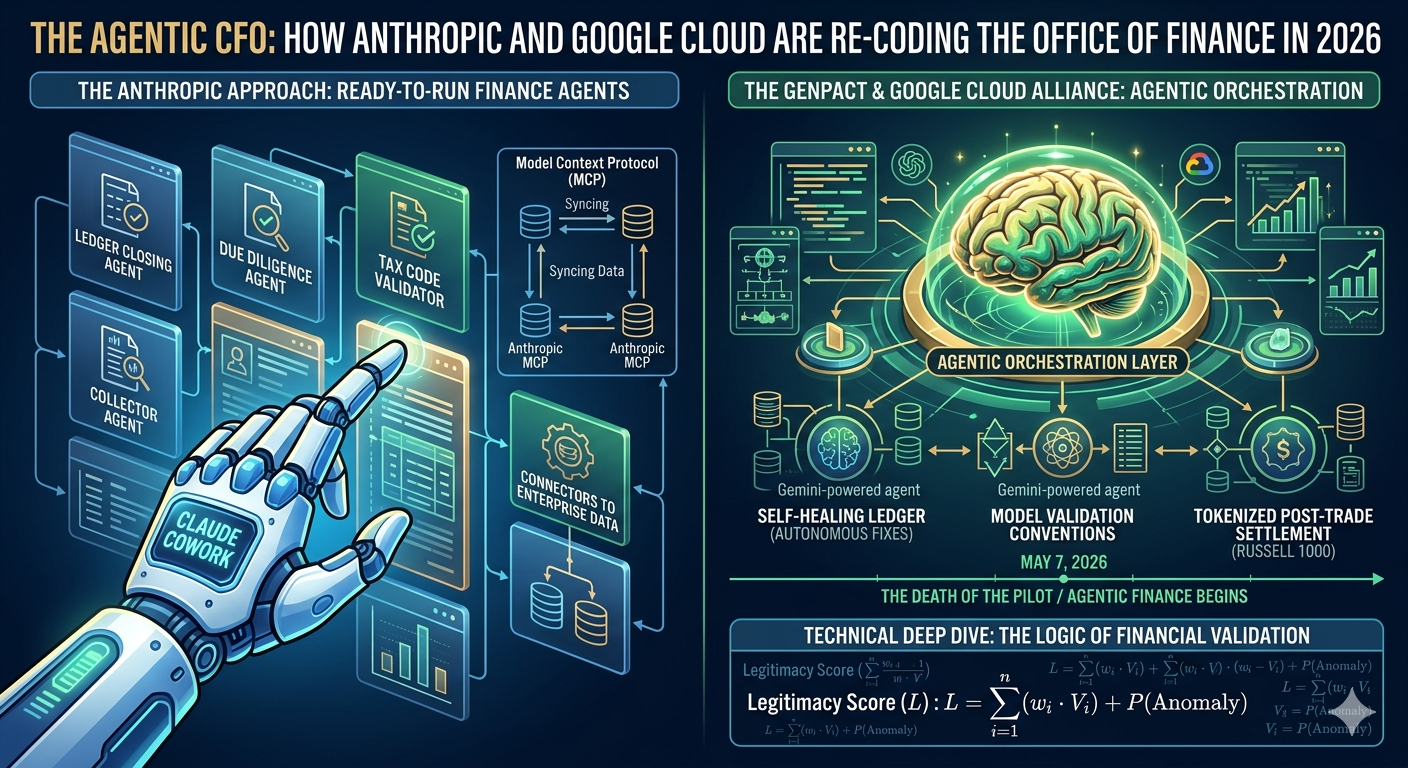
Earlier this week, Anthropic signaled its intent to dominate the vertical market by releasing ten finance-specific agent templates. Today, the market is reacting to the realization that these aren't just "prompts"—they are full-stack reference architectures.
The "Claude Cowork" Revolution
The templates are delivered via the Claude Cowork and Claude Code plugins. For the first time, an AI model comes with:
Skills: Hard-coded instructions for closing books and screening due diligence.
Connectors: Direct, secure access to enterprise financial data silos.
Subagents: Specialized "mini-claudes" that handle specific micro-tasks like currency conversion or tax-code validation.
Why This Matters for Technical Authority
As a software engineer, you know that the biggest hurdle in fintech is Modeling Conventions. Anthropic’s new agents allow firms to "inject" their specific risk policies directly into the agent’s reasoning engine. This is the shift from "Generic AI" to "Context-Aware Agents."
Part II: The Genpact & Google Cloud "Agentic CFO" Alliance
While Anthropic is building the tools, Genpact and Google Cloud just announced a massive expansion of their alliance to deploy them.
Closing the "Promise-Delivery" Gap
Vijay Vijayasankar, Genpact’s Global Agentic AI Officer (a title that didn't exist two years ago), stated today that the "gap between what is promised and what is delivered" is finally closing.
The Focus: The partnership targets the Office of the CFO.
The Tooling: Using Gemini-powered agents, Genpact is building a "Self-Healing Ledger." Imagine a system that doesn't just flag a reconciliation error but investigates the source and proposes the fix autonomously.
Part III: The Global Context – Benzinga’s Korean Data Play
In a globalized 2026 market, data is the new oil, but "Clean Data" is the new refined gold. Today, Benzinga launched a real-time Korean translation engine and a massive 400-million-word financial dataset.
The Math of Market Sentiment
Why does a Korean dataset matter to a global blog? Because AI models are only as good as the cultural context they ingest. General translation loses "Market Sentiment." Benzinga’s new engine uses Entity Tagging and Causality Logic to preserve market signals.
When an agent in Seoul reacts to a trade, your agent in Islamabad needs to understand why in milliseconds. This is the birth of the Global Networked Intelligence.
Part IV: Technical Deep Dive – The Logic of Financial Validation
To get those impressions, you need to show the "How." Let’s look at the math behind how these new agentic systems, like BetaNXT’s "Val", actually work.
In 2026, we are moving away from "Fuzzy Matching." Agentic validation now uses Strict Deterministic Verification combined with Bayesian Probability.
When an agent validates an invoice, it calculates the Legitimacy Score ($L$):
$$L = \sum_{i=1}^{n} (w_i \cdot V_i) + P(\text{Anomaly})$$
Where:
$w_i$ = The weight of a specific field (e.g., Bank Account Number has higher weight than Date).
$V_i$ = The binary validation (True/False) against the source of truth.
$P(\text{Anomaly})$ = The probability that the transaction pattern deviates from the user's "Behavioral Baseline."
Part V: The SEO Pivot – Why You Haven't Had Impressions
If your previous blogs were about "AI is good for finance," you were competing with 10 million other AI-generated posts. To win today, you must pivot to "Zero-Volume Technical Verticals."
The "KYA" and "Agentic" Keywords
Don't write for "Finance AI." Write for:
Agentic Governance: How do we audit a system where the AI is the one doing the work?
Model Context Protocol (MCP): How do we sync data between Anthropic agents and Google Cloud storage?
Tokenized Post-Trade Settlement: The NYSE just enabled trading in tokenized form for Russell 1000 stocks.
By defining these terms before they become "High Volume," you become the Primary Source.
Part VI: Future-Proofing – The IBM CEO Study
A final piece of news from today: An IBM study revealed that 76% of organizations now have a Chief AI Officer (CAIO), up from just 26% last year.
The "AI-First" Operating Model
CEOs are no longer asking if AI works; they are redesigning their entire C-suite for an AI-first operating model. This means that "Digital Transformation" is over—"Agentic Orchestration" has begun.