For most people, an emergency fund should cover three to six months of essential expenses: the costs you'd still have to pay if your income stopped tomorrow. Aim nearer three months if your income is secure and someone else in the household earns too; aim for six months or more if you're the only earner, have dependents or work for yourself.
The key word is expenses. Sizing the fund from your income, which is how the rule is often quoted, usually makes the target bigger than it needs to be and harder to reach.
What an emergency fund is for
An emergency fund is cash set aside for things that are both unexpected and necessary: losing your job, a medical bill, an urgent car or home repair, a sudden trip to help family.
It isn't for things you know are coming, like an annual insurance renewal or holiday gifts. Those belong in a separate set-aside you build monthly (see how to categorize expenses for how to handle irregular costs). Mixing the two means your emergency fund quietly empties every December.
Why size it from essential expenses, not income
If you lose your income, your spending changes. You'd stop saving, cut back on eating out and pause most non-essential subscriptions. What's left is the bare cost of keeping your life running.
That's the number the fund needs to cover. Income includes money you currently save, spend on extras, or pay in tax, none of which you'd need to replace in a crisis.
Worked example: calculating essential expenses
Take someone with a take-home income of 3,500 a month. Going through their last few statements, these are the costs they couldn't avoid. The maths works the same in any currency.
| Essential expense | Per month |
|---|---|
| Rent | 1,200 |
| Groceries | 400 |
| Utilities | 150 |
| Transport | 150 |
| Minimum debt payments | 150 |
| Insurance | 100 |
| Phone | 50 |
| Medical and prescriptions | 50 |
| Total | 2,250 |
Step by step:
- Add the essentials: 1,200 + 400 + 150 + 150 + 150 + 100 + 50 + 50 = 2,250 a month.
- Three months: 2,250 × 3 = 6,750.
- Six months: 2,250 × 6 = 13,500.
Compare that with sizing from income. Three months of 3,500 would be 10,500, and six months would be 21,000. The expense-based targets are 3,750 and 7,500 lower, for the same level of protection.
A few rules for building your own list:
- Use minimum debt payments, not what you usually pay. In an emergency you'd drop to the minimum.
- Include insurance you can't let lapse, especially health and home cover.
- Be honest about groceries. Use what you'd really spend on a careful month, not an aspirational figure.
- Leave out savings contributions, investments and most entertainment.
How to adjust the 3–6 month range
The range exists because people's risks differ. These are the factors that should push you up or down.
| Your situation | Suggested target | Why |
|---|---|---|
| Two earners, stable jobs, no dependents | About 3 months | A second income covers part of the gap |
| Single earner, stable job | 3–6 months | No backup income in the household |
| Dependents (children or others relying on you) | 6 months | Higher essential costs and less room to cut |
| Freelance, contract or commission-based income | 6 months or more | Income is irregular even in good times |
| Work in an industry where job searches tend to take a long time | Toward 6 months | The gap between jobs may be longer |
| Older car, older home, or a health condition | Add a margin | Large one-off costs are more likely |
These are judgment calls, not fixed rules. A useful question to ask yourself is: if my income stopped, how long would it realistically take to replace it? Then add a little.
For the person in the example, a single earner in a stable job, a target of four months, 2,250 × 4 = 9,000, would be a reasonable middle choice.
If you're self-employed
Freelancers have two separate pots: a business buffer that smooths normal monthly swings in income, and a personal emergency fund for true emergencies. The first is covered in cash-flow forecasting for freelancers. The second should usually sit at the top of the range, because a quiet patch and an emergency can easily arrive at the same time.
Where to keep it
The general rules are the same everywhere, even though the specific accounts and protections vary by country:
- Easy to reach, within a day or two. You shouldn't need to sell anything or wait weeks to get the money.
- Low risk. Emergency money shouldn't be in shares or other investments whose value can drop just as you need them. A downturn and a job loss often come together.
- Separate from your everyday account, so it doesn't get spent by accident.
- Earning some interest if possible. A savings account that pays a reasonable rate helps the fund keep up with rising prices.
Check how deposits are protected where you live. Many countries have a scheme that covers bank deposits up to a limit, but the limits and rules differ, so look up the current details for your bank and country.
How to build it gradually
Six months of expenses can look like an impossible number. Breaking it into milestones makes it manageable, and each step is useful on its own.
Here's how long each milestone takes for the example (essential expenses of 2,250 a month) at two saving rates.
| Milestone | Amount | Months at 300/month | Months at 450/month |
|---|---|---|---|
| Starter fund | 1,000 | 4 | 3 |
| One month of essentials | 2,250 | 8 | 5 |
| Three months of essentials | 6,750 | 23 | 15 |
| Six months of essentials | 13,500 | 45 | 30 |
Months are rounded up to the month in which you'd pass the milestone. At 300 a month, 6,750 ÷ 300 = 22.5, so you cross three months of essentials in month 23.
A few things speed this up:
- Automate it. Set a transfer for the day after payday so it happens before you can spend the money.
- Add windfalls. A tax refund, bonus or gift goes a long way. In the example, putting a one-off 1,000 in at the start and then saving 300 a month brings the three-month target forward from month 23 to month 20, since (6,750 − 1,000) ÷ 300 = 19.2.
- Redirect freed-up money. When a loan is paid off, send that monthly payment to the fund.
Should you build it or pay off debt first?
A common approach is to build the starter fund first, then focus on clearing high-interest debt, then return to the full emergency fund. The starter fund stops a small emergency from going straight onto a credit card. Beyond that, interest on expensive debt usually costs more than a savings account earns, so paying it down tends to win. Low-interest debt, like many mortgages, is a different case, and building the full fund alongside it is reasonable.
Mistakes and limits
- Sizing it from income, which makes the target bigger and slower to reach than it needs to be.
- Investing it. The point of the fund is that it's there in full when you need it.
- Using it for predictable costs. Holidays and annual bills need their own set-aside.
- Not refilling it. After you use it, rebuilding goes back to the top of your list.
- Never updating it. If your rent goes up or you have a child, your essential expenses change and so should the target. Recheck once a year.
An emergency fund also isn't a replacement for insurance. It covers months of costs, not a large medical bill or major damage to your home. The two work together.
Next step
List your essential expenses from your last two or three statements and multiply by the number of months that fits your situation from the table above. That's your target.
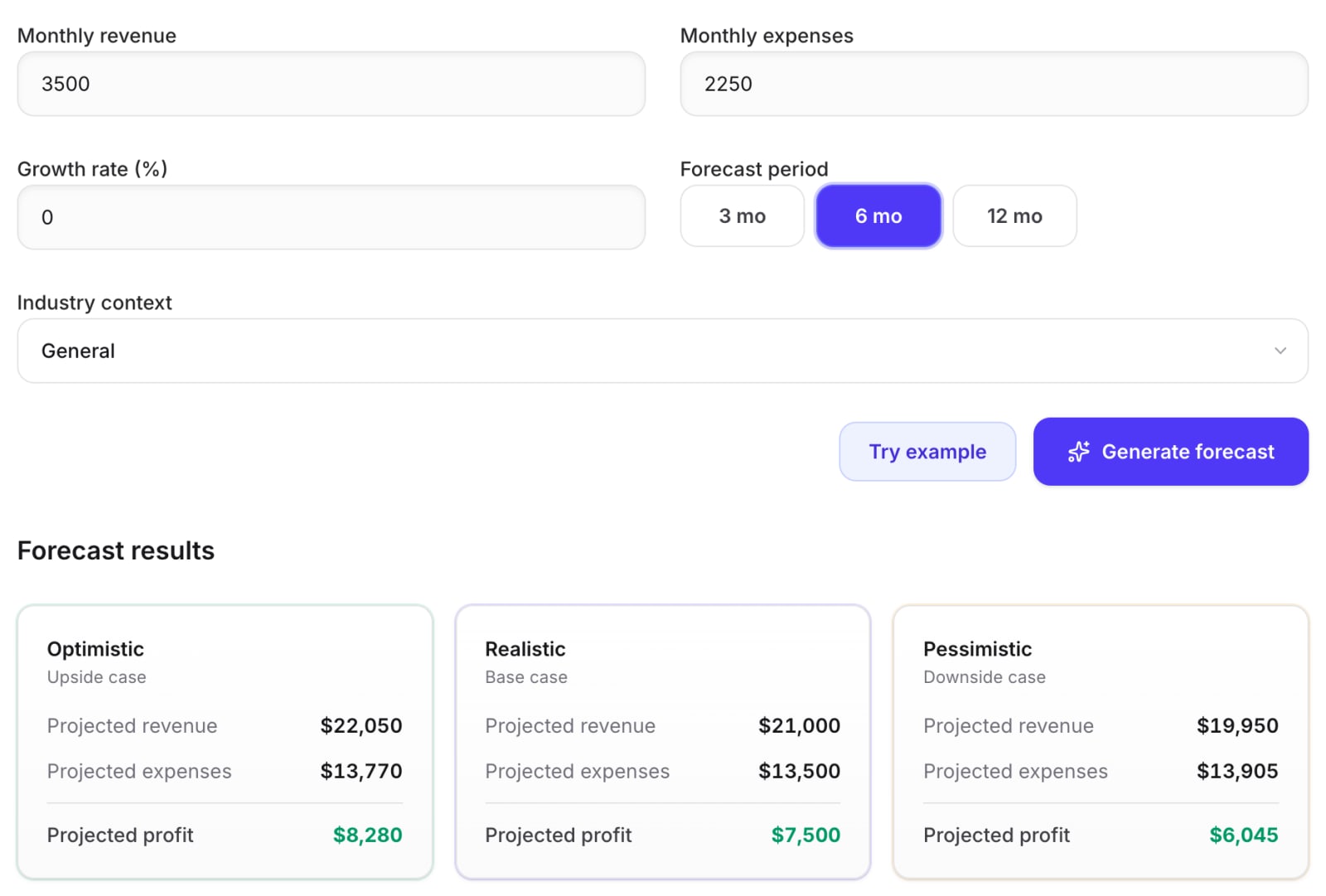
To see how much room your budget has for saving toward it, enter your monthly income and essential expenses in the AI Budget Forecaster and check the pessimistic scenario. Its figures are totals for the whole forecast period, so divide by the number of months to compare with a monthly saving amount. Then use how to make a monthly budget to find the monthly amount to set aside.
This article is general information, not financial advice.