The best way to categorize expenses is to use a small, fixed set of categories (around 10 to 14), sort every transaction into exactly one of them, and keep transfers and refunds out of your spending totals. Then tag each category as fixed, variable or irregular so you can see which costs you can actually change.
Why most category lists fail
People start with too few categories ("Bills" and "Other") or far too many ("Coffee", "Lunch at work", "Lunch at weekends"). The first tells you nothing. The second turns every month into a filing job you'll soon quit.
A good set gives every transaction an obvious home, keeps each category big enough to matter, and stays the same month to month so comparisons mean something.
A category set you can copy
This is a starting set for a household budget. Rename anything you like, but resist adding more until you've used it for two or three months.
| Category | What goes in it | Example transactions | Usually |
|---|---|---|---|
| Housing | Rent or mortgage payment, service charges, property tax | Monthly rent, building maintenance fee | Fixed |
| Utilities | Electricity, gas, water, heating | Power bill, water bill | Variable |
| Phone & internet | Mobile plan, home broadband | Mobile contract, fibre bill | Fixed |
| Groceries | Food and household supplies you bring home | Supermarket shop, local market, cleaning products | Variable |
| Eating out | Restaurants, cafes, takeaway, delivery apps | Coffee, food delivery order, dinner with friends | Variable |
| Transport | Fuel, public transport, taxis, parking, tolls | Fuel station, metro card top-up, ride-hailing trip | Variable |
| Insurance | Health, home, life, car (if paid monthly) | Monthly health premium | Fixed |
| Health | Pharmacy, doctor, dentist, glasses | Pharmacy purchase, dental check-up | Variable |
| Subscriptions | Streaming, apps, software, gym | Video streaming, cloud storage, gym membership | Fixed |
| Personal & clothing | Clothes, haircuts, toiletries, gifts for yourself | Clothing store, hairdresser | Variable |
| Debt repayments | Loan instalments, card interest and fees | Personal loan instalment, car loan | Fixed |
| Irregular & annual | Costs that land once or twice a year | Annual car insurance, car service, holiday gifts | Irregular |
Savings and investments are deliberately missing from this list. Money you move to a savings account hasn't been spent, so it gets its own line below the spending total (more on that in the transfers section).
If you have children, pets or a side business, add one category for each.
Fixed, variable and irregular: why the label matters
The category tells you what you spent on. The label tells you what you can do about it.
- Fixed costs barely move month to month: rent, loan instalments, insurance premiums. You change them with one decision (moving, refinancing, switching provider), not daily discipline.
- Variable costs respond to behaviour: groceries, eating out, transport. Small changes show up here fast.
- Irregular costs are predictable in total but arrive in lumps: an annual renewal, a car service, holiday gifts. They wreck budgets because they feel like emergencies even though you knew they were coming.
The fix for irregular costs is to turn them into a monthly figure. Add up what you expect to pay over a year and divide by 12.
| Irregular cost | Per year | Per month |
|---|---|---|
| Car insurance renewal | 720 | 60 |
| Car service | 360 | 30 |
| Gifts and holidays | 600 | 50 |
| Annual memberships | 120 | 10 |
| Total | 1,800 | 150 |
Move that 150 into a separate account every month. When the renewal arrives, the money is already there and the bill doesn't distort the month it lands in.
A worked example: one month, sorted
Here is a month for someone with a take-home income of 3,200. The maths works the same in any currency.
| Category | Amount | Type |
|---|---|---|
| Housing | 1,100 | Fixed |
| Debt repayments | 200 | Fixed |
| Insurance | 90 | Fixed |
| Phone & internet | 60 | Fixed |
| Subscriptions | 35 | Fixed |
| Groceries | 420 | Variable |
| Transport | 180 | Variable |
| Eating out | 160 | Variable |
| Utilities | 140 | Variable |
| Personal & clothing | 90 | Variable |
| Health | 40 | Variable |
| Irregular & annual (set-aside) | 150 | Irregular |
| Total spending | 2,665 |
Step by step:
- Fixed costs: 1,100 + 200 + 90 + 60 + 35 = 1,485.
- Variable costs: 420 + 180 + 160 + 140 + 90 + 40 = 1,030.
- Irregular set-aside: 150.
- Total spending: 1,485 + 1,030 + 150 = 2,665.
- Left over: 3,200 − 2,665 = 535.
This person also moves 400 to savings each month. That's a transfer, not spending, so it comes out of the 535 rather than being added to the total: 535 − 400 = 135 of genuine slack.
Fixed costs are just over half of spending (about 56%), so trimming coffee won't change much. The real levers are housing and the loan, or the 1,030 of variable spending as a whole.
How granular should you go?
A simple test: only split a category if you would act differently on the two halves.
Groceries and eating out are separate because they behave differently and people often want to shift money from one to the other. Splitting "Eating out" into "Coffee" and "Restaurants" is only worth it if coffee is a habit you're actively trying to change. Once you've made the change, merge them back.
If a category is consistently tiny, fold it into a neighbour. For one-off detail ("wedding", "moving house"), use a note or tag instead of a new category.
Transfers, refunds and shared costs
These three cause a lot of budgeting errors. Handle them the same way every time.
Transfers between your own accounts
Moving money from your current account to savings, paying off your own credit card from your bank account, or topping up a digital wallet are all transfers. None of them is spending.
The credit card case catches people out. If you categorized each card purchase when you made it, then the payment to the card company is a transfer. Count it as spending as well and you've counted the same groceries twice.
Refunds and returns
Put a refund in the same category as the original purchase, as a negative amount. If you bought clothes for 80 and returned items worth 60, your clothing spend for the month is 80 − 60 = 20, not 80 spending plus 60 "income".
Shared costs
If you pay for a dinner of 90 and a friend sends you 45 for their half, record the dinner under Eating out and the 45 back under Eating out too, as a negative. Your real cost is 45. The same applies to shared bills with a flatmate or partner: your category should show your share, not the full bill.
A 30-minute monthly review
Once a month, a few days after your main income arrives:
- Open last month's transactions from every account and card.
- Categorize anything still uncategorized and correct anything your app got wrong.
- Mark transfers and refunds so they don't inflate spending.
- Compare each category with last month and with your plan. Look for anything that moved by more than about 10%.
- Pick one category to adjust next month. One change you keep beats five you forget.
- Check your irregular set-aside covers what's due in the next few months.
Using the Finaiver Expense Categorizer for the first pass
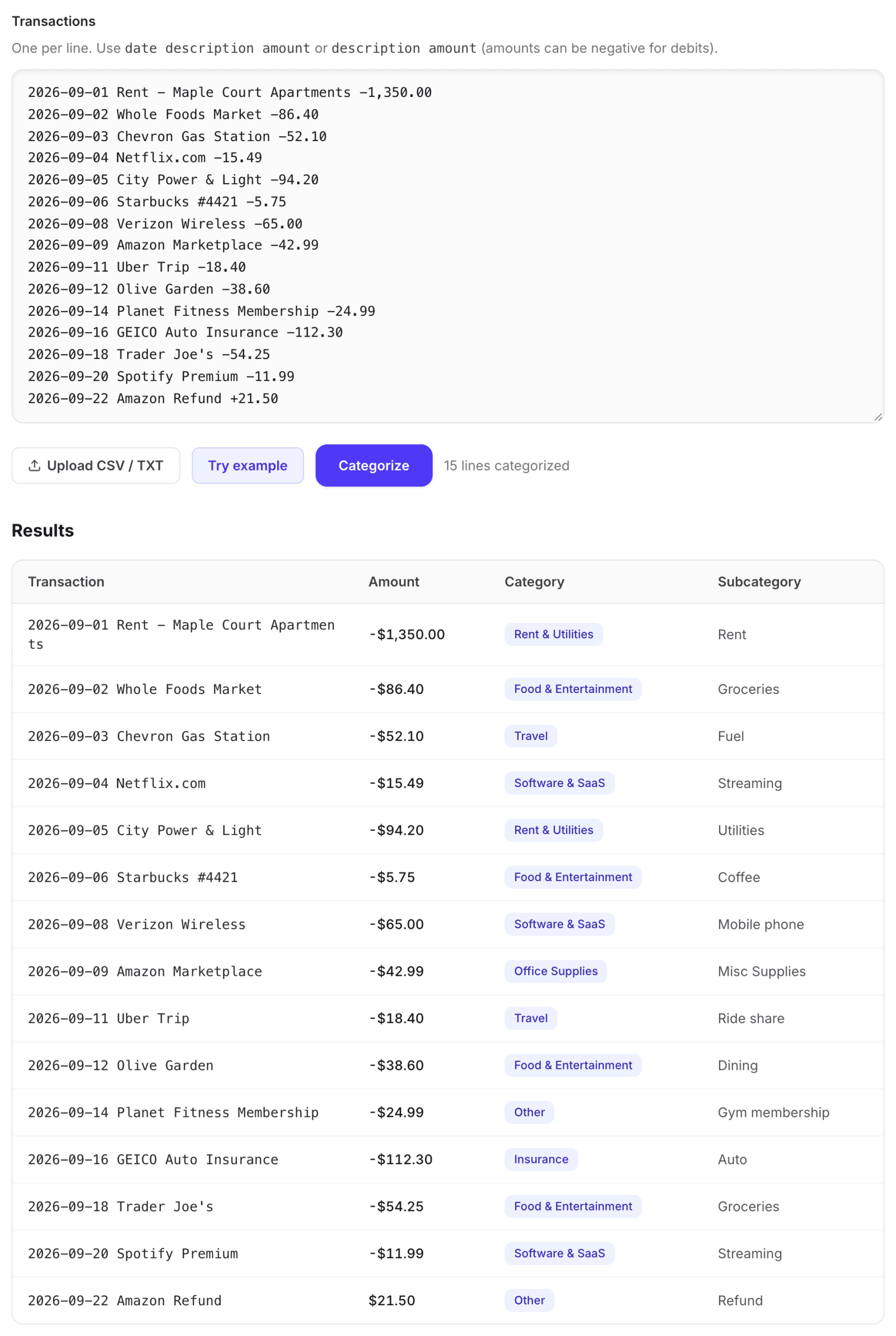
The AI Expense Categorizer takes transactions one per line, in the form date description amount or description amount, with debits as negative numbers. You can paste them in or upload a CSV or TXT export. It returns a table with a category and subcategory for each line and a summary of totals by category.
Two things to know so you read the output correctly:
- It uses a fixed, accounting-style category list (for example Rent & Utilities, Food & Entertainment, Travel, Insurance, Transfer and Other). That's a good first pass, but you'll need to map its labels onto your own set. Groceries and restaurants, for instance, can both land in Food & Entertainment, so split them yourself.
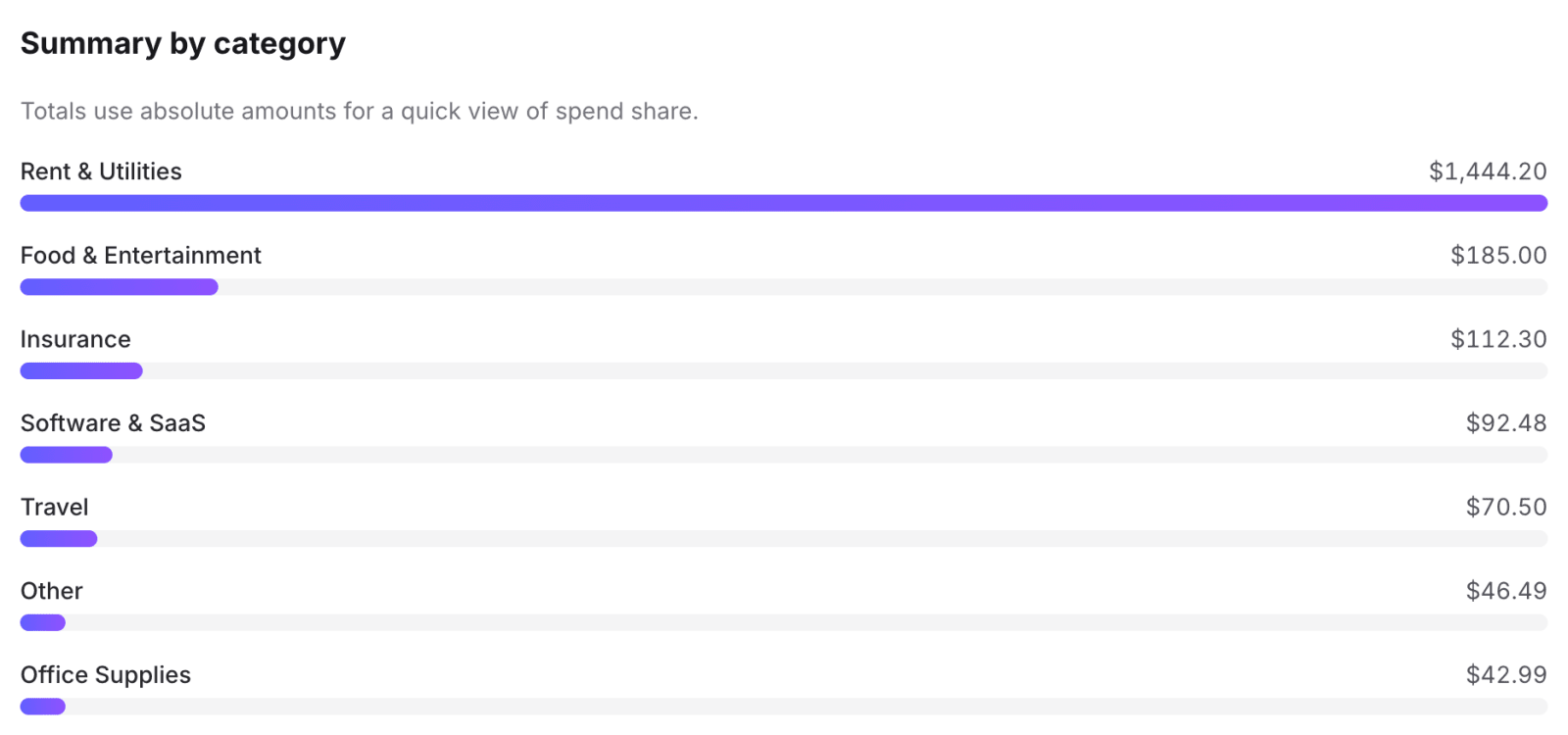
- The category summary adds up absolute amounts. Income lines and refunds get added to a category's total rather than subtracted. Leave salary out of the paste, and adjust refunds by hand.
Long pastes get cut off, so work through a month in batches of a few dozen lines.
Common mistakes
- Changing categories every month. You lose the ability to compare.
- Counting card payments as spending after already categorizing the purchases.
- Leaving annual costs out. A budget that only works in months without renewals isn't a budget.
- A huge "Other" category. If "Other" is more than about 5% of spending, something regular is hiding in it. Find it and give it a home.
- Sorting perfectly and never reviewing. The review is the point.
Next step
Take last month's statement, sort it into the 12 categories above, and label each as fixed, variable or irregular. If you want a head start, paste the lines into the AI Expense Categorizer and correct its labels as you go.
Then turn the result into a plan with how to make a monthly budget, and use your essential categories to work out how big your emergency fund should be.
This article is general information, not financial advice.