To make a monthly budget, track what you actually spend for one month, sort it into fixed and variable costs, then give every part of your take-home pay a job: bills, everyday spending, and savings. The 50/30/20 split is a useful first draft, but your rent, debts and income pattern should decide the final numbers, not a rule.
Below is the method, a worked example, and the usual reasons budgets fall apart, with fixes.
The examples use round numbers without a currency symbol. The method works the same in any currency.
Step 1: Track one normal month before you plan anything
Many budgets fail because they're built on guesses. People remember their rent and their phone bill, and badly underestimate groceries, takeaways and small card payments.
So start by recording, not planning. For one month, write down everything that leaves your account or wallet. Your bank statement and card history will cover most of it. Add cash spending by hand.
A spreadsheet or notes app with date, amount and a short label is enough. If you're not sure how to label things, how to categorize expenses suggests a simple set of categories that's easy to stick with.
Pick a month that's reasonably typical. If it included a holiday or a big one-off repair, note that so it doesn't distort your averages.
Step 2: Work out your real monthly income
Use take-home pay: what actually lands in your account after tax and any deductions taken by your employer. Budgeting from gross salary is an easy way to end up short every month.
If you're paid weekly or every two weeks, multiply your typical payment by the number of paydays in a year and divide by 12. Don't just multiply a weekly figure by four, because most months have slightly more than four weeks.
Step 3: Split spending into fixed and variable
Sort every item from your tracked month into two groups.
Fixed costs are roughly the same each month and hard to change quickly: rent or mortgage, insurance, loan minimums, phone contracts.
Variable costs change month to month and are where you have room to adjust: groceries, eating out, transport, clothes, entertainment.
Then deal with costs that don't come monthly at all. Car insurance paid once a year, servicing, annual renewals, birthdays and holidays all count. Add up a year of them and divide by 12. Setting that amount aside each month stops these costs from wrecking an otherwise sound budget.
Step 4: Use 50/30/20 as a starting draft
The 50/30/20 split is a simple way to sketch a first budget from take-home pay:
- 50% for needs: housing, utilities, groceries, transport, insurance, minimum debt payments
- 30% for wants: eating out, hobbies, subscriptions, most clothes, holidays
- 20% for savings and extra debt repayment
On a take-home pay of 4,000 a month, that's 2,000 for needs, 1,200 for wants and 800 for savings.
Treat it as a starting point. In expensive cities, rent alone can eat most of the "needs" half. If you have high-interest debt, you may want more than 20% going to repayments for a while. Adjust the percentages to fit your life, then hold yourself to the numbers you choose.
A worked example
Take someone with a take-home pay of 4,000 a month. Here is what one month of tracking showed:
| Category | Tracked month |
|---|---|
| Rent | 1,150 |
| Utilities | 165 |
| Groceries | 540 |
| Transport | 210 |
| Insurance | 60 |
| Phone and internet | 60 |
| Minimum debt payments | 100 |
| Eating out and takeaways | 460 |
| Subscriptions | 85 |
| Clothes and personal care | 260 |
| Entertainment and hobbies | 210 |
| Everything else | 420 |
| Total spent | 3,720 |
Income was 4,000, so 280 was left at the end of the month, with nothing deliberately saved and nothing set aside for annual costs.
Fixed costs (rent, insurance, phone and internet, debt minimums) came to 1,370. Variable costs came to 2,350, which is 58.75% of take-home pay. That's where the room is.
The largest variable line was "everything else" at 420. That label usually means lots of small spends that never got a label, and it's the first thing worth breaking down.
Here is the budget built from that month:
| Category | Group | Monthly budget |
|---|---|---|
| Rent | Need | 1,150 |
| Utilities | Need | 150 |
| Groceries | Need | 400 |
| Transport | Need | 160 |
| Insurance | Need | 60 |
| Phone and internet | Need | 60 |
| Minimum debt payments | Need | 100 |
| Annual costs fund | Need | 150 |
| Eating out and takeaways | Want | 250 |
| Subscriptions | Want | 45 |
| Clothes and personal care | Want | 160 |
| Entertainment and hobbies | Want | 150 |
| Holiday fund | Want | 150 |
| Everything else | Want | 115 |
| Emergency fund | Savings | 400 |
| Retirement or investing | Savings | 300 |
| Extra debt repayment | Savings | 200 |
| Total | 4,000 |
That's 2,230 on needs (55.75%), 870 on wants (21.75%) and 900 on savings and extra debt repayment (22.5%). It isn't exactly 50/30/20, and it doesn't need to be.
The annual costs fund of 150 covers 1,800 a year: car insurance of 540, servicing of 360, 600 for gifts and celebrations, and 300 of renewals and fees.
Compared with the tracked month, the budget cuts 920 from variable spending. That's ambitious. If the second month only gets halfway there, that's still 460 more going to savings than before, and a clear idea of which categories need a more realistic number.
Adjusting for high rent
Suppose the same person pays 1,750 in rent instead of 1,150. Everything else in "needs" stays the same, so needs rise to 2,830, which is about 71% of take-home pay. That leaves 1,170 for wants and savings.
A workable version might be about 15% (600) to savings and 14% (570) to wants. That's tight but honest. Over the longer term, the bigger levers are the large fixed costs: a cheaper place when the lease ends, sharing, or cutting transport costs by living closer to work. Trimming coffee spending won't fix a rent problem.
Adjusting for irregular income
If you're self-employed, work shifts or earn commission, your income might look like this over six months:
| Month | 1 | 2 | 3 | 4 | 5 | 6 |
|---|---|---|---|---|---|---|
| Income | 2,800 | 4,600 | 3,200 | 5,100 | 2,600 | 3,900 |
The average is 3,700, but budgeting to the average means you'll be short in a bad month. A safer approach:
- Build your core budget on a low month. Here, 2,800 is a reasonable base. Only one month fell below it.
- Pay yourself a steady amount. Keep your income in a separate holding account and move 2,800 to your spending account each month.
- Use the surplus as a buffer. Across these six months, income above 2,800 added up to 5,600. The one month below the base was short by 200, which the buffer covered.
- Once the buffer covers a few months of your core budget, direct extra income to savings and goals.
How to forecast cash flow as a freelancer goes deeper into this, including tax set-asides.
Why budgets fail, and how to fix it
The numbers were guesses. Fix: track first, as in step 1. Then review after each month and correct the categories that were wrong.
Irregular costs weren't included. A budget that works for ten months and collapses at insurance renewal or in the holiday season isn't working. Fix: an annual costs fund, as in the example.
It's too strict. A budget with no room for anything enjoyable tends to last a few weeks. Fix: keep a realistic wants budget and cut gradually rather than all at once.
Savings come last. If you save whatever's left over, there usually isn't much. Fix: set up an automatic transfer to savings on payday, so it happens before you start spending.
One bad month ends it. Overspending happens. Fix: treat it as information. Move money from another category, or carry the shortfall into next month's plan, and keep going.
There's no buffer. Without an emergency fund, any surprise expense goes on a credit card and the budget unravels. Fix: make building one the first savings goal. How big should an emergency fund be? helps you set a target.
Too many categories. Fix: keep it to around ten to fifteen, and merge anything small.
When this method doesn't fit
If your income doesn't cover your needs even after cutting wants, the problem isn't the budget. It's income or fixed costs, and the decisions there are bigger: housing, debt restructuring, or increasing income. If you're struggling with debt payments, many countries have free, independent debt advice services. A budget still helps there, because it shows what you can realistically offer creditors.
Your next step
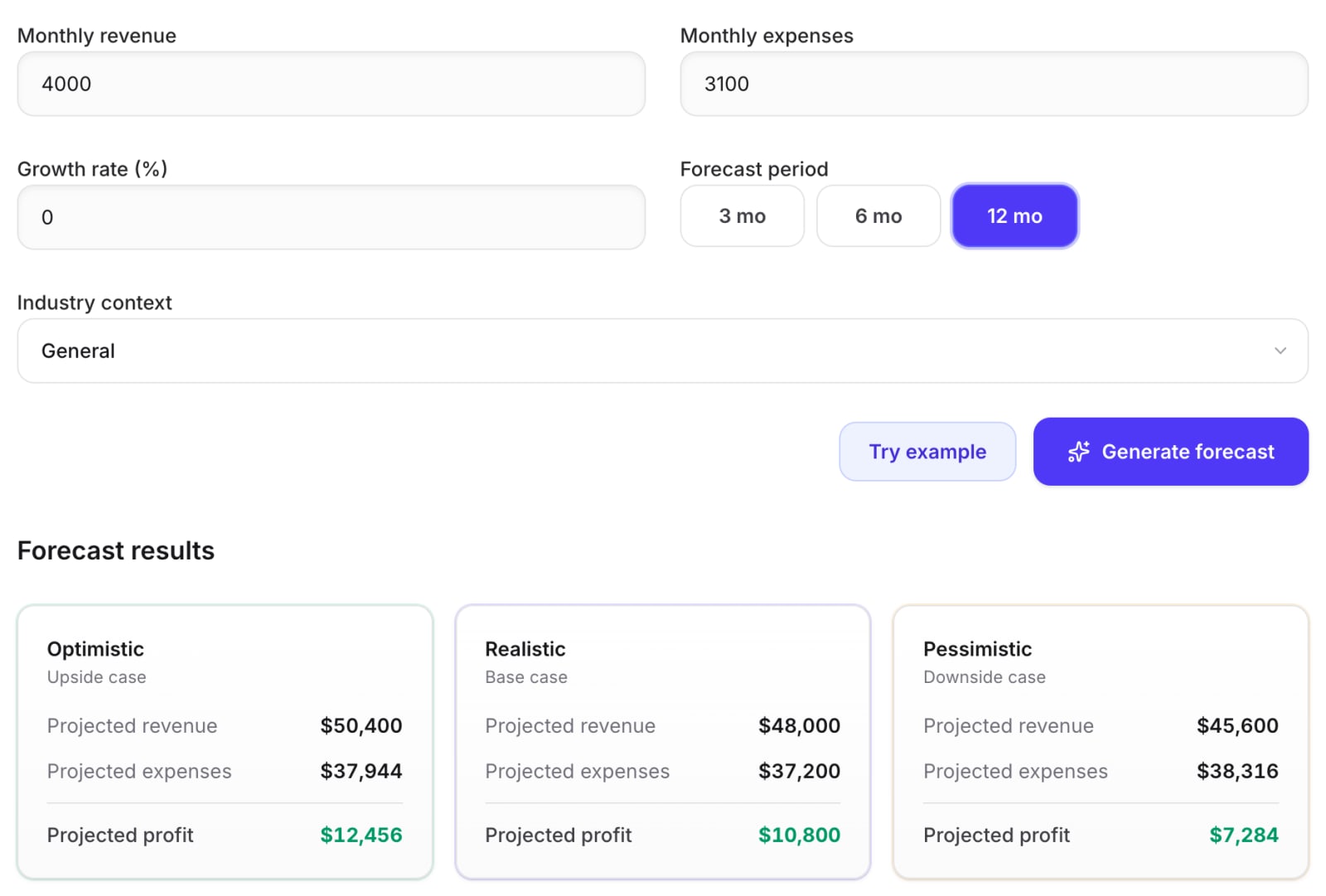
Track this month. Then try the Finaiver AI Budget Forecaster for a rough look ahead: it was built around business revenue and expenses, but you can enter your take-home pay as "Monthly revenue" and your total spending as "Monthly expenses", choose General as the industry context, set a growth rate and pick 3, 6 or 12 months. It returns AI-generated optimistic, realistic and pessimistic totals for revenue, expenses and profit over that period. For a household, "profit" is what you'd have left to save. Treat the output as a rough sense-check, not a precise forecast.
Related reading: how to categorize expenses and monthly investing vs lump sum, for what to do with the money you start saving.
This article is general information, not financial advice.