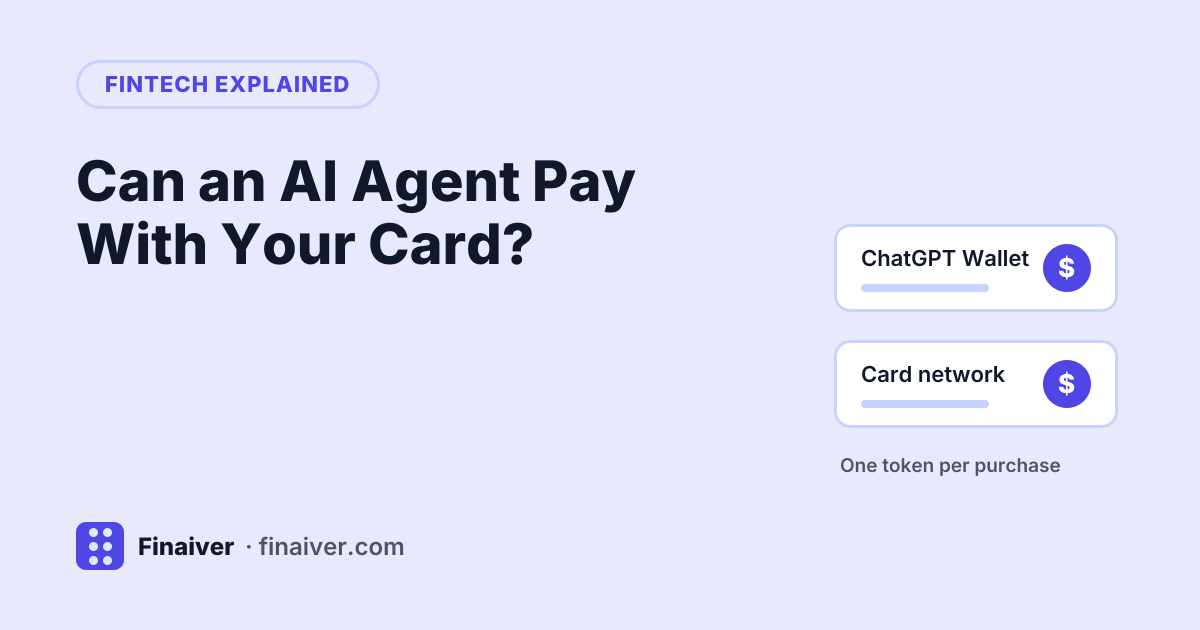
On 13 November 2026 OpenAI launched ChatGPT Wallet, which lets an AI agent in ChatGPT complete a purchase with your card. It was built with American Express, Chase, Mastercard and Visa. It's the most visible sign of something the card networks have been building for 18 months: agentic payments, where software, not a person, presses "buy".
The short answer to the title: yes, an AI agent can pay with your card, but only in a few places, and today you still approve every purchase yourself. The agent never sees your real card number. It gets a one-off token that the card network issues for that purchase. Fully hands-off buying, where you set a budget and let the agent shop, is planned but not here yet.
This explainer is built from the official announcements by OpenAI, Visa, Mastercard, Google and American Express, and the CFPB's text of the US credit card rules, read on 19 November 2026. If you want the basics of how a normal card payment moves first, read how card payments work.
What's actually live in November 2026
| What it is | Status (19 Nov 2026) | |
|---|---|---|
| ChatGPT Wallet | A wallet inside ChatGPT that lets its agents ("dots") pay for you | Launched 13 Nov 2026. ChatGPT Pro subscribers in the US aged 18+, with eligible US-issued cards |
| Visa Intelligent Commerce | Visa's system of tokenized "AI-ready" cards with spending controls for agents | Announced April 2025; its business integration, Intelligent Commerce Connect, is in pilot |
| Mastercard Agent Pay | Mastercard's "Agentic Tokens" for agent purchases | Announced April 2025. Citi and U.S. Bank cardholders enabled by Sept 2025; Mastercard said all US cardholders would follow |
| Mastercard Agent Pay for Machines | Fast, low-value machine-to-machine payments | Launched June 2026, aimed at businesses and developers |
| Google AP2 | An open protocol for proving what a user approved | Announced Sept 2025; donated to the FIDO Alliance in April 2026 |
| American Express ACE | Amex's developer kit for agent purchases | Announced April 2026; ChatGPT Wallet is its first integration, per Amex |
| OpenAI / Stripe Instant Checkout | Buy inside ChatGPT from Etsy and Shopify sellers | Launched Sept 2025; news reports say it was retired in March 2026 |
How an AI agent pays without seeing your card
ChatGPT Wallet is a good example because OpenAI has published the steps:
- You add a card once.
- The agent finds what you asked for and builds the order.
- You review the items, total and card, then approve with a security check such as Face ID or a fingerprint.
- The card network issues a payment token, a substitute card number with its own security code and expiry date, for that purchase.
- The shop charges the token. Neither the shop nor the agent ever gets your real card details.
OpenAI says each approval "creates a clear record of the purchase the user authorized the agent to make." That record matters later if something goes wrong.
The same idea runs through every system in the table. Visa calls its version "AI-Ready Cards": tokens with limits and conditions you set. Mastercard's Agentic Tokens are tied to a specific agent, so the bank can see which agent acted and where. Google's AP2 adds signed "mandates": an Intent Mandate records what you asked for, such as "running shoes under $120", and a Cart Mandate is an unchangeable record of the exact items and price you approved.
Why the card networks care so much
Shops can't tell a helpful AI agent from a fraud bot. Both are software clicking through checkout. So the networks are building ways for agents to prove who they are:
- Visa's Trusted Agent Protocol (October 2025, built with Cloudflare) lets approved agents sign their requests, so a merchant's site can let them through instead of blocking them as bots.
- Mastercard added an "agent-initiated" score in September 2026 to help banks spot when a transaction came from an agent.
- OpenAI asks merchants to recognise its agents' signed requests (Web Bot Auth) and admits some sites may still block ChatGPT Wallet purchases by accident.
That's also why rollout is slow. A purchase only works if the agent, the network, your bank and the shop's fraud system all accept it.
Who pays if an AI agent buys the wrong thing?
This is the part most explainers skip. With a credit card, US law (Regulation Z, under the Fair Credit Billing Act) gives you two kinds of protection:
- Unauthorized use. Your liability is capped at $50, and card networks' zero-liability policies usually bring that to $0. Visa's Zero Liability policy promises you won't be held responsible for unauthorized charges, provided you report them promptly.
- Billing errors. You can dispute a charge for goods you didn't accept or that weren't delivered as agreed. You must write to the issuer within 60 days of the first statement showing it, and the issuer must resolve it within two billing cycles and no later than 90 days.
The catch is the word "unauthorized". Regulation Z's official commentary says that if you give someone authority to use your card and they go beyond it, you're liable until you tell the issuer that use is no longer allowed. An agent you approved that buys the wrong size or the wrong flight probably isn't "unauthorized" in that sense. It's closer to a mistake by someone you sent shopping. No regulator has said yet how this applies to AI agents, so treat it as untested.
Here's what does help:
- Per-purchase approval. Under ChatGPT Wallet as launched, you approve every total yourself, so an agent can't quietly overspend.
- Normal merchant disputes still apply. OpenAI says users keep "existing rewards and protections for eligible disputes", for example a defective item.
- Tokens limit the damage. A stolen agent token is tied to one agent or purchase, unlike a stolen card number.
Debit cards are weaker. Debit payments fall under Regulation E: your liability depends on how fast you report, and the money is already gone from your account while the bank investigates. If you let an agent pay, use a credit card. Our guide on linking your bank to AI assistants covers the bank-account side and the new bank terms on AI agents.
Do people actually want this?
Not as much as the industry hopes. Visa's own research found that 47% of US shoppers use AI tools for at least one shopping task. That mostly means research, not paying. Accenture's 2026 survey of 25,590 consumers in 16 countries found 32% ready to hand over some purchase decisions, but only 9% open to fully autonomous shopping and 12% open to agents making payment decisions on their own. Today's "approve every purchase" design matches that.
The other names you'll hear
- Agentic Commerce Protocol (ACP): an open standard from OpenAI and Stripe that let merchants sell inside ChatGPT. It launched in September 2025 with US Etsy sellers.
- PayPal Agent Ready and Store Sync (October 2025): let PayPal merchants accept agent payments and show their catalogues to AI shopping tools.
- x402: a Coinbase-started open standard for stablecoin payments over the web, aimed at machine-to-machine payments rather than shoppers.
- MCP: the protocol many finance apps use to let AI assistants read data or take actions. We cover which apps support it in finance apps with MCP connectors.
Should you let an AI agent pay for you?
For now, only for low-stakes, easy-to-return purchases, and only with these habits:
- Use a credit card, not a debit card, so disputes don't come out of your cash.
- Read the total and the item before you approve. Approval is your protection and your liability.
- Prefer token-based wallets (ChatGPT Wallet, network agent tokens) over giving an agent your card number or a website login.
- Never give an agent your bank or card account password. Banks including Citi now treat whatever an agent does with your login as done by you.
- Turn on card alerts and check them the same day.
- Dispute in writing within 60 days if an agent's purchase is wrong and the merchant won't fix it.
Frequently asked questions
What is ChatGPT Wallet?
A payment wallet inside ChatGPT, launched on 13 November 2026, that lets ChatGPT's agents complete purchases with your card. You approve every purchase with Face ID or a fingerprint, and the shop receives a one-time token, not your card number. It's available to ChatGPT Pro subscribers in the US aged 18 and over.
Can an AI agent buy things without my approval?
Not with the systems live today. ChatGPT Wallet requires approval for every purchase. OpenAI, Visa and Mastercard all describe pre-approved spending limits as the next step, not something available now.
Is it safe to give ChatGPT my credit card?
Safer than typing your card into a random site, because the card number is never shared with the shop or the agent. The risk is approving the wrong item or price, which card protections may not treat as unauthorized.
What is agentic commerce?
Shopping where an AI agent searches, compares and completes the purchase for you. Agentic payments are the payment side: tokens, approvals and records that let banks and shops trust a purchase made by software.
Next step
Agent payments are one part of a bigger shift in how AI touches your money. Read what AI in finance apps actually helps with, and before you link any account, check whether connecting your bank to ChatGPT, Claude or Gemini is safe.
Sources, all read on 19 November 2026: OpenAI, "Introducing ChatGPT Wallet" (13 November 2026); Visa press releases on Visa Intelligent Commerce (30 April 2025), Trusted Agent Protocol (14 October 2025), AI transactions (18 December 2025) and Intelligent Commerce Connect (2026); Mastercard, Agent Pay announcement (29 April 2025), "Making agentic AI commerce a reality" (30 September 2025), Agent Pay for Machines (10 June 2026) and agentic trust services (30 September 2026); Google Cloud, "Announcing Agent Payments Protocol (AP2)" (17 September 2025) and Google's FIDO Alliance announcement (28 April 2026); American Express developer blog (22 April 2026); Stripe, Instant Checkout announcement (29 September 2025); PayPal newsroom (28 October 2025); x402.org; CFPB, Regulation Z sections 1026.12 and 1026.13 and official commentary; Visa Zero Liability policy; Accenture, "Talk to my AI agent" (2026). Instant Checkout's retirement is from news reports (AP, June 2026), not an OpenAI statement. This article is general information, not legal or financial advice.