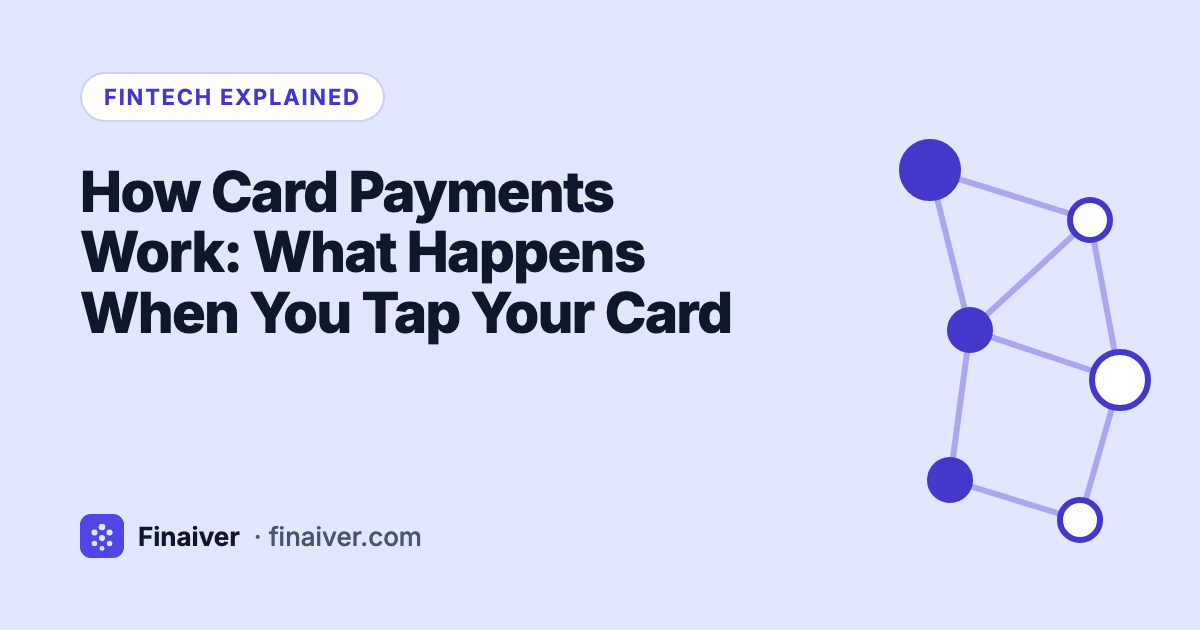
When you tap a card, the shop's terminal sends a request through the merchant's payment provider and the card network to your bank, which checks the card and your balance and replies "approved" or "declined" within a couple of seconds. That's only the first step. The money itself moves later, usually in batches, and the merchant receives the sale amount minus a set of fees shared between the businesses involved.
Here's who those businesses are, what each step does, and where the fees go.
The five parties in every card payment
| Party | Who they are | What they do |
|---|---|---|
| Cardholder | You | Pays with the card |
| Merchant | The shop, website or app | Accepts the card and sells the goods |
| Acquirer | The merchant's bank or payment provider | Connects the merchant to the card networks and pays the merchant |
| Card network | The scheme whose logo is on the card | Runs the rails between acquirers and issuers and sets the rules |
| Issuer | Your bank or card provider | Issued the card, approves payments and bills you |
The terms are worth learning because they come up in every conversation about payments. "Acquirer" and "issuer" sound alike but sit on opposite sides: the acquirer works for the merchant, the issuer works for you.
Many merchants don't deal with an acquirer directly. They use a payment service provider or payment facilitator, which bundles the acquiring relationship with a terminal, an online checkout and reporting. From the merchant's point of view, that company is "the card processor". Behind it, an acquirer is still doing the job above.
Some card networks act as both network and issuer, issuing cards themselves rather than through banks. The steps are the same; one company just plays two roles.
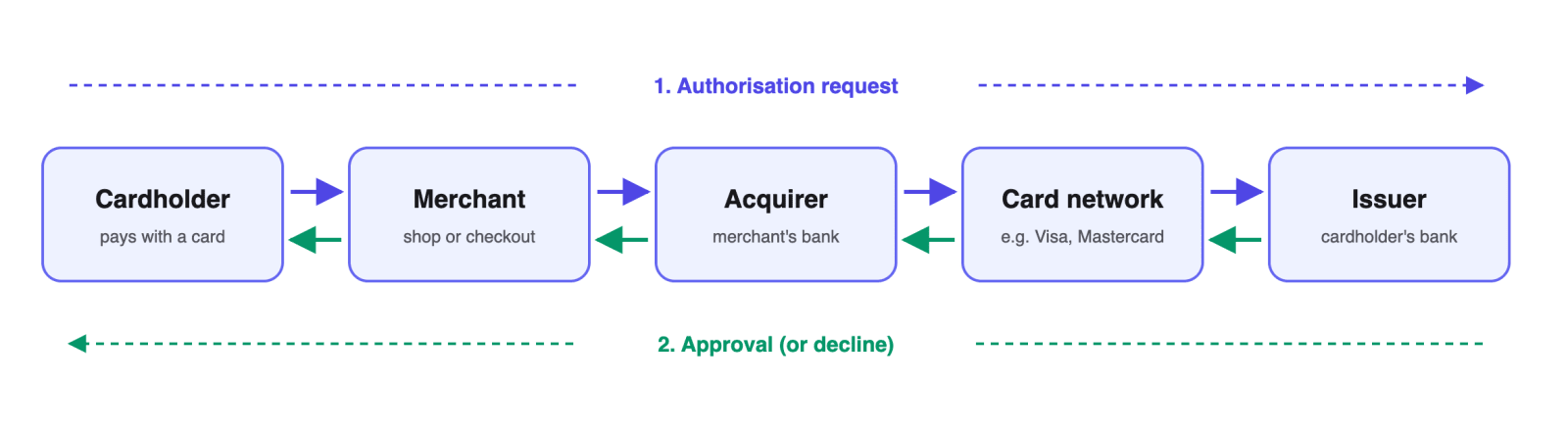
Step 1: Authorisation (the two seconds at the till)
When you tap or insert your card, or enter its details online:
- The terminal or checkout reads the card and builds an authorisation request: the amount, the merchant, and a cryptogram generated by the card's chip or your phone that proves the card is present and genuine.
- The request goes to the acquirer, which forwards it to the right card network based on the card number.
- The network routes it to your issuer.
- The issuer runs its checks: Is the card valid and not reported lost? Is there enough balance or credit? Does the transaction look like fraud for this customer?
- The issuer sends back an approval or decline, which travels back the same way to the terminal.
If approved, the issuer places a hold on that amount. On a debit card, your available balance drops straight away. On a credit card, your available credit does. But no money has actually moved yet.
This is why hotels and fuel stations sometimes authorise a larger amount than you end up paying. They're reserving funds, not taking them.
Step 2: Clearing (confirming what to charge)
At the end of the day, or at intervals, the merchant's system sends the completed transactions to the acquirer in a batch. This is clearing: confirming the final amount of each authorised payment and passing those details through the network to each issuer.
The final amount can differ from the authorisation. A restaurant authorises the bill, then clears it with the tip added. A fuel pump authorises a round amount, then clears what you actually pumped.
Once the issuer receives the cleared transaction, the pending item on your statement becomes a posted one.
Step 3: Settlement (when the money moves)
Settlement is the actual transfer of funds. Typically:
- The issuer pays the network for all the cleared transactions its cardholders made, minus its share of fees (interchange).
- The network passes the funds to each acquirer.
- The acquirer pays the merchant, minus its own fees.
Settlement to the merchant usually takes one to a few business days, depending on the provider and the merchant's agreement. For you, nothing changes at this point: on a debit card the money has already left your account, and on a credit card it appears on your next bill.
Who pays which fees
Merchants pay to accept cards. The total they pay is often called the merchant service charge or merchant discount rate, and it's made up of three conceptual parts.
| Fee | Paid to | What it's for |
|---|---|---|
| Interchange | The issuer (your bank) | Covers the issuer's costs: fraud losses, credit risk, running card accounts, and rewards on some cards |
| Scheme fees | The card network | Covers running the network, setting rules and processing |
| Acquirer markup | The acquirer or payment provider | Their margin for terminals, processing, support and risk |
Interchange is usually the largest part. It's set by the card networks, often differs by card type (debit, credit, premium, commercial), by whether the card was present, and by the merchant's sector. In some regions it's capped by regulation; the caps, where they exist, vary by region and change, so check current rules for the market you're interested in.
As a cardholder, you don't usually see any of this. Some merchants add a surcharge for card payments, which is allowed in some places and restricted in others.
An illustrative fee breakdown
The figures below are made up to show how the pieces fit together. They aren't real rates for any network, country or provider. The maths works the same in any currency.
Say you spend 100.00 at a shop with a credit card.
| Line | Illustrative rate | Amount |
|---|---|---|
| Sale | 100.00 | |
| Interchange (to issuer) | 1.10% | 1.10 |
| Scheme fees (to network) | 0.20% | 0.20 |
| Acquirer markup | 0.50% | 0.50 |
| Total fees | 1.80% | 1.80 |
| Merchant receives | 98.20 |
Step by step: 100.00 × 1.10% = 1.10; 100.00 × 0.20% = 0.20; 100.00 × 0.50% = 0.50. Total fees are 1.10 + 0.20 + 0.50 = 1.80, so the merchant receives 100.00 − 1.80 = 98.20.
Many payment providers don't show this split. They charge a single blended price, such as a percentage plus a small fixed fee per transaction, and handle interchange and scheme fees behind the scenes. The fixed part matters a lot for small payments.
Using an illustrative blended price of 1.5% plus 0.10 per transaction:
- On a 100.00 sale: 1.50 + 0.10 = 1.60, or 1.6% of the sale.
- On a 4.00 coffee: 0.06 + 0.10 = 0.16, or 4% of the sale.
That's why some small shops set a minimum card spend or prefer other payment methods for very small amounts.
Chargebacks: when a payment is reversed
A chargeback is a forced reversal of a card payment, started by the cardholder through their issuer. Common reasons include fraud ("I didn't make this payment"), goods that never arrived, items not as described, or being charged twice.
The process in outline:
- You raise a dispute with your issuer.
- The issuer checks it against the network's rules and, if it qualifies, sends the chargeback through the network to the acquirer.
- The acquirer takes the money back from the merchant, often adding a chargeback fee.
- The merchant can accept it or challenge it with evidence, such as proof of delivery.
- The network's rules decide the outcome if both sides keep disputing.
Chargebacks are a big part of why card payments feel safe for consumers. They're also a real cost for merchants, and a high chargeback rate can lead an acquirer to raise fees or stop serving a business. Time limits and eligible reasons vary by network, so check with your card provider if you need to dispute something.
Tokenisation and 3-D Secure
Two technologies do most of the work of keeping card payments secure.
Tokenisation
When you add a card to a phone wallet, or a website stores your card, the real card number is often replaced by a token: a stand-in number that only works in a specific context, like one device or one merchant. If a merchant's database is breached, stolen tokens are far less useful than real card numbers. When you pay, the network or issuer maps the token back to your actual card.
3-D Secure
3-D Secure is an extra check for online payments where the card isn't physically present. During checkout, the issuer may ask you to confirm the payment, typically in your banking app or with a one-time code. Newer versions use data about the device and transaction to approve many low-risk payments without interrupting you, and only ask for confirmation when something looks unusual.
When a payment is authenticated with 3-D Secure, liability for certain fraud chargebacks often shifts from the merchant to the issuer, which is one reason merchants use it. The exact rules depend on the network and region.
Where this explanation simplifies
- Debit, credit and prepaid cards follow the same broad flow, but fees, holds and dispute rights can differ.
- Domestic card schemes in some countries route local payments differently from international networks.
- Large merchants may connect to more than one acquirer and route payments between them.
- Fee figures here are illustrative. Real pricing depends on the network, region, card type, merchant sector and contract.
Next step
Next time you check your card statement, look for transactions still marked as pending: those are authorised but not yet cleared. If you want to see how other payment methods differ from cards, read what open banking is, which moves money directly between bank accounts, and how buy now, pay later works. AI agents can now pay with cards too, using one-off tokens: see can an AI agent pay with your card?
This article is general information, not financial advice.