A flat interest rate is charged on the full amount you borrowed for the entire loan, even though you pay part of it back every month. A reducing-balance rate is charged only on what you still owe. Because of that difference, a flat rate of 10% costs about the same as a reducing-balance rate of just over 17% on a typical 5-year loan.
If you are comparing two quotes and one says "flat", you can't compare the headline numbers directly. This guide shows how to convert one into the other.
The maths works the same in any currency, so the examples use plain numbers.
How each method charges interest
Flat rate
Interest is worked out once, at the start, on the original loan amount:
Total interest = Principal × flat rate × years
That total is added to the principal and divided by the number of months to get the EMI. The interest portion of every EMI is the same, from the first month to the last.
Flat rates are sometimes used for car loans, consumer-goods financing, and some short personal loans. Whether they're common, and how they must be disclosed, depends on where you live and the type of lender.
Reducing balance
Each month, interest is charged on the balance still outstanding. As you repay principal, the balance falls, so the interest falls with it. The EMI stays fixed, but its interest share shrinks over time. This is the method most home loans and many personal loans use, and the one described in how loan EMI is calculated.
Worked example: 500,000 for 5 years at a 10% flat rate
Step 1: total interest. 500,000 × 0.10 × 5 = 250,000
Step 2: total repayable. 500,000 + 250,000 = 750,000
Step 3: EMI. 750,000 ÷ 60 months = 12,500 per month
Every one of those 60 payments contains 4,166.67 of interest (250,000 ÷ 60), whether you owe 500,000 or almost nothing.
The same loan at a 10% reducing-balance rate
Using the standard EMI formula with r = 10 ÷ 12 ÷ 100 and n = 60:
- EMI = 10,623.52
- Total interest = 137,411.34
So at the same headline 10%, the flat version costs you 1,876.48 more every month and 112,588.66 more in total interest.
Why the gap is so large
Under the flat method you are paying interest on 500,000 for five full years. But you aren't borrowing 500,000 for five years. You're paying it back steadily. Halfway through a 60-month reducing-balance loan with the same EMI of 12,500, you'd owe only about 302,789, yet the flat method is still charging interest as if you owed the full 500,000.
In effect, the flat rate charges you interest on money you have already returned.
Converting a flat rate to its effective reducing-balance rate
There's no neat formula that converts one rate into the other. The reliable method is to find the reducing-balance rate that produces the same EMI over the same number of months.
Step 1: Work out the flat-rate EMI. Here it is 12,500.
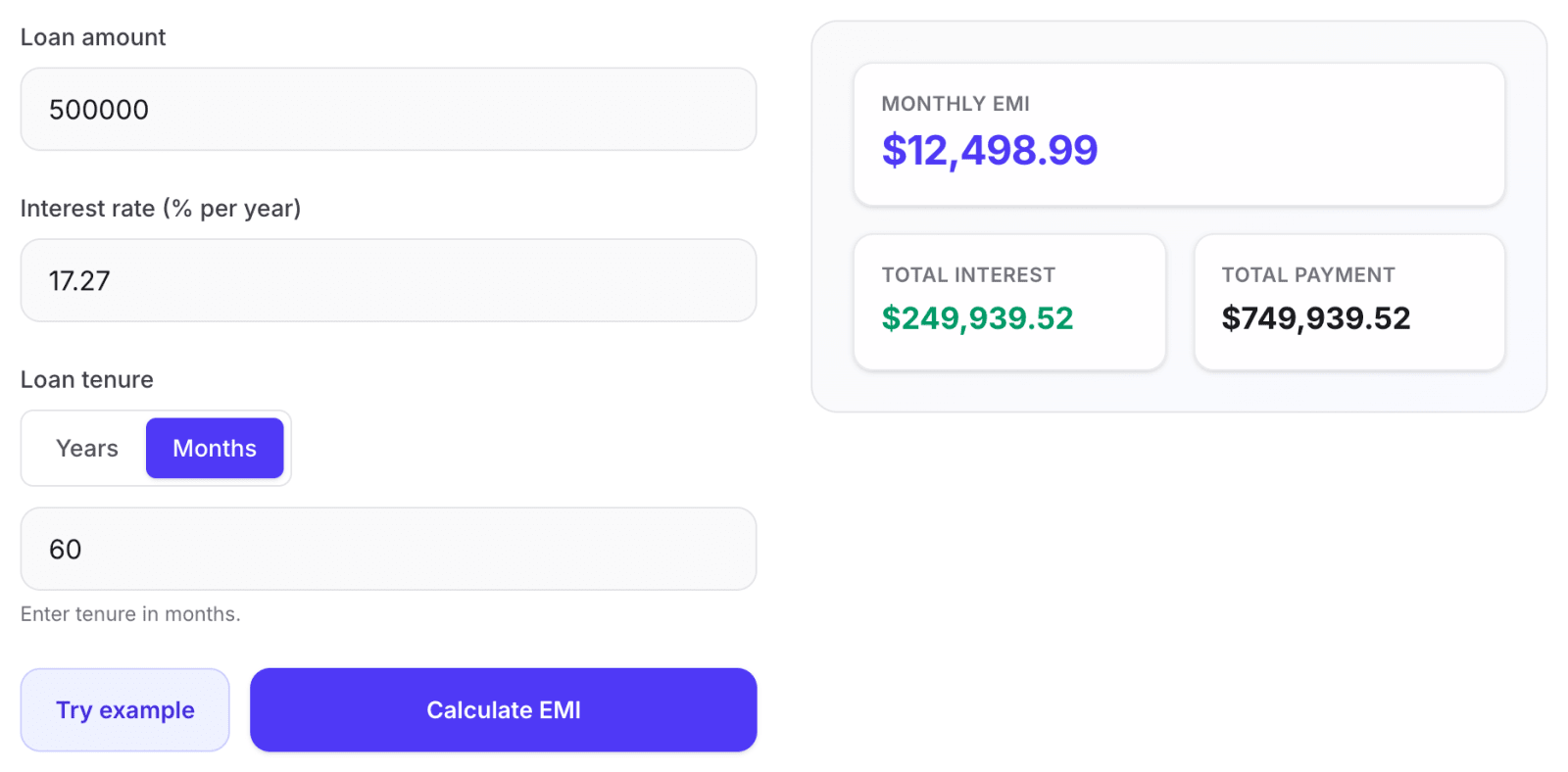
Step 2: Try reducing-balance rates until the EMI matches. For 500,000 over 60 months:
| Reducing-balance rate tried | EMI |
|---|---|
| 10% | 10,623.52 |
| 15% | 11,894.97 |
| 17% | 12,426.29 |
| 17.25% | 12,493.60 |
| 17.27% | 12,498.99 |
| 17.3% | 12,507.08 |
Step 3: Read off the answer. The EMI of 12,500 sits at about 17.27%. That is the rate you should compare against other quotes.
You can do this trial in any reducing-balance EMI calculator. Enter the loan amount and tenure, then adjust the rate up or down until the EMI matches the lender's flat-rate EMI.
Comparison table: flat rates and what they really cost
All rows below are for a 500,000 loan. The effective rate is the reducing-balance rate that gives the same EMI.
| Flat rate | Tenure | EMI | Total interest | Effective reducing-balance rate |
|---|---|---|---|---|
| 8% | 1 year | 45,000.00 | 40,000 | 14.45% |
| 8% | 3 years | 17,222.22 | 120,000 | 14.55% |
| 8% | 5 years | 11,666.67 | 200,000 | 14.13% |
| 10% | 1 year | 45,833.33 | 50,000 | 17.97% |
| 10% | 3 years | 18,055.56 | 150,000 | 17.92% |
| 10% | 5 years | 12,500.00 | 250,000 | 17.27% |
| 12% | 1 year | 46,666.67 | 60,000 | 21.46% |
| 12% | 3 years | 18,888.89 | 180,000 | 21.20% |
| 12% | 5 years | 13,333.33 | 300,000 | 20.31% |
Across these examples, the effective rate comes out at roughly 1.7 to 1.8 times the flat rate. That's useful as a quick sanity check when someone quotes you a flat rate on the phone. For a real decision, do the proper conversion; the multiple shifts with the rate and the tenure.
Notice that the loan amount doesn't change the effective rate. A 10% flat rate over 5 years works out to about 17.27% whether you borrow 50,000 or 5,000,000, because both the flat interest and the EMI scale in proportion.
Is a flat rate always worse?
Not automatically. A flat rate is just a different way of expressing the price. A 7% flat rate is cheaper than a 15% reducing-balance rate over 5 years, because 7% flat converts to about 12.5% reducing. The problem is only when the two are compared side by side as if they were the same kind of number.
What matters is the effective rate, the EMI, and the total amount you'll repay for the same amount and tenure.
Questions to ask a lender
Before you sign, get clear written answers to these:
- "Is this rate flat or reducing balance?" If the answer is vague, ask how the interest in month 1 compares to the interest in the last month. If they're the same, it's flat.
- "What is the EMI, and what is the total amount I'll repay?" These two numbers let you compare any two offers, whatever method they use, as long as the loan amount and tenure match.
- "What fees are charged, and are they deducted from the loan or added to it?" A processing fee taken from the payout means you receive less than the amount you pay interest on.
- "Is there an annual percentage rate (APR) or similar figure that includes fees?" In many places lenders must disclose a standardised cost figure, but the name, the rules, and what's included vary by country and loan type. Check your local consumer-finance regulator's guidance. Our guide to APR vs interest rate explains the difference.
- "What happens if I repay early?" On a flat-rate loan, early repayment sometimes saves less than you'd expect, because the interest may be calculated up front. Ask how a settlement figure would be worked out.
Common mistakes
Comparing headline rates across methods. This is the big one. "9% flat" and "15% reducing" can't be ranked by looking at 9 and 15.
Assuming the salesperson means reducing balance. At a car showroom or a point-of-sale finance desk, a rate may be quoted flat without the word "flat" being used. Ask.
Ignoring tenure. Comparing a 3-year quote with a 5-year quote by total interest alone isn't fair; the longer one will almost always show more interest. Compare at the same tenure, or compare effective rates.
Forgetting that fees change the picture too. Two loans with the same effective interest rate can have quite different real costs once fees are counted.
Limits of this comparison
The conversion above assumes equal monthly payments, a fixed rate, and no fees. If your loan has a different structure, such as a balloon payment at the end, a payment holiday, or interest calculated daily, the effective rate will differ. In those cases, ask the lender for the full repayment schedule and compare total cost.
Next step
Open the Finaiver Loan EMI Calculator. It works on the reducing-balance method, so it's the right tool for the conversion: enter the loan amount and tenure from your flat-rate quote, then adjust the interest rate until the Monthly EMI matches the lender's EMI. The rate you land on is the effective rate to compare. The calculator shows a dollar sign, but the numbers work in any currency.
Then read how loan EMI is calculated to understand the formula behind it, and loan tenure vs total interest to choose a term once you've picked a lender.
This article is general information, not financial advice.