An EMI (equated monthly instalment) is the fixed amount you pay every month so that a loan, plus its interest, is fully repaid by the last instalment. Lenders work it out with one formula that uses three inputs: how much you borrow, the monthly interest rate, and the number of months. Once you see how those three fit together, you can check any loan quote yourself.
The maths below works the same in any currency, so the examples use plain numbers without a currency symbol.
The EMI formula
Most home loans, and many personal and car loans, use the reducing-balance method. The formula is:
E = P × r × (1 + r)^n / ((1 + r)^n − 1)
Where:
- E is the EMI, the fixed monthly payment.
- P is the principal, the amount you borrow.
- r is the monthly interest rate, written as a decimal.
- n is the tenure in months.
Two details trip people up.
First, r is monthly, not yearly. Lenders quote an annual rate, so you divide it by 12 and then by 100. A 12% annual rate becomes 12 ÷ 12 ÷ 100 = 0.01. A 9% annual rate becomes 0.0075.
Second, n is counted in months. A 5-year loan has n = 60. A 20-year loan has n = 240.
What the formula is doing, in plain words
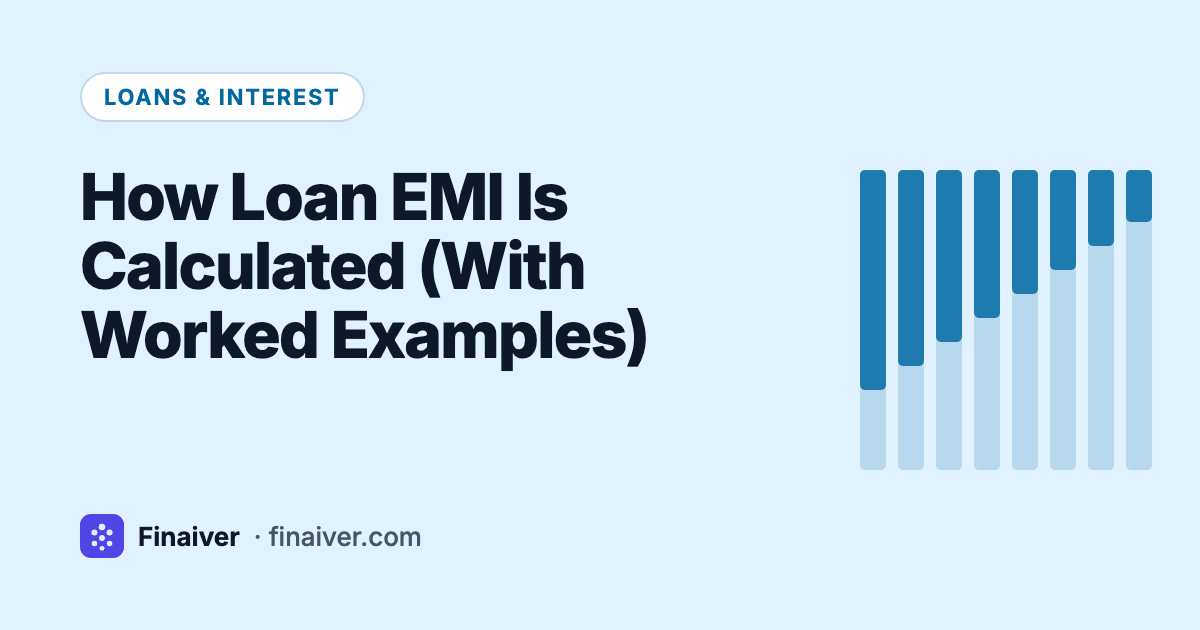
Each month the lender charges interest only on the balance you still owe. Part of your EMI pays that interest, and whatever is left over reduces the balance. Next month the balance is a little smaller, so the interest is a little smaller, and more of the same EMI goes to principal.
The formula simply finds the one fixed payment that makes this process land exactly on zero after n months. The (1 + r)^n part is the growth factor: what one unit of debt would grow to if you paid nothing for n months. The formula balances that growth against your stream of payments.
If the interest rate is zero, the formula breaks (you'd be dividing by zero), and the EMI is just P ÷ n.
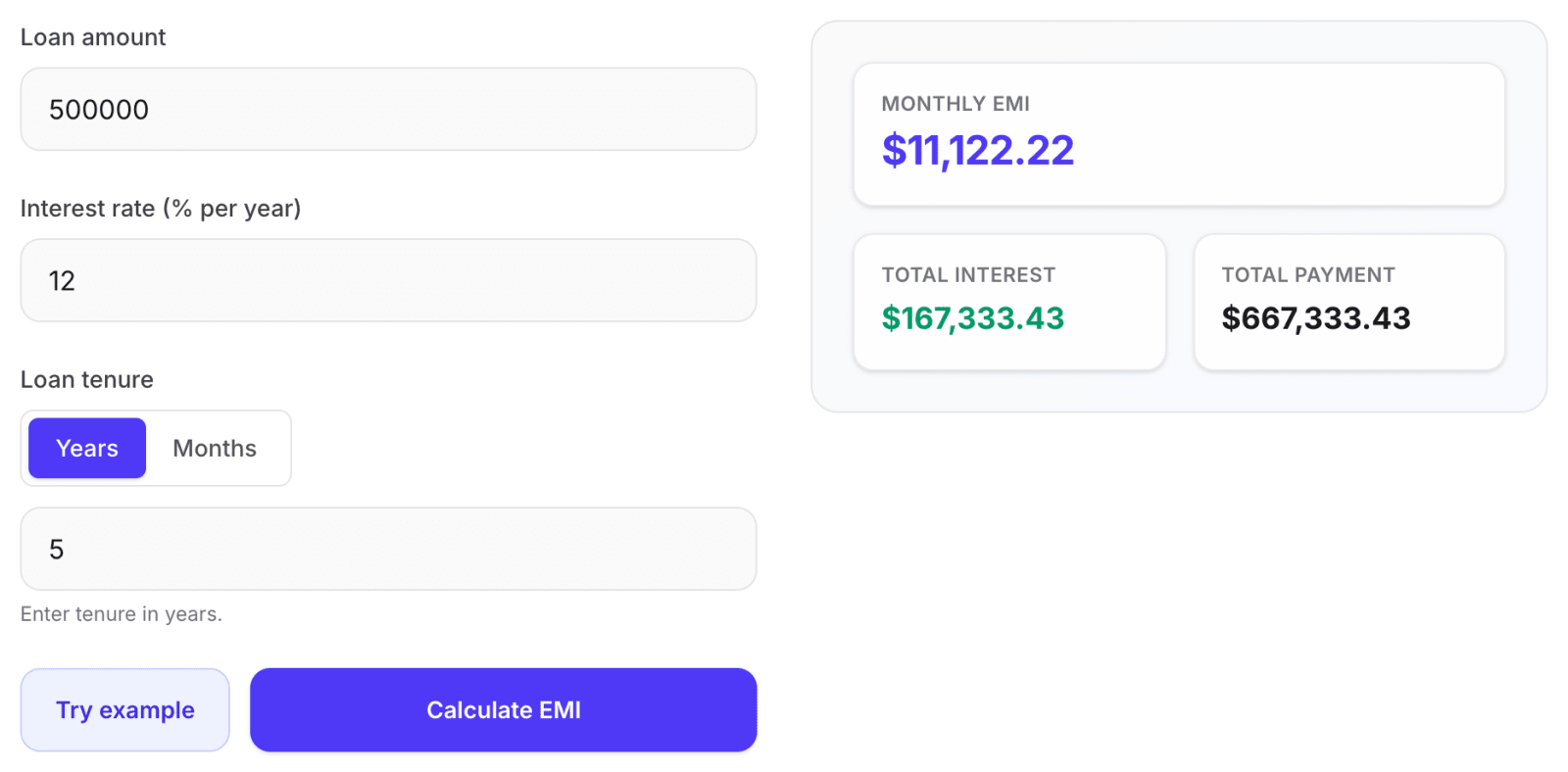
Worked example 1: a 500,000 personal loan at 12% for 5 years
Inputs
- P = 500,000
- Annual rate = 12%, so r = 12 ÷ 12 ÷ 100 = 0.01
- Tenure = 5 years, so n = 60
Step 1: work out (1 + r)^n. (1.01)^60 = 1.816697 (rounded to six decimals).
Step 2: the top of the fraction. P × r × (1 + r)^n = 500,000 × 0.01 × 1.816697 = 9,083.48
Step 3: the bottom of the fraction. (1 + r)^n − 1 = 1.816697 − 1 = 0.816697
Step 4: divide. E = 9,083.48 ÷ 0.816697 = 11,122.22 per month
Over 60 months you pay 11,122.22 × 60 = 667,333.43 in total. Take away the 500,000 you borrowed and the total interest is 167,333.43.
The first three months
Here is how the first few EMIs split between interest and principal.
| Month | EMI | Interest | Principal | Balance after payment |
|---|---|---|---|---|
| 1 | 11,122.22 | 5,000.00 | 6,122.22 | 493,877.78 |
| 2 | 11,122.22 | 4,938.78 | 6,183.45 | 487,694.33 |
| 3 | 11,122.22 | 4,876.94 | 6,245.28 | 481,449.05 |
Month 1 interest is simply 500,000 × 0.01 = 5,000. The remaining 6,122.22 of the EMI comes off the balance. Month 2 interest is charged on 493,877.78, which is why it is a little lower.
By the final month the interest portion has shrunk to just 110.12, and almost the entire EMI goes to principal.
Worked example 2: a 3,000,000 home loan at 9% for 20 years
A long loan shows the interest effect much more sharply.
Inputs
- P = 3,000,000
- Annual rate = 9%, so r = 9 ÷ 12 ÷ 100 = 0.0075
- Tenure = 20 years, so n = 240
Step 1: (1.0075)^240 = 6.009152
Step 2: 3,000,000 × 0.0075 × 6.009152 = 135,205.91
Step 3: 6.009152 − 1 = 5.009152
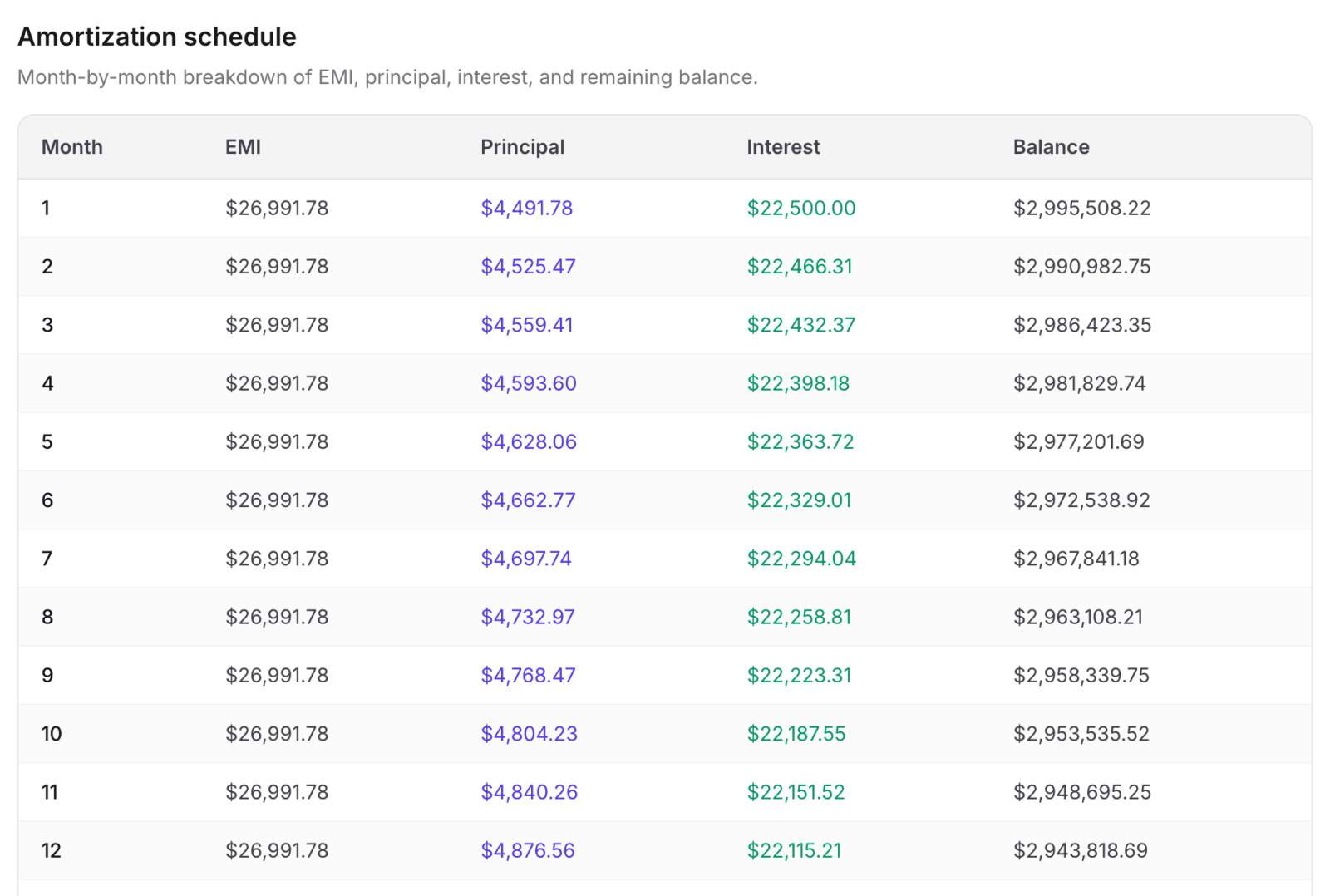
Step 4: E = 135,205.91 ÷ 5.009152 = 26,991.78 per month
Total paid over 240 months is 6,478,026.88, so total interest is 3,478,026.88. You repay more in interest than you borrowed. That is not a trick by the lender; it is what 9% a year does over two decades on a large balance.
How much of your early EMIs is interest?
This is the part that surprises most borrowers. Because interest is charged on the outstanding balance, and the balance is highest at the start, the early EMIs are weighted heavily towards interest.
| 500,000 at 12%, 5 years | 3,000,000 at 9%, 20 years | |
|---|---|---|
| EMI | 11,122.22 | 26,991.78 |
| Interest in the first EMI | 5,000.00 (45.0%) | 22,500.00 (83.4%) |
| Interest paid in year one | 55,821.56 | 267,720.03 |
| Principal repaid in year one | 77,645.12 | 56,181.31 |
| Share of year-one payments that is interest | 41.8% | 82.7% |
On the home loan, the principal portion of the EMI doesn't overtake the interest portion until month 149, more than 12 years in.
Look at it another way. After five years of payments on the home loan you've paid 1,619,506.72, yet the balance has only fallen from 3,000,000 to 2,661,211.47. Only 338,788.53 of what you paid went towards the debt itself.
This is why extra payments made early in a loan save so much interest, and why the question of reducing your EMI or your tenure after a prepayment matters.
What changes your EMI?
Only the three inputs. Here is the 500,000 loan at 12% for 5 years with one input changed at a time.
| Change | EMI | Total interest |
|---|---|---|
| Base case: 500,000, 12%, 5 years | 11,122.22 | 167,333.43 |
| Borrow 600,000 instead | 13,346.67 | 200,800.12 |
| Rate 11% instead of 12% | 10,871.21 | 152,272.69 |
| Rate 13% instead of 12% | 11,376.54 | 182,592.19 |
| Tenure 4 years | 13,166.92 | 132,012.05 |
| Tenure 6 years | 9,775.10 | 203,806.93 |
| Tenure 7 years | 8,826.37 | 241,414.78 |
A few patterns stand out.
The amount borrowed scales the EMI directly. Borrow 20% more and the EMI and interest rise by 20%.
A one-point rate change moves the EMI less than you might expect, about 250 a month here, but it adds or removes around 15,000 in total interest on this loan. On a longer loan the same rate change matters far more.
Tenure has the biggest effect on the EMI, in both directions. Stretching from 5 to 7 years cuts the EMI by about a fifth but adds 74,081.35 in interest. The trade-off is covered in detail in loan tenure vs total interest.
Mistakes to avoid when checking an EMI
Using the annual rate as r. If you plug 0.12 into the formula for a 12% loan, you'll get a wildly wrong answer. Always divide by 12 first.
Mixing years and months. n must be in months. A 5-year loan is 60, not 5.
Comparing against a flat-rate quote. Some lenders quote a "flat" rate, where interest is charged on the original amount for the whole term. A flat 10% is much more expensive than a reducing-balance 10%. See flat rate vs reducing balance interest for how to convert one to the other.
Forgetting fees. The EMI formula covers principal and interest only. Processing fees, insurance bundled into the loan, and other charges add to your real cost. Ask for them in writing.
Assuming the rate never changes. On a floating-rate loan the lender can change the rate during the term, and either the EMI or the tenure gets adjusted. The formula still applies; you rerun it on the remaining balance and months at the new rate.
When the standard formula doesn't apply
The formula assumes a fixed rate, equal monthly payments, and interest calculated monthly on the reducing balance. Some products work differently: loans with a payment holiday at the start, interest-only periods, balloon payments at the end, or interest computed daily. Lenders may also round the EMI or adjust the last instalment slightly, so your schedule can differ from the formula by small amounts. If your loan agreement describes a different method, follow the agreement.
Check your own loan
Open the Finaiver Loan EMI Calculator and enter your loan amount, the annual interest rate, and the tenure (you can switch between years and months). It shows your monthly EMI, total interest and total payment, a principal-versus-interest chart, the outstanding balance over time, and a month-by-month amortization schedule. The calculator displays a dollar sign, but the arithmetic is identical in any currency.
Try the two examples above first, so you can see the numbers match. Then run your own loan and look at how much of your first year's payments goes to interest.
Next, read loan tenure vs total interest to pick a term, or how to read an amortization schedule to get more out of the schedule table.
This article is general information, not financial advice.