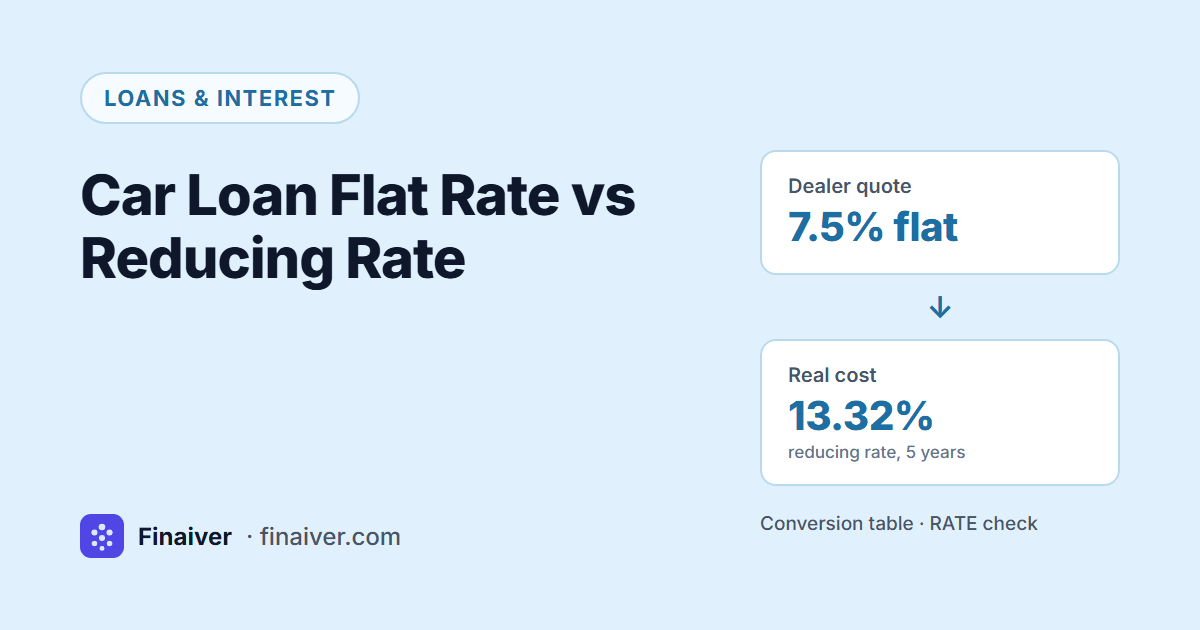
A car loan flat rate charges interest on the full amount you borrowed for the whole term, even as you pay it down. To compare it with a bank's reducing-balance rate, you convert it: a 7.5% flat rate over 5 years is about 13.3% reducing, and a 3% flat rate is about 5.6%. As a quick check, the reducing rate is usually 1.7 to 1.9 times the flat rate.
Car dealers and some car finance companies often quote flat rates because the number looks small. This guide gives you the flat rate formula, a conversion table for common car loan rates, a one-line spreadsheet check, and the two things that change the comparison: balloon payments and early settlement.
The maths works in any currency, so the examples use plain numbers. For the general case on any loan, see flat rate vs reducing balance interest.
The flat rate formula
Total interest = Loan amount × flat rate × years Monthly instalment = (Loan amount + total interest) ÷ number of months
The interest is fixed at the start and split equally across every payment.
Worked example: 800,000 at 7.5% flat for 5 years
Say the car costs 1,000,000, you pay 200,000 down, and the dealer finances 800,000 at 7.5% flat over 5 years.
Step 1: total interest. 800,000 × 0.075 × 5 = 300,000
Step 2: total repayable. 800,000 + 300,000 = 1,100,000
Step 3: monthly instalment. 1,100,000 ÷ 60 = 18,333.33
Each instalment includes 5,000 of interest (300,000 ÷ 60), from the first month to the last. On a reducing-balance loan with the same instalment, interest in month 1 would be about 8,879 and in month 60 about 201. A flat loan charges the same 5,000 in month 60, when you owe almost nothing.
Converting it to a reducing rate
Find the reducing-balance rate that gives the same 18,333.33 instalment on 800,000 over 60 months:
| Reducing rate tried | Monthly EMI |
|---|---|
| 7.5% | 16,030.36 |
| 12% | 17,795.56 |
| 13% | 18,202.46 |
| 13.3% | 18,325.55 |
| 13.32% | 18,333.78 |
| 13.5% | 18,407.88 |
The match is at about 13.32%. That's the number to compare with a bank's car loan quote.
Compare it with a real alternative. Suppose a bank offers 12.5% reducing for the same 800,000 over 5 years. Its EMI is 17,998.35 and total interest is 279,901.03. The dealer's "7.5%" costs 335 more a month and about 20,100 more in total.
The fastest way: one spreadsheet formula
Excel and Google Sheets can find the reducing rate directly:
=RATE(60, -18333.33, 800000)*12
The parts are the number of months, the monthly instalment (as a negative), and the loan amount. The function returns a monthly rate, so multiply by 12. The answer is 13.32%.
This works for any flat-rate quote. All you need is the loan amount, the instalment and the number of months, which every dealer has to give you.
Car loan flat rate to reducing rate conversion table
Effective reducing-balance rates for common flat rates. The loan amount doesn't matter; the conversion is the same whether you borrow 50,000 or 5,000,000.
| Flat rate | 3 years | 5 years | 7 years |
|---|---|---|---|
| 2.5% | 4.76% | 4.73% | 4.69% |
| 3% | 5.68% | 5.64% | 5.57% |
| 3.5% | 6.60% | 6.54% | 6.44% |
| 4% | 7.51% | 7.42% | 7.30% |
| 5% | 9.31% | 9.15% | 8.97% |
| 6% | 11.08% | 10.85% | 10.58% |
| 7% | 12.83% | 12.50% | 12.16% |
| 7.5% | 13.69% | 13.32% | 12.93% |
| 8% | 14.55% | 14.13% | 13.69% |
| 9% | 16.24% | 15.71% | 15.19% |
| 10% | 17.92% | 17.27% | 16.66% |
Two patterns:
- The multiple shrinks as rates and tenures rise. At 2.5% flat over 3 years the reducing rate is 1.90 times the flat rate. At 10% flat over 7 years it's 1.67 times.
- A longer tenure lowers the effective rate slightly, but not the cost. 7.5% flat over 7 years converts to 12.93%, lower than 13.32% over 5 years, yet you pay interest for two more years, so total interest is higher.
A shortcut that overstates the rate
You may see the rule "effective rate ≈ 2 × n × flat rate ÷ (n + 1)", where n is the number of payments. It's a rough approximation and it errs high. For 7.5% flat over 60 months it gives 14.75%, against the true 13.32%. Use the table or the RATE formula instead.
Balloon payments change the comparison
Some car finance plans leave a large final "balloon" payment, often a fixed share of the car's price, which you pay at the end, refinance, or settle by returning the car. Balloons lower the monthly payment but keep your balance high for longer, so you pay interest on more money.
Reducing-rate example. 800,000 at 9% reducing over 5 years:
| No balloon | 240,000 balloon (30%) | |
|---|---|---|
| Monthly payment | 16,606.68 | 13,424.68 |
| Total interest | 196,401.05 | 245,480.74 |
The balloon saves 3,182 a month and costs about 49,080 more in interest, plus you still owe 240,000 at the end.
Flat-rate balloons are different. If a dealer charges 5% flat on the full 800,000 for 5 years (200,000 interest) and leaves a 240,000 balloon, the monthly payment is (800,000 + 200,000 − 240,000) ÷ 60 = 12,666.67. Because the balance stays high, the flat rate is closer to fair: the effective rate is about 7.38%, compared with 9.15% for the same 5% flat rate without a balloon. With balloons, the conversion table above doesn't apply. Use the spreadsheet version that includes the final payment:
=RATE(60, -12666.67, 800000, -240000)*12
Paying off a flat-rate car loan early
This is where flat-rate loans can cost more than they seem. When you settle early, the lender works out how much of the pre-calculated interest to rebate. The method decides how much you save.
Rule of 78. Some flat-rate car loans use this method, which front-loads interest into the early months. On our 800,000 loan at 7.5% flat, settled after 24 of 60 payments:
- Total interest: 300,000
- Rebate under the Rule of 78: 109,180.33
- Interest kept by the lender for 24 months: 190,819.67
- Interest charged on a true reducing-balance basis at 13.32%: 181,640.79
So the Rule of 78 settlement figure is about 9,179 higher than an actuarial (reducing-balance) settlement for the same loan. Lenders may also add a settlement fee on top.
Notice also that neither method gives you the "even" split you might expect. Five years of interest divided equally would put 120,000 in the first 24 months, but both methods charge far more early on, because that's when you owe the most.
Many countries restrict the Rule of 78 or require an actuarial method for consumer loans, and some still allow it for car hire purchase. Check your agreement for the words "Rule of 78", "sum of digits" or "actuarial", and ask the lender for a written settlement quote before you decide.
"0% finance" vs a cash discount
A dealer offering 0% finance may not offer the cash discount a buyer paying outright would get. That lost discount is a hidden cost.
Example: a car priced at 800,000, with 0% finance over 3 years (22,222.22 a month), or a 50,000 discount for paying cash. If you take the finance, you are effectively borrowing 750,000 (what the car would cost you) and repaying 800,000. That's an effective rate of about 4.24%.
That may still be a good deal, but it isn't free. If a bank would lend you 750,000 at less than 4.24% reducing, taking the discount and the bank loan is cheaper.
Questions to ask the dealer
- "Is this rate flat or reducing?" If the interest is the same every month, it's flat.
- "What is the loan amount, the monthly instalment and the number of months?" With these three numbers you can run the RATE formula yourself.
- "Is there a balloon payment, and how much?"
- "What fees are included: documentation, insurance, admin?" Fees added to the loan raise the effective rate further.
- "How is early settlement calculated?" Ask whether it's the Rule of 78 or actuarial, and whether there's a settlement fee.
- "What's the price if I pay cash?" This tells you the cost of the finance offer.
Common mistakes
Comparing a flat rate with a reducing rate directly. 7.5% flat is not cheaper than 12.5% reducing.
Comparing different tenures. A 7-year flat loan has a lower effective rate than a 5-year one but costs more in total. Compare at the same tenure, or compare total repayment.
Ignoring the balloon. A low monthly payment with a large final payment isn't a cheaper loan.
Forgetting the trade-in and deposit. The loan amount is the price minus your deposit and trade-in value. Make sure the instalment is based on the right figure.
Frequently asked questions
What is 7.5% flat rate in reducing rate?
About 13.69% over 3 years, 13.32% over 5 years and 12.93% over 7 years, assuming equal monthly payments, no balloon and no fees.
Is a flat rate or a reducing rate better for a car loan?
Neither is better in itself; they are two ways of stating a price. Convert the flat rate to its reducing equivalent, then pick the loan with the lower effective rate and total cost for the same amount and tenure.
How do I convert a flat rate to a reducing rate?
Work out the flat-rate instalment, then find the reducing rate that gives the same instalment. In a spreadsheet, =RATE(months, −instalment, loan amount)*12 does it in one step.
Why do car dealers quote flat rates?
A flat rate is a smaller number for the same cost, and it's simple to calculate. Where lenders must also show an APR or effective rate, look for it in the paperwork.
Next step
Open the Finaiver Loan EMI Calculator. It uses the reducing-balance method, so you can check a dealer quote: enter the loan amount and tenure, then adjust the interest rate until the Monthly EMI matches the dealer's instalment. That rate is the one to compare. The calculator shows a dollar sign, but the numbers work in any currency.
Then read APR vs interest rate to see how fees change the picture, or how personal loan EMI is calculated for the formula worked step by step.
This article is general information, not financial advice.