The interest rate is what the lender charges on the money you borrow. The APR (annual percentage rate) tries to capture the whole cost of the loan, including fees, as a single yearly rate. When a loan has upfront fees, its APR is higher than its interest rate, sometimes by a lot.
If you only remember one thing: compare loans on their total cost or their APR, never on the headline rate alone. The rest of this article shows why, with numbers.
Three rates that sound alike
Loan documents can mention three different percentages. They answer different questions.
| Rate | What it measures | Includes fees? | Includes compounding? |
|---|---|---|---|
| Nominal interest rate | The rate used to calculate interest on the balance | No | No |
| APR | The yearly cost of the loan including required fees | Yes | Depends on local rules |
| Effective annual rate (EAR) | What a rate really amounts to over a year once compounding is counted | Only if you include them | Yes |
The nominal rate
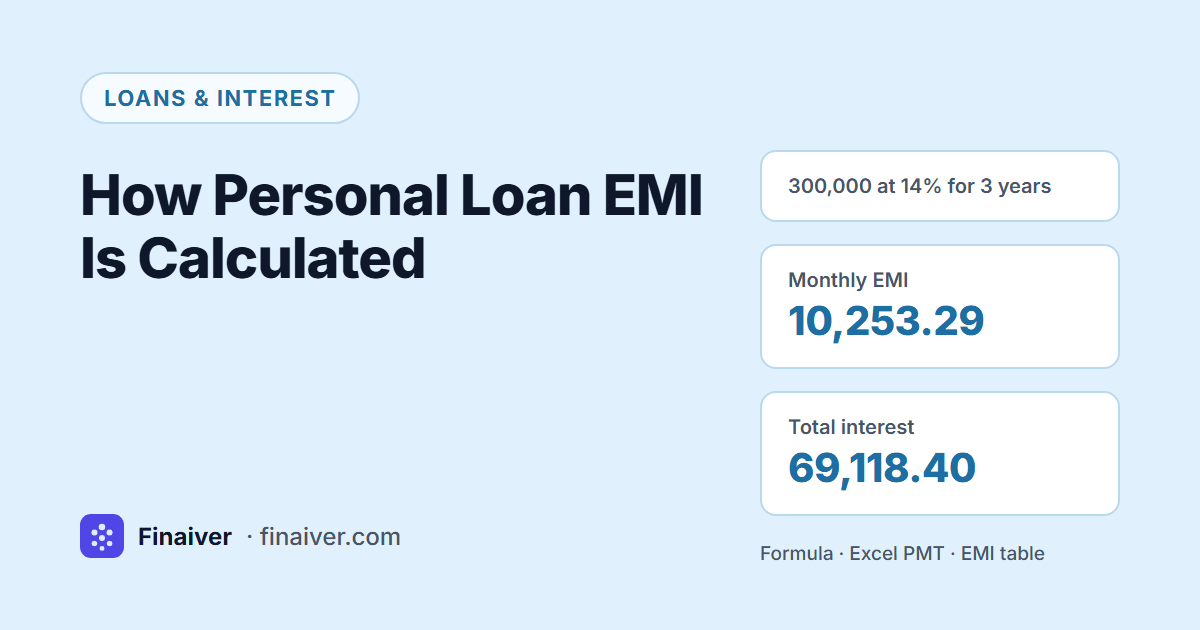
This is the number in the advert. A loan at "12% a year" with monthly payments charges 12 ÷ 12 = 1% a month on the outstanding balance. Your monthly payment is calculated from this rate; how loan EMI is calculated shows the formula.
The effective annual rate
Paying 1% a month is not quite the same as paying 12% a year, because each month's interest is charged on a balance that would otherwise have grown. The effective annual rate converts a periodic rate into its true yearly equivalent:
EAR = (1 + monthly rate)^12 − 1
For 1% a month: 1.01^12 − 1 = 12.68%.
| Nominal rate (monthly payments) | Effective annual rate |
|---|---|
| 6% | 6.17% |
| 12% | 12.68% |
| 18% | 19.56% |
| 24% | 26.82% |
The gap widens as rates rise. On savings this works in your favour; on a loan it works against you.
APR
APR adds fees into the picture. It's the interest rate that would make the money you actually receive equal to the payments you actually make. If a lender deducts a fee before paying you, you receive less but still repay on the full amount, so the true rate is higher.
How APR is defined depends on where you live
There is no single worldwide definition of APR. It's set by local regulation, and the rules differ by country and sometimes by product type. Some regimes express APR as a nominal yearly figure (the monthly rate times 12). Others express it as an effective annual figure that includes compounding. Rules also differ on which fees must be included: processing fees are commonly in, while things like optional insurance or late-payment charges may or may not be.
So two "APRs" from different countries may not be directly comparable. Within one market, lenders are usually required to calculate it the same way, which is what makes it useful. To find out how it works where you are, check the loan's key facts document or your financial regulator's consumer pages, and ask the lender which fees are included.
Worked example: a loan with a processing fee
Here's a typical offer. The figures work in any currency.
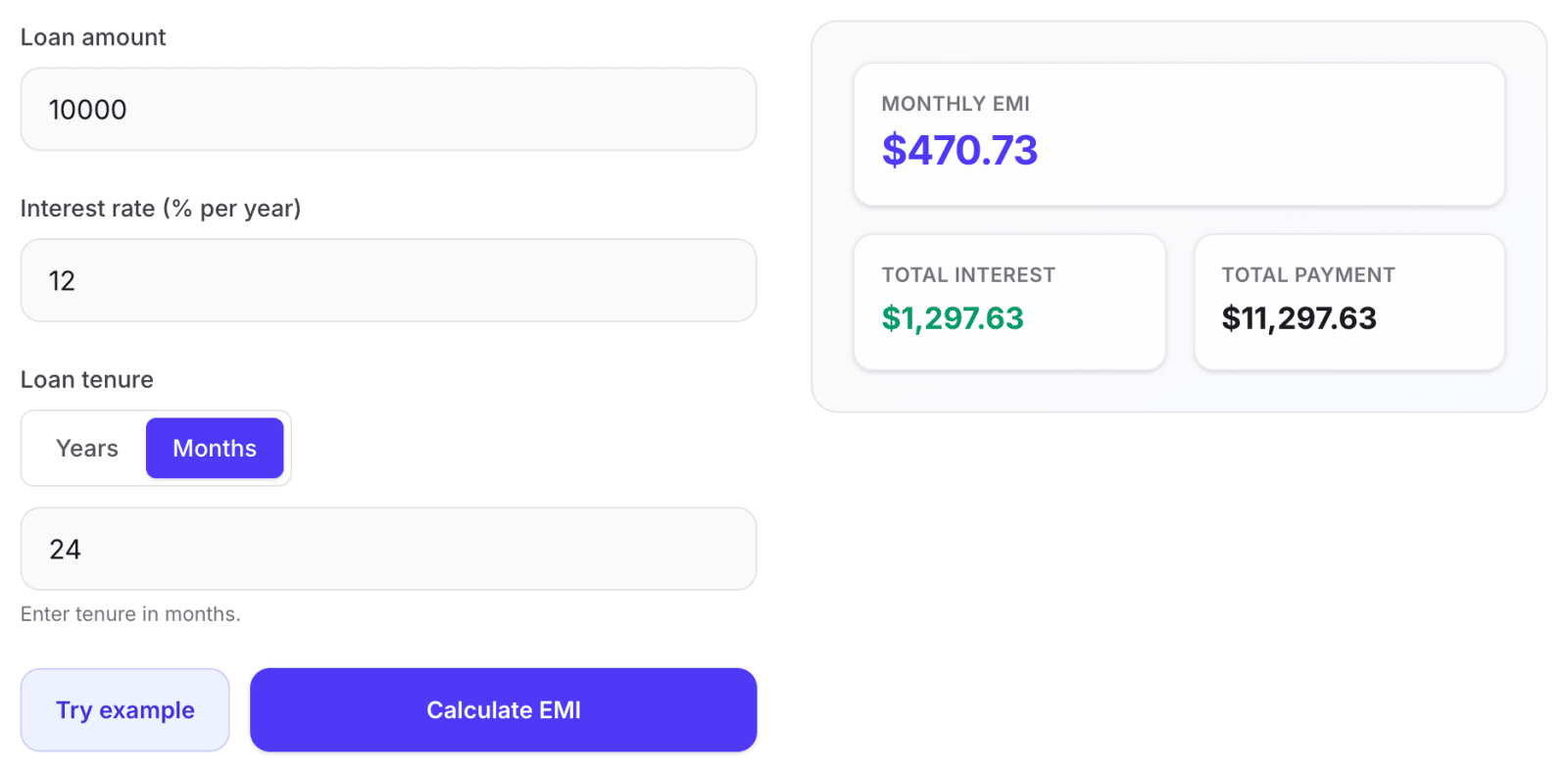
- Loan amount: 10,000
- Interest rate: 12% a year, reducing balance
- Tenure: 24 months
- Processing fee: 2% of the loan, deducted from the amount paid out
Step 1: the monthly payment
The EMI is calculated on the full 10,000 at 12%:
- Monthly payment: 470.73
- Total repaid: 470.73 × 24 = 11,297.63
- Interest: 11,297.63 − 10,000 = 1,297.63
Step 2: add the fee
The fee is 2% × 10,000 = 200. You receive 9,800, but repay as if you received 10,000.
- Total cost of borrowing: 1,297.63 interest + 200 fee = 1,497.63
The fee adds about 15% to the cost of this loan.
Step 3: find the true rate
Now ask: what monthly rate makes 24 payments of 470.73 worth exactly the 9,800 you received at the start? There's no neat formula for this, so it's solved numerically (a spreadsheet's RATE or IRR function does it). The answer is about 1.17% a month.
- As a nominal annual rate: about 14.05%
- As an effective annual rate: about 14.99%
So a loan advertised at 12% really costs around 14% to 15% a year, depending on which convention you use. That's what the APR is meant to reveal.
Why the same fee hurts more on a short loan
A flat fee is paid once, up front. Spread over a short loan, it's a big share of the cost. Spread over a long one, it's diluted. Here is the same 10,000 loan at 12% with the same 2% fee:
| Tenure | Monthly payment | Interest | Interest + fee | True rate (nominal) |
|---|---|---|---|---|
| 12 months | 888.49 | 661.85 | 861.85 | 15.85% |
| 24 months | 470.73 | 1,297.63 | 1,497.63 | 14.05% |
| 36 months | 332.14 | 1,957.15 | 2,157.15 | 13.41% |
| 60 months | 222.44 | 3,346.67 | 3,546.67 | 12.89% |
The longer loan has the lowest true rate but by far the highest total cost. A low APR doesn't mean a cheap loan; it means a cheap rate. You need both numbers. Loan tenure vs total interest goes deeper on that trade-off.
This also matters if you plan to repay early. If you take the 60-month loan and clear it after 12 payments (the balance would be 8,447.10), you've paid the full fee but only a year of interest. Your true rate rises from 12.89% to about 14.32%, before any prepayment charge.
How to compare two loan offers
Say you need 10,000 and you're offered:
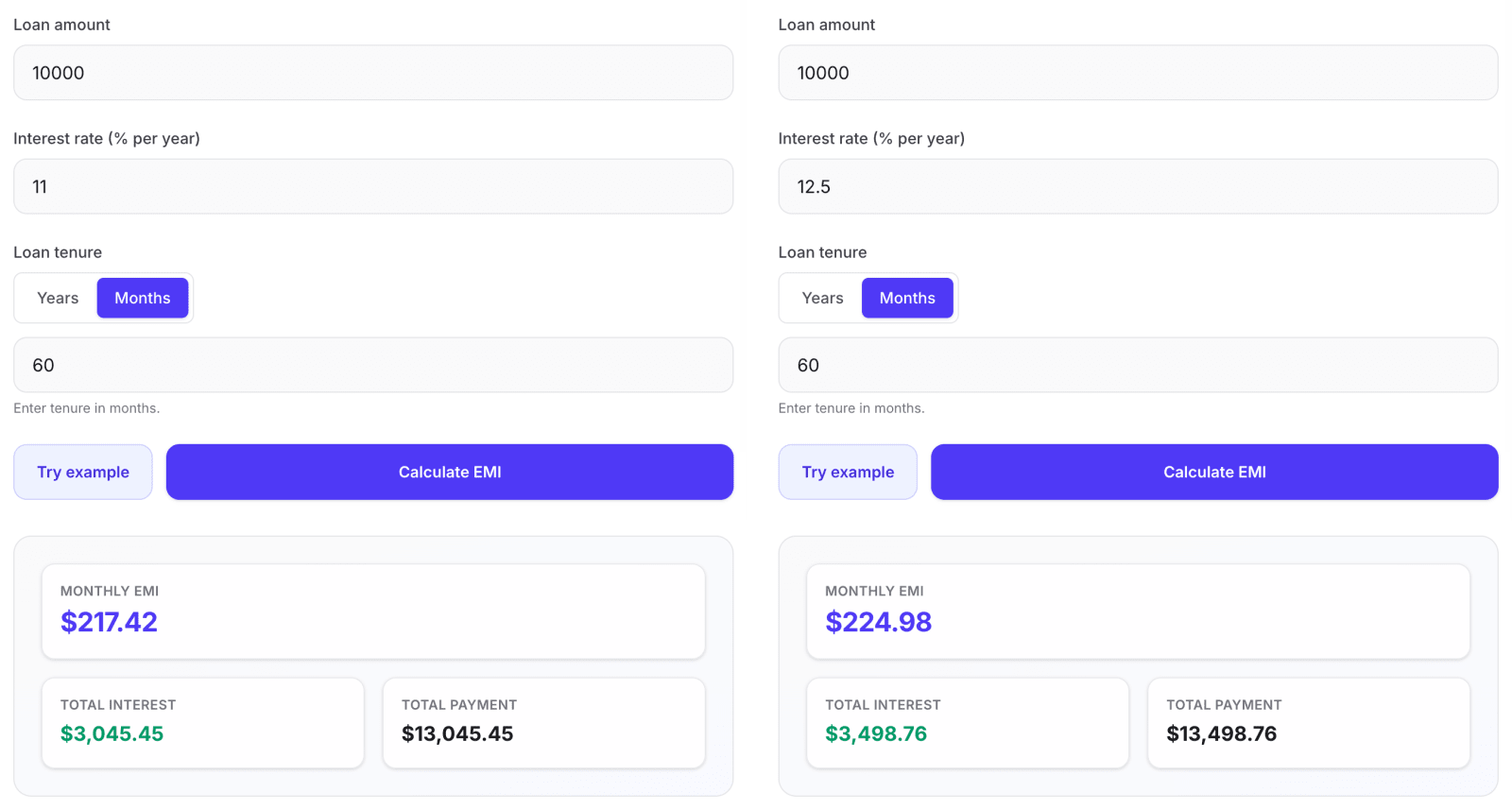
- Offer X: 11% interest, 3% processing fee
- Offer Y: 12.5% interest, no fee
Which is cheaper? It depends on how long you borrow for.
| Offer X, 36 months | Offer Y, 36 months | Offer X, 60 months | Offer Y, 60 months | |
|---|---|---|---|---|
| Monthly payment | 327.39 | 334.54 | 217.42 | 224.98 |
| Interest | 1,785.94 | 2,043.31 | 3,045.45 | 3,498.76 |
| Fee | 300.00 | 0.00 | 300.00 | 0.00 |
| Total cost | 2,085.94 | 2,043.31 | 3,345.45 | 3,498.76 |
| True rate (nominal) | 13.12% | 12.50% | 12.34% | 12.50% |
Over 36 months, the no-fee loan is cheaper by 42.63, even though its rate is 1.5 points higher. Over 60 months, the lower-rate loan wins by 153.31, because there's more time for the rate difference to outweigh the fee.
Offer X has the lower monthly payment in both cases. That's exactly why comparing on monthly payment alone can mislead you.
A simple comparison method
- Fix the same loan amount and tenure for every offer.
- Calculate the monthly payment from each offer's interest rate.
- Multiply by the number of months and subtract the loan amount to get interest.
- Add every required fee: processing, arrangement, mandatory insurance, documentation.
- Compare the totals. If you might repay early, also compare the totals for the period you realistically expect to keep the loan, and include any prepayment charge.
If lenders give you an APR calculated under the same local rules, you can use it as a shortcut for step 5, but still check the total.
Mistakes and limits
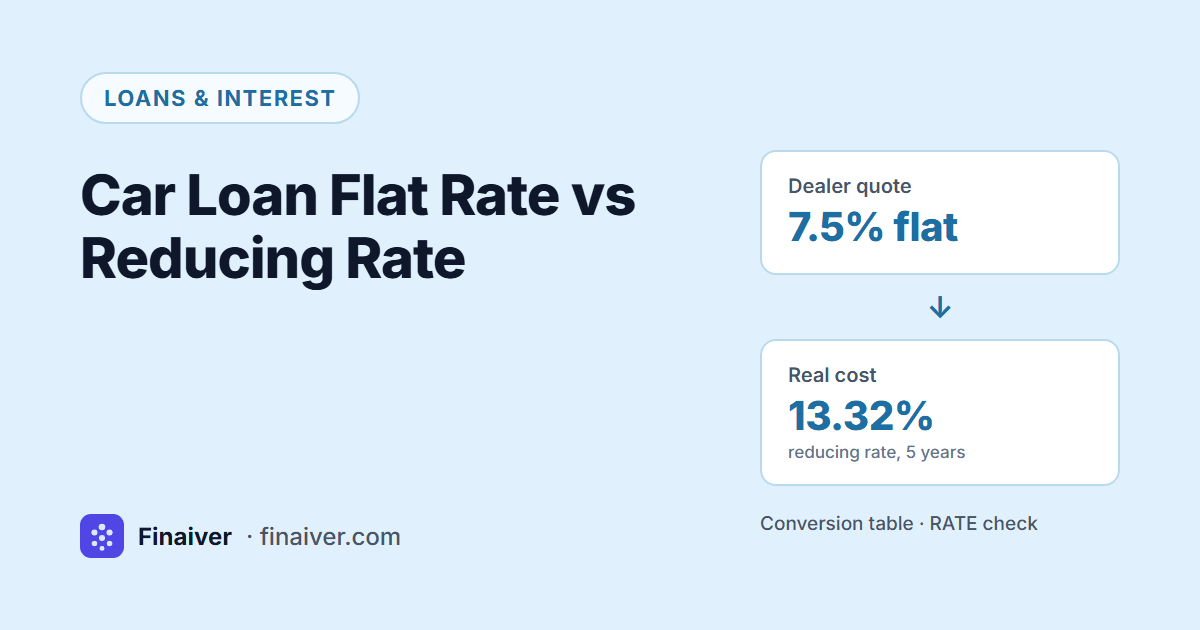
- Comparing a flat rate with a reducing-balance rate. A flat rate of 10% costs far more than a reducing-balance rate of 10%. Convert first; see flat rate vs reducing balance interest.
- Ignoring fees that aren't in the APR. Depending on local rules, some charges, such as optional add-ons or penalty fees, may be left out. Read the fee schedule, not just the summary.
- Treating a variable-rate APR as fixed. If the rate can change, the APR is an estimate based on the starting rate.
- Assuming a lower APR always means less money paid. As the tenure table shows, a longer loan can have a lower APR and a much larger total cost.
- Mixing nominal and effective figures. 14.05% nominal and 14.99% effective describe the same loan. Make sure you're comparing like with like.
Next step: run your offers through the calculator
The Loan EMI Calculator takes a loan amount, an annual interest rate and a tenure (in years or months), and gives you the monthly EMI, total interest and total payment, plus a full amortization schedule. It doesn't have a fee field, so run each offer at its headline rate, then add that offer's fees to the total interest yourself. That's step 4 of the comparison method above, and it takes a minute.
To see how each payment splits between interest and principal once you've picked a loan, read how to read an amortization schedule.
This article is general information, not financial advice.