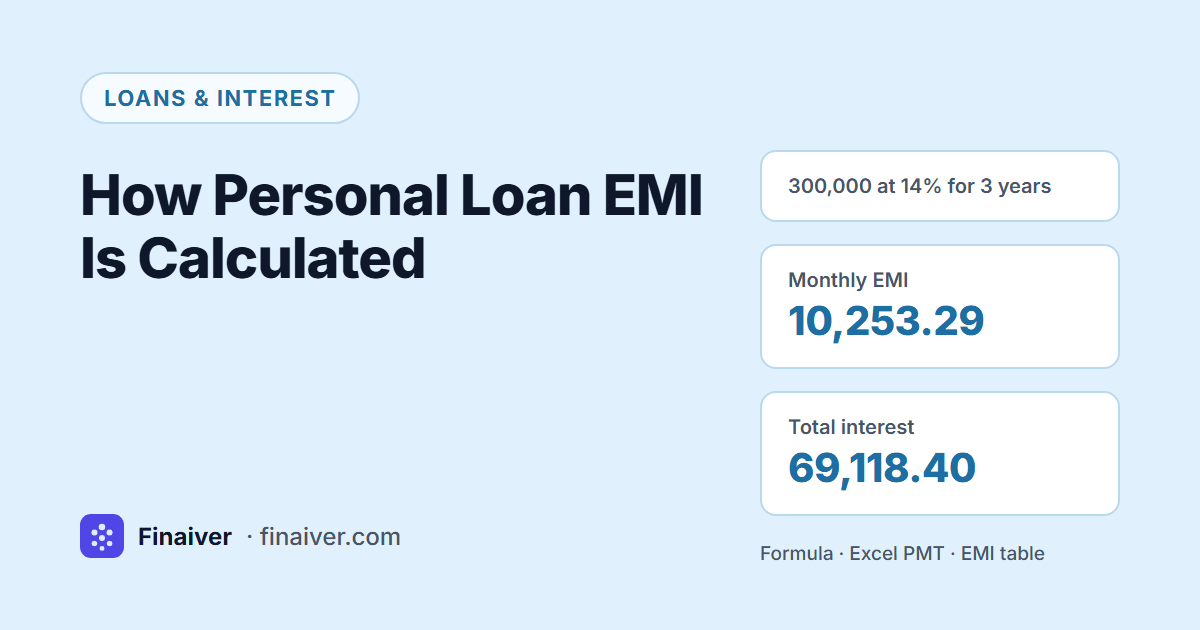
A personal loan EMI is calculated with the reducing-balance formula EMI = P × r × (1 + r)^n / ((1 + r)^n − 1), where P is the amount you borrow, r is the monthly interest rate and n is the number of months. A 300,000 personal loan at 14% a year for 3 years works out to an EMI of 10,253.29, and you repay 69,118.40 in interest over the term.
This guide works that example step by step, shows how to get the same answer on a phone calculator and in Excel, and gives a ready-reckoner table. It also covers the parts of a personal loan that the EMI hides: processing fees, first-month interest, and how lenders decide how large an EMI you can take on.
The maths is the same in any currency, so the examples use plain numbers. If you think in lakhs, 100,000 is 1 lakh.
The personal loan EMI formula
Almost all personal loans from banks and established lenders use the reducing-balance method. Interest is charged each month only on the amount you still owe.
EMI = P × r × (1 + r)^n / ((1 + r)^n − 1)
- P is the loan amount (principal).
- r is the monthly rate as a decimal: annual rate ÷ 12 ÷ 100.
- n is the tenure in months.
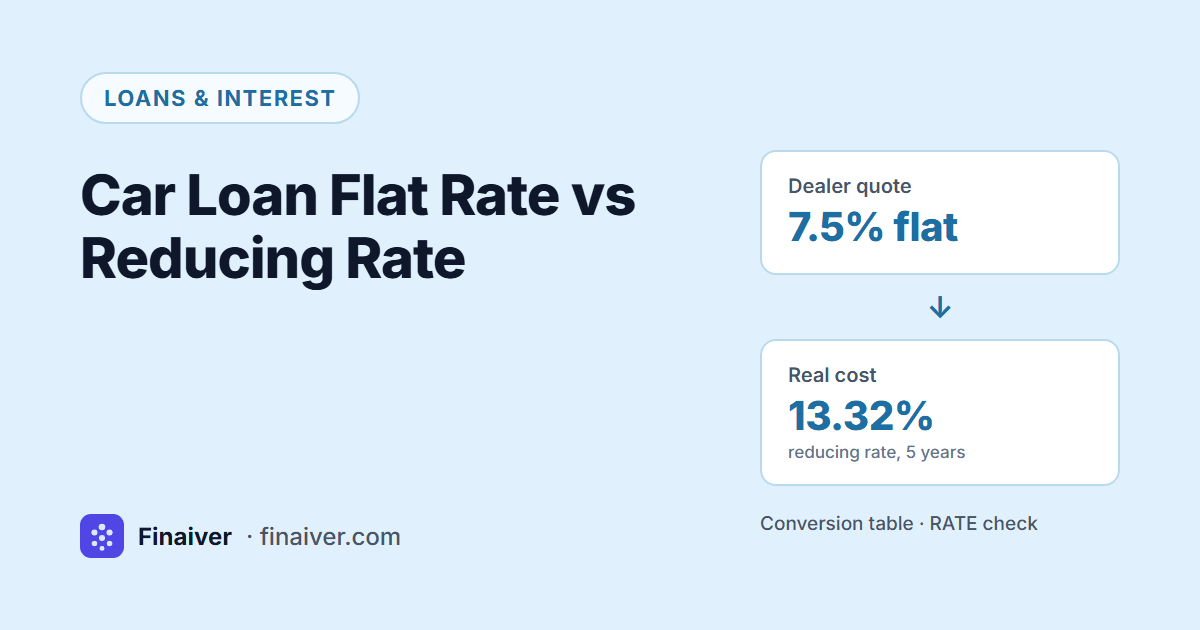
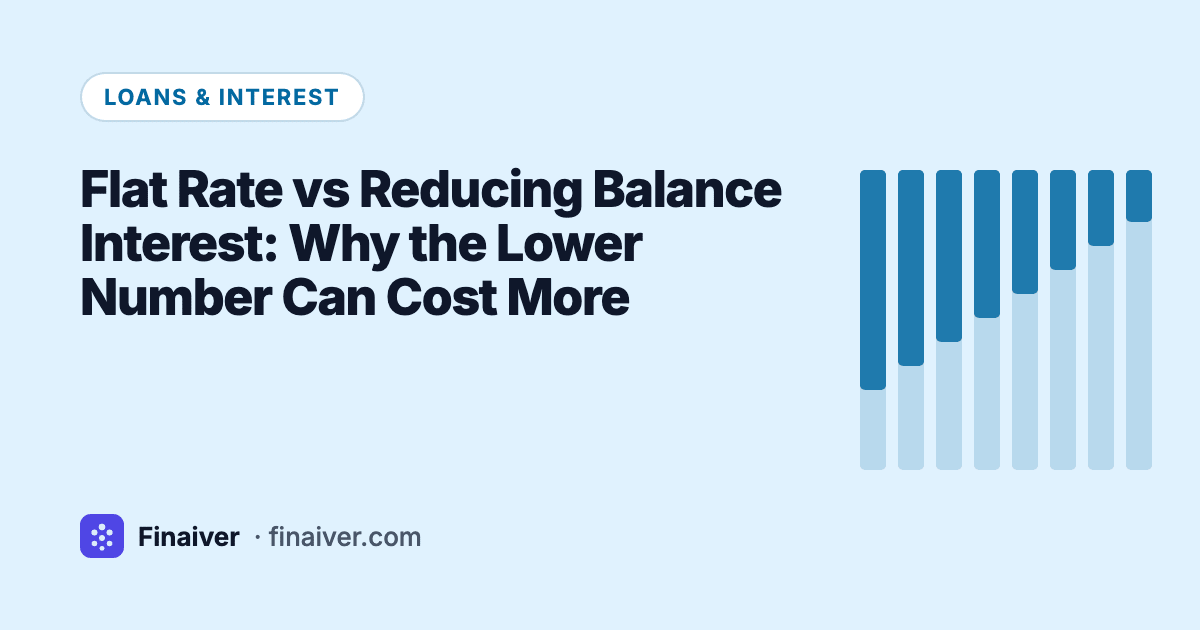
If a lender quotes a "flat" rate instead, the formula above doesn't apply and the loan is more expensive than the number suggests. See flat rate vs reducing balance interest before you compare offers.
For a deeper look at why the formula works and how a long home loan behaves, read how loan EMI is calculated. This guide stays focused on personal loans.
Worked example: 300,000 at 14% for 3 years
Inputs
- P = 300,000
- r = 14 ÷ 12 ÷ 100 = 0.0116667
- n = 3 × 12 = 36
Step 1: (1 + r)^n. (1.0116667)^36 = 1.518266
Step 2: top of the fraction. 300,000 × 0.0116667 × 1.518266 = 5,313.93
Step 3: bottom of the fraction. 1.518266 − 1 = 0.518266
Step 4: divide. 5,313.93 ÷ 0.518266 = 10,253.29 per month
Total repaid: 10,253.29 × 36 = 369,118.40. Total interest: 69,118.40.
Where each EMI goes
| Month | EMI | Interest | Principal | Balance after |
|---|---|---|---|---|
| 1 | 10,253.29 | 3,500.00 | 6,753.29 | 293,246.71 |
| 2 | 10,253.29 | 3,421.21 | 6,832.08 | 286,414.63 |
| 3 | 10,253.29 | 3,341.50 | 6,911.78 | 279,502.85 |
| 12 | 10,253.29 | 2,580.96 | 7,672.33 | 213,552.87 |
| 24 | 10,253.29 | 1,435.16 | 8,818.13 | 114,195.55 |
| 36 | 10,253.29 | 118.24 | 10,135.05 | 0.00 |
Month 1 interest is 300,000 × 0.0116667 = 3,500. The rest of the EMI reduces the balance. In the first year you pay 36,592.34 in interest, more than half of the loan's total interest, which is why prepaying early saves the most.
How to calculate EMI on a phone calculator
You don't need a scientific calculator. Most phone calculators can do it if you go in this order:
- Monthly rate: 14 ÷ 1200 = 0.0116667. Add 1 to get 1.0116667.
- Raise to the power of n: use the xʸ key with y = 36. You get 1.518266. Write it down.
- Multiply: 300,000 × 0.0116667 × 1.518266 = 5,313.93.
- Divide by (1.518266 − 1) = 0.518266. The answer is 10,253.29.
If your calculator has no power key, turn the phone sideways; on most phones that reveals the scientific layout.
How to calculate EMI in Excel or Google Sheets
Spreadsheets have the formula built in. Type this into any cell:
=PMT(14%/12, 36, -300000)
It returns 10,253.29. The three parts are the monthly rate, the number of months, and the loan amount (entered as negative so the EMI shows as a positive number).
Two related functions split any month's EMI:
- =IPMT(14%/12, 1, 36, -300000) gives the interest in month 1: 3,500.00.
- =PPMT(14%/12, 1, 36, -300000) gives the principal in month 1: 6,753.29.
Change the second number to see any other month. Copy them down 36 rows and you have your own amortization schedule.
Personal loan EMI table per 100,000
Use this to estimate quickly. For any loan amount, divide by 100,000 and multiply by the figure in the table. A 250,000 loan at 16% for 3 years is 2.5 × 3,515.70 = 8,789.25.
| Annual rate | 1 year | 2 years | 3 years | 4 years | 5 years |
|---|---|---|---|---|---|
| 10% | 8,791.59 | 4,614.49 | 3,226.72 | 2,536.26 | 2,124.70 |
| 12% | 8,884.88 | 4,707.35 | 3,321.43 | 2,633.38 | 2,224.44 |
| 14% | 8,978.71 | 4,801.29 | 3,417.76 | 2,732.65 | 2,326.83 |
| 16% | 9,073.09 | 4,896.31 | 3,515.70 | 2,834.03 | 2,431.81 |
| 18% | 9,168.00 | 4,992.41 | 3,615.24 | 2,937.50 | 2,539.34 |
| 20% | 9,263.45 | 5,089.58 | 3,716.36 | 3,043.04 | 2,649.39 |
| 24% | 9,455.96 | 5,287.11 | 3,923.29 | 3,260.18 | 2,876.80 |
Look across the rows: going from 10% to 20% on a 3-year loan raises the EMI by about 15%, but more than doubles the interest, from 16,161.87 to 33,788.90 per 100,000. Personal loan rates vary widely with your credit profile and lender, so the rate you're offered matters more than almost anything else on this page.
Tenure: lower EMI, higher cost
Same 300,000 at 14%, different tenures:
| Tenure | EMI | Total interest |
|---|---|---|
| 2 years | 14,403.86 | 45,692.76 |
| 3 years | 10,253.29 | 69,118.40 |
| 4 years | 8,197.94 | 93,501.26 |
| 5 years | 6,980.48 | 118,828.52 |
Stretching from 3 to 5 years cuts the EMI by about 3,270 a month but adds 49,710.12 in interest. Pick the shortest tenure whose EMI you can pay comfortably every month, with room left for savings. Loan tenure vs total interest goes through this choice in detail.
What your EMI doesn't show
Processing fees raise your real rate
Many personal loans charge a processing fee, often deducted from the amount paid out. You then pay interest on 300,000 but only receive, say, 294,000. The EMI stays 10,253.29, so your real cost is higher than 14%.
| Processing fee | Amount you receive | Effective annual rate |
|---|---|---|
| None | 300,000 | 14.00% |
| 1% | 297,000 | 14.71% |
| 2% | 294,000 | 15.43% |
| 3% | 291,000 | 16.16% |
A 2% fee on a 3-year loan adds about 1.4 percentage points to the rate. On a shorter loan, the same fee adds even more, because it's spread over fewer months. Taxes on fees, insurance sold with the loan, and other charges push it further. Ask for every fee in writing, and compare offers on their APR or total cost, not only the interest rate. Our guide to APR vs interest rate explains how.
You can check the effective rate yourself in a spreadsheet: =RATE(36, -10253.29, 294000)*12 returns 15.43%.
Broken-period interest on the first EMI
Your loan is paid out on one date, but EMIs usually fall on a fixed date each month. The gap is often more or less than a month. Lenders handle the extra days differently: some collect "broken-period" or "pre-EMI" interest up front, some add it to the first EMI, some deduct it from the payout.
On 300,000 at 14%, 20 extra days of interest is about 2,301.37 if the lender counts a 365-day year, or 2,333.33 on a 360-day basis. That's why your first EMI or your payout can differ from what a calculator shows. Your loan agreement or repayment schedule states the exact method.
How lenders decide how big an EMI you can get
Before approving a loan, most lenders check how much of your monthly income already goes to debt. They often cap your total EMIs (existing plus new) at a set share of take-home income. The share differs by lender, product and income level, so treat any figure as illustrative.
Example. Take-home income 80,000 a month, an existing car loan EMI of 10,000, and a lender cap of 50%.
- Maximum total EMIs: 80,000 × 50% = 40,000
- Room for a new EMI: 40,000 − 10,000 = 30,000
- At 14% for 3 years, an EMI of 30,000 supports a loan of about 877,767
- At 14% for 5 years, it supports about 1,289,310
That's the most a lender might approve, not what you should borrow. A cap of 50% leaves little room if your income drops. Many people keep their total EMIs well below what a lender would allow.
Can your personal loan EMI change?
On a fixed-rate personal loan, which is the most common kind, the EMI stays the same for the whole term unless you prepay or restructure. On a floating-rate loan, the lender can change the rate, and either the EMI or the tenure changes with it.
It also changes if you prepay part of the loan. Most lenders let you choose between a lower EMI and a shorter tenure; reducing EMI or tenure after a prepayment shows which saves more.
Check the foreclosure terms before you prepay. Some personal loans charge a fee for early repayment, often a percentage of the outstanding balance, and some don't allow it during an initial lock-in period. On our example, the balance after 12 EMIs is 213,552.87, and 32,526.07 of interest is still to come. A hypothetical 3% foreclosure charge would be 6,406.59, so closing the loan then would still save about 26,000. Rules on these charges vary by country and lender, so read your agreement.
Common mistakes
Using the annual rate in the formula. r must be monthly. 14% becomes 0.0116667, not 0.14.
Entering years instead of months. A 3-year loan is n = 36.
Comparing EMIs across different tenures. A lower EMI over a longer term usually costs more. Compare at the same tenure, or compare total repayment.
Ignoring the payout amount. If fees are deducted, work out your effective rate on what you actually receive.
Assuming a quoted rate is reducing-balance. Ask. A flat rate of 10% costs about the same as 17% reducing over 5 years.
Frequently asked questions
Is personal loan interest calculated on a reducing balance?
Usually, yes. Most banks and regulated lenders calculate personal loan interest monthly on the outstanding balance. Some lenders, especially at points of sale, quote flat rates instead. Your loan agreement states which.
How do I calculate personal loan EMI manually?
Divide the annual rate by 1,200 to get r, raise (1 + r) to the power of the number of months, then apply EMI = P × r × (1 + r)^n / ((1 + r)^n − 1). The worked example above shows each step.
What is the EMI on a 100,000 personal loan?
At 14% it's 8,978.71 over 1 year, 3,417.76 over 3 years and 2,326.83 over 5 years. The table above covers rates from 10% to 24%.
Why is my first EMI different from the calculator?
Usually because of broken-period interest: the days between the payout and your first EMI date are charged separately, either in the first EMI or up front.
Next step
Open the Finaiver Loan EMI Calculator and enter your loan amount, interest rate and tenure (in years or months). It shows your EMI, total interest and total payment, a principal-versus-interest chart, the balance over time, and a month-by-month amortization schedule. The calculator shows a dollar sign, but the arithmetic is the same in any currency. Try 300,000 at 14% for 3 years first to see the numbers above.
Then read how to read an amortization schedule, or flat rate vs reducing balance interest if a lender has quoted you a flat rate.
This article is general information, not financial advice.