
Your real return is what your money earns after inflation, measured in what it can actually buy. If your savings grow by 7% in a year while prices rise by 3%, your real return is about 3.9%, not the full 7%. Over long periods that gap makes a big difference, and money that earns nothing loses a large share of its buying power.
This guide covers the exact formula, the quick shortcut most people use, how far apart they can be, and what inflation does to cash over 10 and 20 years.
The examples use plain numbers with no currency symbol. The maths works in any currency.
Nominal return vs real return
The nominal return is the number you see on a statement: the interest rate on a savings account, or the percentage a fund went up. It measures growth in money.
The real return measures growth in purchasing power. It answers the question you actually care about: can I buy more with this money than I could before, and how much more?
If prices rise faster than your balance grows, your nominal return is positive but your real return is negative. You have more money and can buy less with it.
The exact formula
The precise relationship between the two is:
Real return = (1 + nominal return) ÷ (1 + inflation) − 1
Use decimals, so 7% is 0.07 and 3% is 0.03.
The shortcut, and where it breaks
Most people use a simpler approximation:
Real return ≈ nominal return − inflation
It's quick, and at low rates it's close enough. But it always overstates a positive real return slightly, and the error grows as rates rise.
| Nominal return | Inflation | Shortcut (n − i) | Exact real return |
|---|---|---|---|
| 4% | 3% | 1.00% | 0.97% |
| 5% | 2% | 3.00% | 2.94% |
| 7% | 3% | 4.00% | 3.88% |
| 12% | 9% | 3.00% | 2.75% |
| 25% | 20% | 5.00% | 4.17% |
At 7% and 3%, the shortcut is out by about 0.12 percentage points, which is fine for a rough check. At 25% and 20%, which can happen in countries going through high inflation, the shortcut is off by almost a full percentage point. Use the exact formula whenever rates are high or you're projecting over many years.
Worked example: 10,000 at 7% with 3% inflation
One year
- Nominal growth: 10,000 × 1.07 = 10,700.
- Adjust for inflation: 10,700 ÷ 1.03 = 10,388.35.
- Real gain: 10,388.35 − 10,000 = 388.35, or 3.88%.
So you end the year with 10,700 in your account, but it buys what 10,388 would have bought at the start. The exact formula gives the same answer in one step: 1.07 ÷ 1.03 − 1 = 0.0388.
Twenty years
Now leave it for 20 years, compounding once a year.
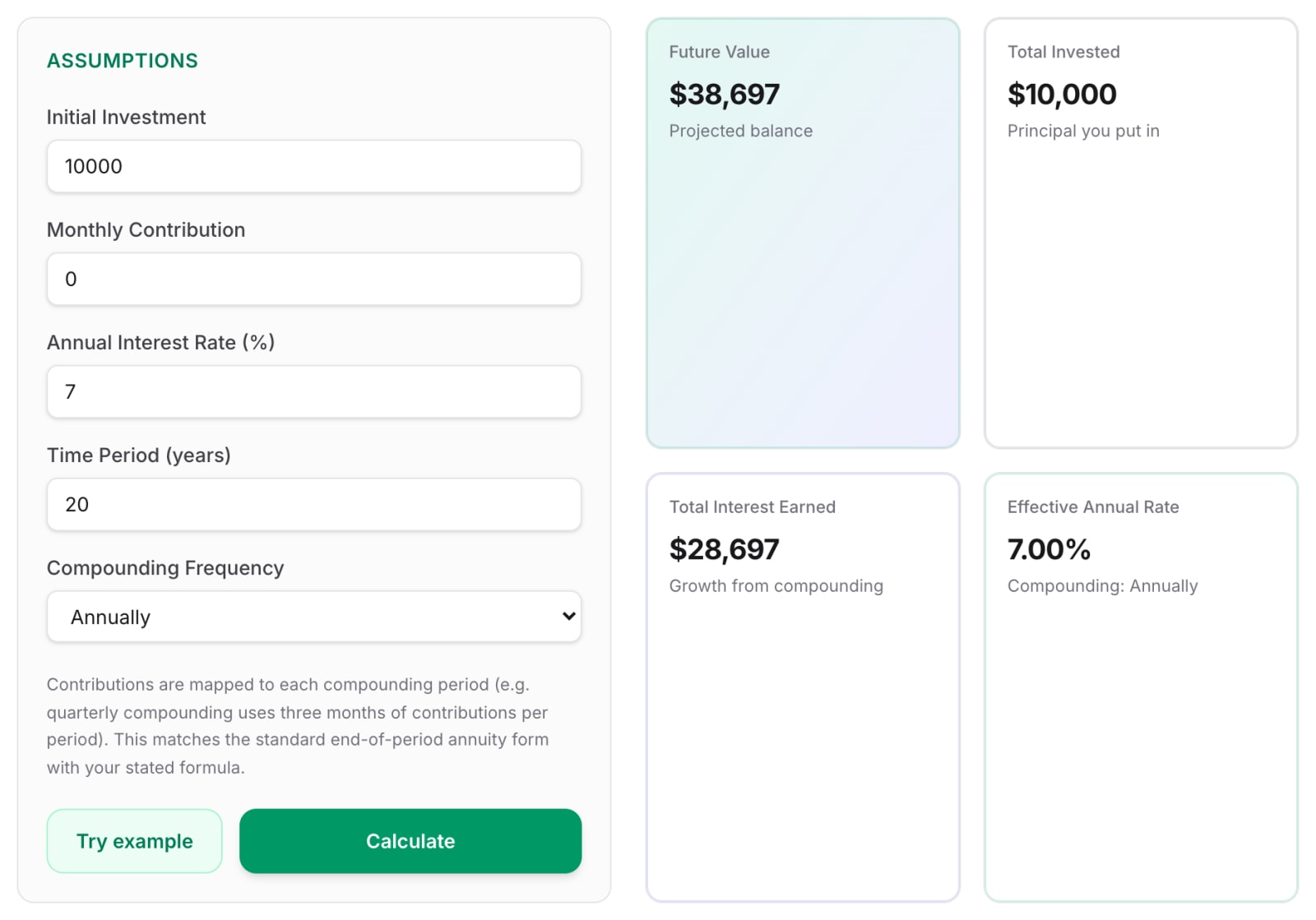
- Nominal value: 10,000 × 1.07^20 = 38,697.
- Real value using the exact rate: 10,000 × (1.07 ÷ 1.03)^20 = 21,426.
- Real value using the 4% shortcut: 10,000 × 1.04^20 = 21,911.
The statement will say 38,697. In today's money it's worth about 21,426. The shortcut overestimates by nearly 500, because a small error in the rate compounds along with everything else.
That doesn't mean the growth was disappointing. Your buying power more than doubled. It just didn't nearly quadruple, which is what the nominal figure suggests.
What inflation does to cash savings
Cash that earns no interest loses buying power every year that prices rise. The table shows what 10,000 left in cash would be worth in today's money, at different steady inflation rates.
| Inflation rate | Real value after 10 years | Real value after 20 years |
|---|---|---|
| 2% | 8,203 | 6,730 |
| 3% | 7,441 | 5,537 |
| 5% | 6,139 | 3,769 |
| 8% | 4,632 | 2,145 |
At 3% inflation, cash loses about a quarter of its buying power in ten years and close to half in twenty. Seen from the other side, something that costs 10,000 now would cost about 18,061 after 20 years of 3% inflation.
A quick way to estimate this is the rule of 72: divide 72 by the inflation rate to get roughly how many years it takes prices to double. At 3% that's about 24 years. The exact figure is 23.4. The rule of 72 guide explains why the trick works.
What if the cash earns interest?
Most savings earn something. Here is the real value of 10,000 after 3% annual inflation, depending on the interest rate the account pays.
| Savings rate | Balance after 20 years | Real value after 10 years | Real value after 20 years |
|---|---|---|---|
| 1% | 12,202 | 8,219 | 6,756 |
| 2% | 14,859 | 9,070 | 8,227 |
| 3% | 18,061 | 10,000 | 10,000 |
| 4% | 21,911 | 11,014 | 12,132 |
When the savings rate equals inflation, you simply stand still. Your balance grows, but it buys exactly the same amount. Only rates above inflation increase your real wealth.
Using the calculator to see results in today's money
The Finaiver Compound Interest Calculator works in nominal terms. It takes the annual rate you enter and shows the future balance in money of that future date. It doesn't have a separate inflation input.
To see results in today's money, enter the real rate instead of the nominal rate. For 7% nominal and 3% inflation, enter 3.88. With Initial Investment 10,000, 20 years and annual compounding, the Future Value comes out at about 21,411, close to the 21,426 above. The small gap is because the rate is rounded to two decimal places.
There's one catch if you also enter a monthly contribution. Using a real rate means you're assuming your contributions rise with inflation each year, so they keep the same buying power. If your contributions stay at a fixed amount, their real value shrinks over time.
For 10,000 up front plus 300 a month for 20 years, with annual compounding (the calculator then adds each year's 3,600 of contributions at year end):
| Method | Result |
|---|---|
| Nominal 7%, as shown on a statement | 186,281 |
| Real 3.88%, contributions rising with inflation | 127,287 |
| Nominal 7% result converted to today's money, contributions fixed at 300 | 103,139 |
The last figure is the nominal result divided by 1.03^20. It's lower because a fixed 300 buys less every year. If you plan to raise your contributions with your pay, the middle row is the fairer picture.

Mistakes to avoid
Comparing a savings rate with zero instead of with inflation. A 2% account isn't earning 2% in any meaningful sense if prices are rising 3%. It's losing about 1% a year in real terms.
Using one year's inflation for a 20-year plan. Inflation moves around. A single high or low year tells you little about the long run. Many central banks publish an inflation target, which is a reasonable planning assumption, but actual inflation can stay well above or below target for years. Your national statistics office publishes the official figures; check there for history in your country.
Forgetting that your own inflation may differ. Official inflation is an average across a basket of goods. If most of your spending goes on rent, food or fuel, and those rise faster than the average, your personal inflation rate is higher.
Ignoring tax. Tax on interest or gains comes out of the nominal return, not the real one. Suppose an account pays 4% and the interest is taxed at 20% (tax rules vary by country and by account type, so check yours). You keep 3.2%. With 3% inflation, the real after-tax return is (1.032 ÷ 1.03) − 1, about 0.19%. Nearly all of the headline 4% is gone.
Holding too little cash because of inflation. Inflation is a reason not to keep long-term money in cash, but it isn't a reason to have no cash. An emergency fund needs to be available right away and stable in value, and that's worth a small real loss. See how big an emergency fund should be.
Practical takeaways
- Always ask what a return is after inflation. Use the exact formula, (1 + n) ÷ (1 + i) − 1, for anything long-term.
- Keep short-term and emergency money in cash, and accept that it may only roughly keep pace with prices.
- Long-term money needs a return above inflation to grow in real terms. That usually means accepting more risk, and you'll need to decide how much risk suits you.
- When you project savings, use a real rate so the answer is in money you understand. Raising contributions in line with your pay keeps their value from shrinking.
- Fees and taxes come out of your return before inflation does. Small differences in each add up.
Next step
Open the Finaiver Compound Interest Calculator and run your plan twice: once at your expected nominal return, then again at the real rate you get from the formula above. The difference between the two Future Value figures is what inflation is likely to take.
For more context, read monthly investing vs lump sum and does compounding frequency matter?
This article is general information, not financial advice.