Buy now, pay later (BNPL) splits a purchase into several smaller payments, so you get the item now and pay for it over weeks or months. Short plans are often interest-free if you pay on time, because the merchant pays the provider a fee. Longer plans can charge interest or a fixed fee, and missed payments can bring late fees and, depending on the provider, a mark on your credit file.
So the honest answer to "is BNPL free?" is: sometimes. It depends entirely on which kind of plan you're using and whether you pay every instalment on time.
How a typical BNPL plan works
At checkout you pick the BNPL option instead of paying by card. The provider runs a quick check, which may be a soft look at your credit file, its own internal data, or both, and decides whether to approve you and for how much.
If approved, the provider pays the merchant in full, minus its fee. You now owe the provider, not the shop. Your instalments are usually collected automatically from a debit card, credit card or bank account you link.
There are two broad shapes of plan:
- Pay-in-instalments, short term. Commonly four payments: one at checkout, then the rest every two weeks. Typically no interest.
- Longer monthly plans. Six, twelve or more monthly payments. These often carry interest (shown as an APR) or a fixed fee, and they work much like a small personal loan.
Exact terms vary by provider, country and even by merchant, so always read the plan shown at checkout rather than assuming.
Who pays for "interest-free"?
Lending money costs something, so someone always pays. With BNPL there are three possible payers.
| Who pays | How | When it applies |
|---|---|---|
| The merchant | A fee on each sale, usually a percentage of the purchase | Most short interest-free plans |
| You, if you slip | Late fees, sometimes capped per instalment or per order | When an instalment fails or is paid late |
| You, by design | Interest (APR) or a fixed plan fee | Many longer monthly plans |
Merchants accept the fee because offering BNPL can help them sell more, particularly on higher-priced items. That's also worth keeping in mind as a shopper: the option is there partly because it encourages people to spend.
Worked example: a $600 purchase five ways
Say you're buying a $600 laptop. Here's what each option could cost. The rates and fees are illustrative, picked to show how the maths works, not quoted from any provider.
Option A: credit card, paid in full
You pay $600 on the card and clear the statement by the due date. On many cards that means no interest, though this depends on your card's terms. Total: $600.
Option B: pay in 4, all on time
Four payments of $600 ÷ 4 = $150. Pay each on time and the total is $600, the same as Option A.
Option C: pay in 4, one payment late
Same plan, but one instalment fails and an illustrative $10 late fee is added. Total: $610. That $10 is about 1.7% of the purchase, for being late on one $150 payment.
Option D: six-month plan with a $30 fee
The fee is added and split evenly: ($600 + $30) ÷ 6 = $105 a month. Total: $630.
A flat $30 fee sounds small, but because you're paying the balance down each month, you only borrow the full $600 for the first month. Working out the equivalent rate on that repayment pattern gives an annual percentage rate of about 16.9%. A modest-looking fee can be as expensive as a credit card.
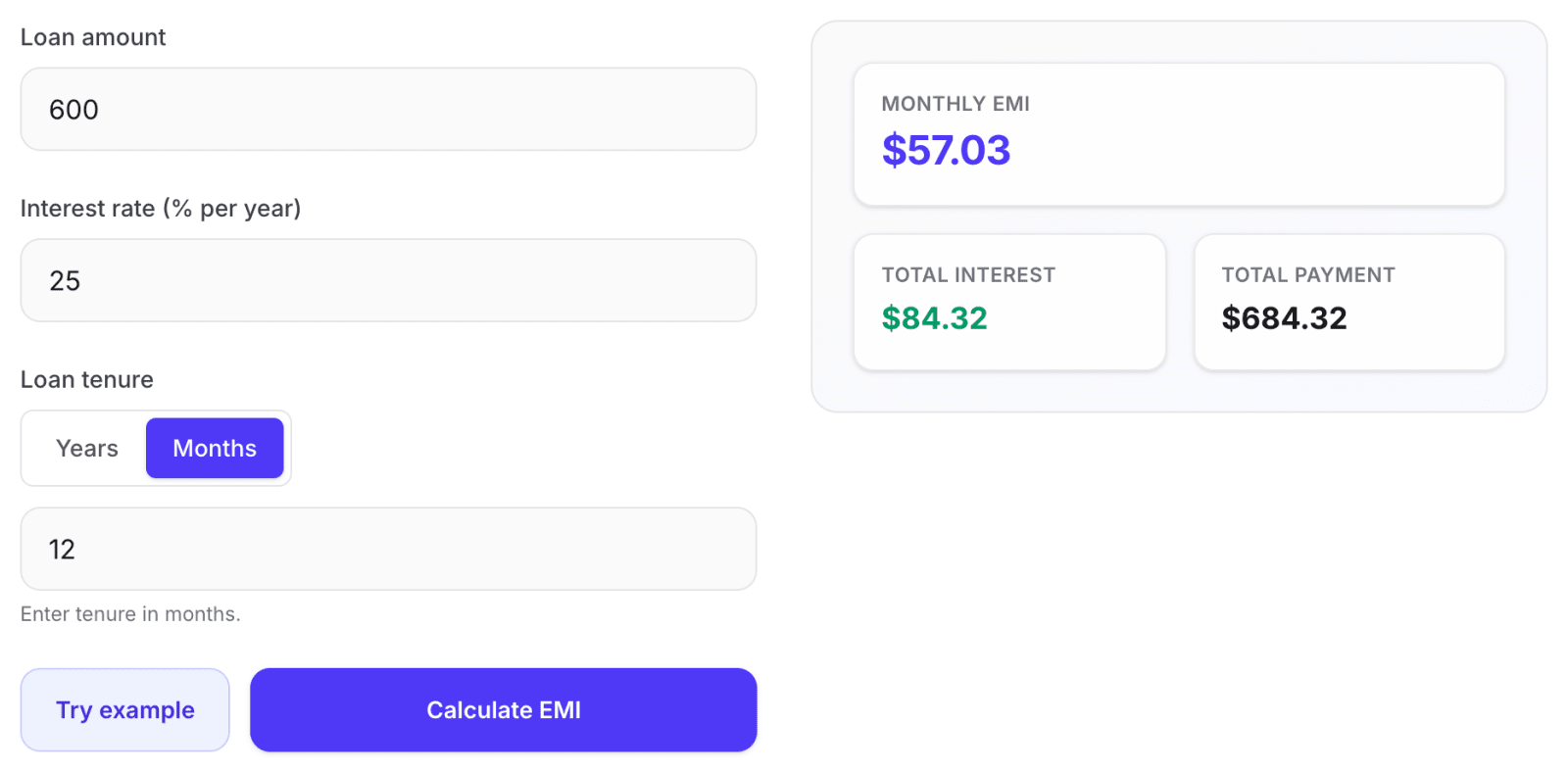
Option E: twelve-month plan at 25% APR
With an illustrative 25% APR over 12 months, the monthly payment is about $57.03. Over 12 months that's about $684.32, so $84.32 in interest.
Compare that with carrying the same $600 on a credit card at an illustrative 22% APR and paying it off in 12 equal monthly payments: about $56.16 a month, $673.88 total, $73.88 interest. In this example the BNPL plan costs more than the card.
| Option | Monthly or per-instalment | Total paid | Extra cost |
|---|---|---|---|
| A. Card, paid in full | $600 once | $600.00 | $0 |
| B. Pay in 4, on time | $150 × 4 | $600.00 | $0 |
| C. Pay in 4, one late fee | $150 × 4 + $10 | $610.00 | $10.00 |
| D. 6 months, $30 fee | $105 × 6 | $630.00 | $30.00 |
| E. 12 months, 25% APR | $57.03 × 12 | $684.32 | $84.32 |
| Card at 22% APR over 12 months | $56.16 × 12 | $673.88 | $73.88 |
The lesson: short, interest-free plans paid on time are genuinely free to you. Once a plan has interest or a fee, compare its APR with your other options the same way you would for any loan. Our guide on APR vs interest rate explains why the APR is the number to compare.
The stacking problem
One BNPL plan is easy to track. Several at once are not, because each has its own schedule.
Suppose you have three pay-in-4 plans running: $600, $240 and $160. The instalments are $150, $60 and $40, which is $250 every two weeks if they line up, and an awkward scatter of smaller debits if they don't. None of the purchases felt large on its own, but together they're a meaningful chunk of a monthly budget, and none of it shows up as a single balance the way a credit card does.
If you use BNPL regularly, write each plan into your monthly budget as a fixed bill until it's paid off.
How BNPL can affect your credit file
This is where practice differs most between providers and countries, so treat what follows as general.
- Applying. Many short plans use a soft check that doesn't affect your score. Longer, interest-bearing plans are more likely to involve a hard check, like other credit applications.
- Reporting. Some providers report BNPL plans and repayment history to credit bureaus; some don't; some report only missed payments. Practices have been changing, so check your provider's terms.
- Missed payments. Even when on-time payments aren't reported, serious arrears may be, and a debt passed to a collection agency can show up on your file.
- Lender views. Separately from your score, a lender looking at your bank statements may see regular BNPL repayments and count them as commitments when judging affordability.
The safest assumption is that missing payments can hurt your credit, and that paying on time may or may not help it.
When BNPL makes sense, and when it doesn't
It can be reasonable when:
- the plan is genuinely interest-free and fee-free if paid on time;
- you could afford to pay the full price right away, and you're spreading it only for cash-flow convenience;
- the payment card behind it is one that won't bounce.
It's a poor fit when:
- you're using it because you can't afford the item otherwise;
- the plan carries an APR higher than cheaper credit you already have;
- you already have several plans running;
- the purchase is for something consumed immediately, like groceries or takeaways, so you're still paying for it after it's gone.
Common mistakes
- Assuming every BNPL plan is interest-free. Longer plans often aren't.
- Linking a card or account that's often near empty. Failed collections are how late fees start.
- Linking a credit card. If you then don't clear the card, you can end up paying card interest on top of a BNPL plan.
- Forgetting about returns. If you return the item, check that the plan is cancelled or adjusted. Keep paying until the provider confirms it, or you may be charged a late fee on something you no longer have.
- Treating the approval as proof of affordability. The check at checkout is quick. It doesn't know your full budget.
Checklist before you click "pay later"
- Is this plan interest-free and fee-free if I pay on time? If not, what's the APR or total fee?
- What's the total I'll pay, not just the instalment?
- When is each payment taken, and from which account or card?
- What is the late fee, and is there a cap?
- Does this provider report to credit bureaus, and how does it run its credit check?
- How many other plans do I have running, and what do they add up to per month?
- Could I pay the full price right now if I had to?
- What happens if I return the item?
If you can't answer the first two, don't proceed until you can.
Next step
For any plan that charges interest, put the amount, the APR and the number of months into the Loan EMI Calculator to see the real monthly payment and total interest, then compare it with a card or a small loan. For the background, read how loan EMI is calculated and flat rate vs reducing balance interest, which explains why a "flat" fee can hide a higher rate.
This article is general information, not financial advice.