An amortization schedule is a table that shows, payment by payment, how much of each instalment goes to interest, how much reduces the loan, and what you still owe afterwards. Reading one takes about five minutes once you know what the columns mean. It tells you far more about a loan than the monthly payment alone.
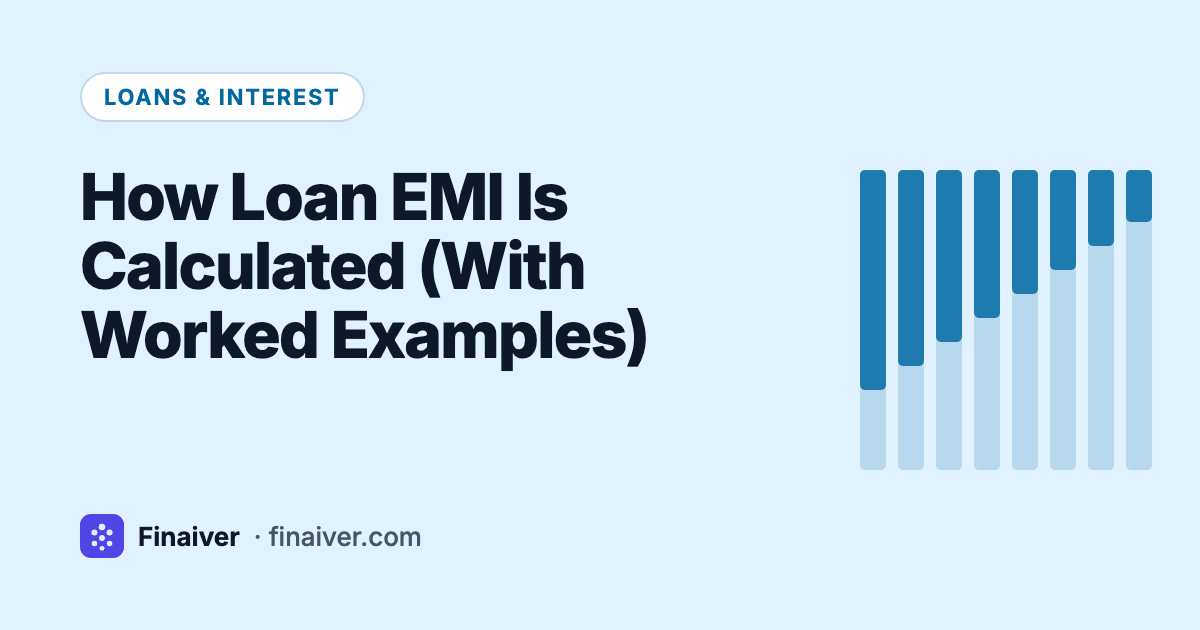
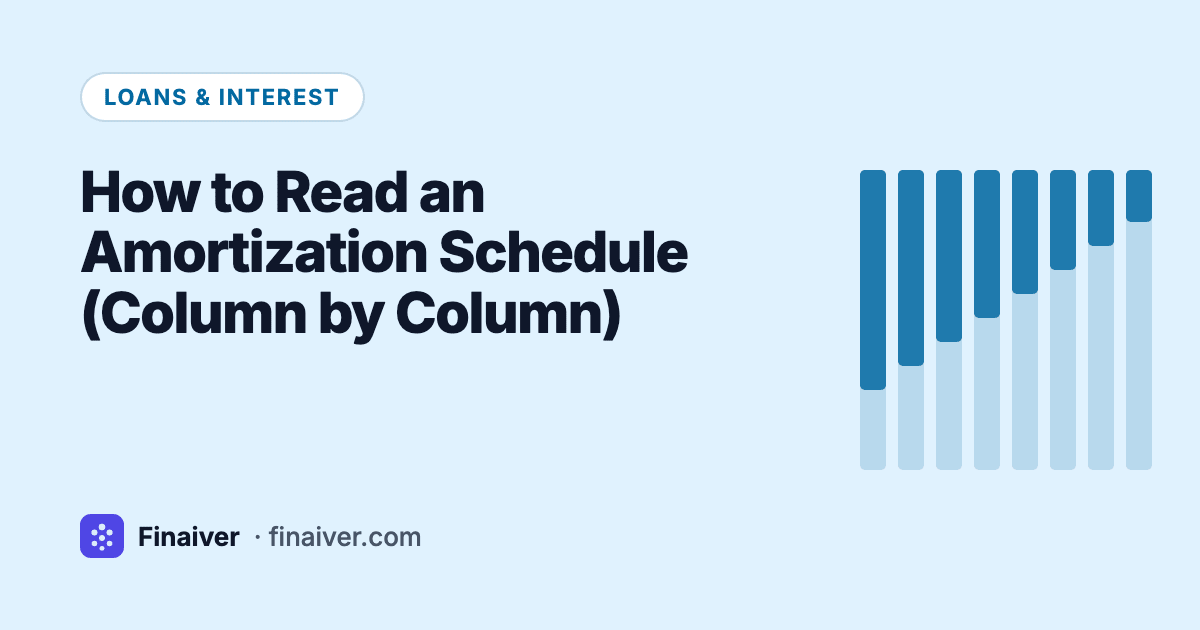
The short version: each month's interest is charged on whatever you still owe, so early payments are mostly interest and later payments are mostly principal. Everything else in the table follows from that.
The four columns, and what each one tells you
Most schedules have a row per payment and some version of these columns. Lenders label them differently, but the meaning is the same.
| Column | Also called | What it means |
|---|---|---|
| Payment | EMI, instalment | The fixed amount you pay each period |
| Interest | Interest component | The lender's charge for that period, based on the balance before the payment |
| Principal | Principal component, capital repaid | The part of the payment that actually reduces your debt |
| Balance | Outstanding, closing balance | What you still owe after this payment |
Two relationships hold on every row, and checking them is a quick way to spot an error:
- Payment = Interest + Principal. The payment is split, never added to.
- New balance = Previous balance − Principal. Only the principal part reduces what you owe. The interest part pays the lender for that month and is gone.
The interest itself is always calculated the same way: previous balance × monthly rate. For an annual rate of 12%, the monthly rate is 12 ÷ 12 = 1%. If you want the full derivation of the payment amount, see how loan EMI is calculated.
A worked example: 25,000 over 5 years at 12%
Let's build a real schedule. The figures below work in any currency.
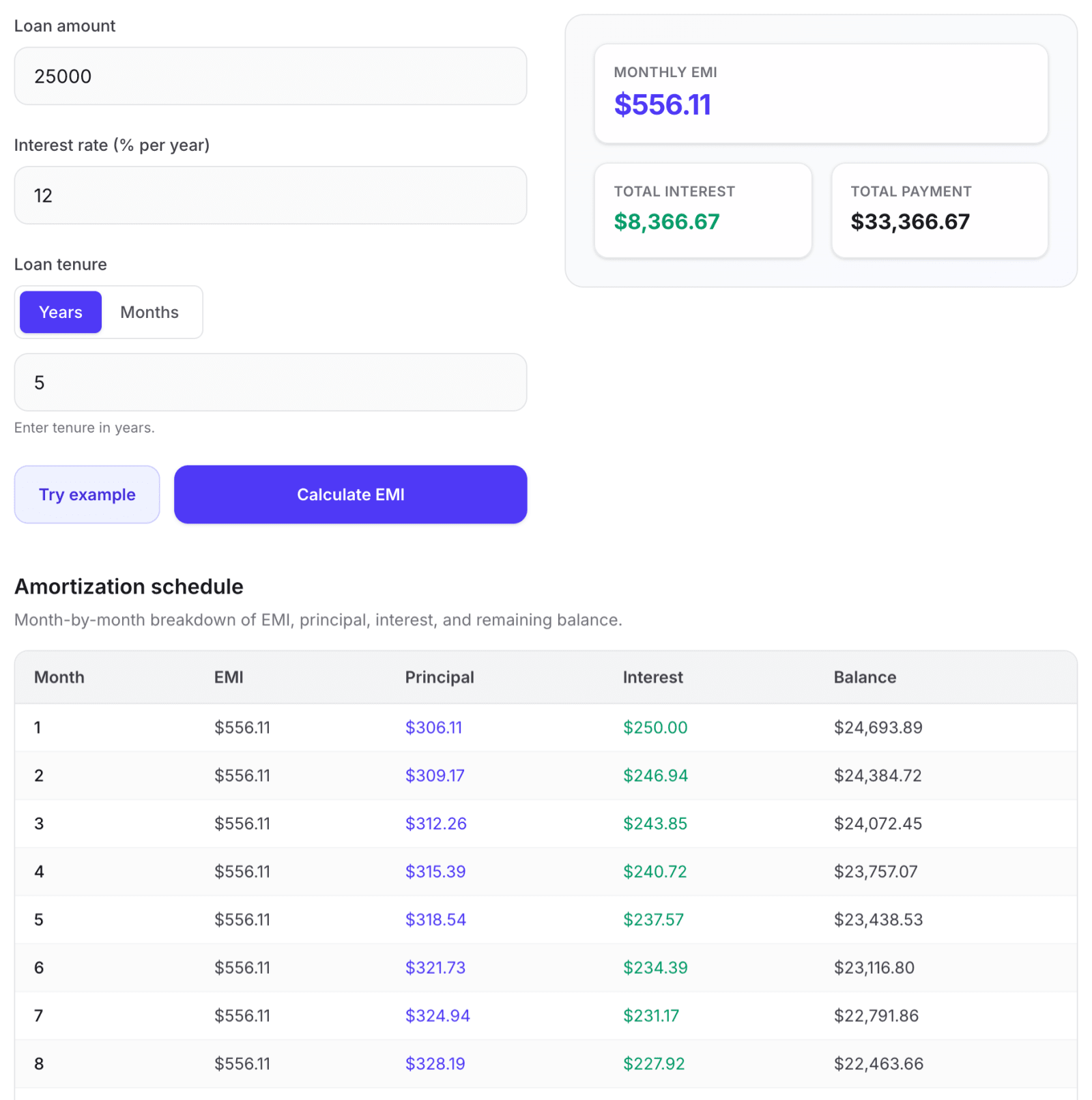
- Loan amount: 25,000
- Annual interest rate: 12% (so 1% a month)
- Tenure: 5 years, which is 60 monthly payments
The EMI formula gives a fixed monthly payment of 556.11. Over 60 months you pay 33,366.67 in total, of which 8,366.67 is interest.
Month 1, step by step
- Starting balance: 25,000.00
- Interest for the month: 25,000 × 1% = 250.00
- Principal repaid: 556.11 − 250.00 = 306.11
- New balance: 25,000.00 − 306.11 = 24,693.89
Month 2
- Interest: 24,693.89 × 1% = 246.94
- Principal: 556.11 − 246.94 = 309.17
- New balance: 24,693.89 − 309.17 = 24,384.72
Notice what happened. The payment stayed the same, the interest fell slightly because the balance is smaller, and so a little more went to principal. That small shift repeats every single month.
The first 6 months
| Month | Payment | Principal | Interest | Balance |
|---|---|---|---|---|
| 1 | 556.11 | 306.11 | 250.00 | 24,693.89 |
| 2 | 556.11 | 309.17 | 246.94 | 24,384.72 |
| 3 | 556.11 | 312.26 | 243.85 | 24,072.45 |
| 4 | 556.11 | 315.39 | 240.72 | 23,757.07 |
| 5 | 556.11 | 318.54 | 237.57 | 23,438.53 |
| 6 | 556.11 | 321.73 | 234.39 | 23,116.80 |
The last 3 months
| Month | Payment | Principal | Interest | Balance |
|---|---|---|---|---|
| 58 | 556.11 | 539.76 | 16.36 | 1,095.76 |
| 59 | 556.11 | 545.15 | 10.96 | 550.61 |
| 60 | 556.11 | 550.61 | 5.51 | 0.00 |
In month 1, interest takes 45% of the payment. In month 60 it takes about 1%. Same payment, completely different mix.
You may see a row where principal plus interest differs from the payment by a cent. That's rounding: the schedule is computed with full precision and displayed to two decimals. Lenders usually absorb the difference in the final payment.
Why is interest front-loaded?
It isn't a trick. It's arithmetic. Interest is charged on the outstanding balance, and the balance is highest at the start. So the first payments carry the most interest, and the share falls as the balance shrinks.
Looking at the 5-year example year by year makes the pattern clear:
| Year | Interest paid that year | Balance at year end |
|---|---|---|
| 1 | 2,791.08 | 21,117.74 |
| 2 | 2,298.71 | 16,743.12 |
| 3 | 1,743.90 | 11,813.69 |
| 4 | 1,118.72 | 6,259.07 |
| 5 | 414.26 | 0.00 |
A third of all the interest on this loan is paid in the first year.
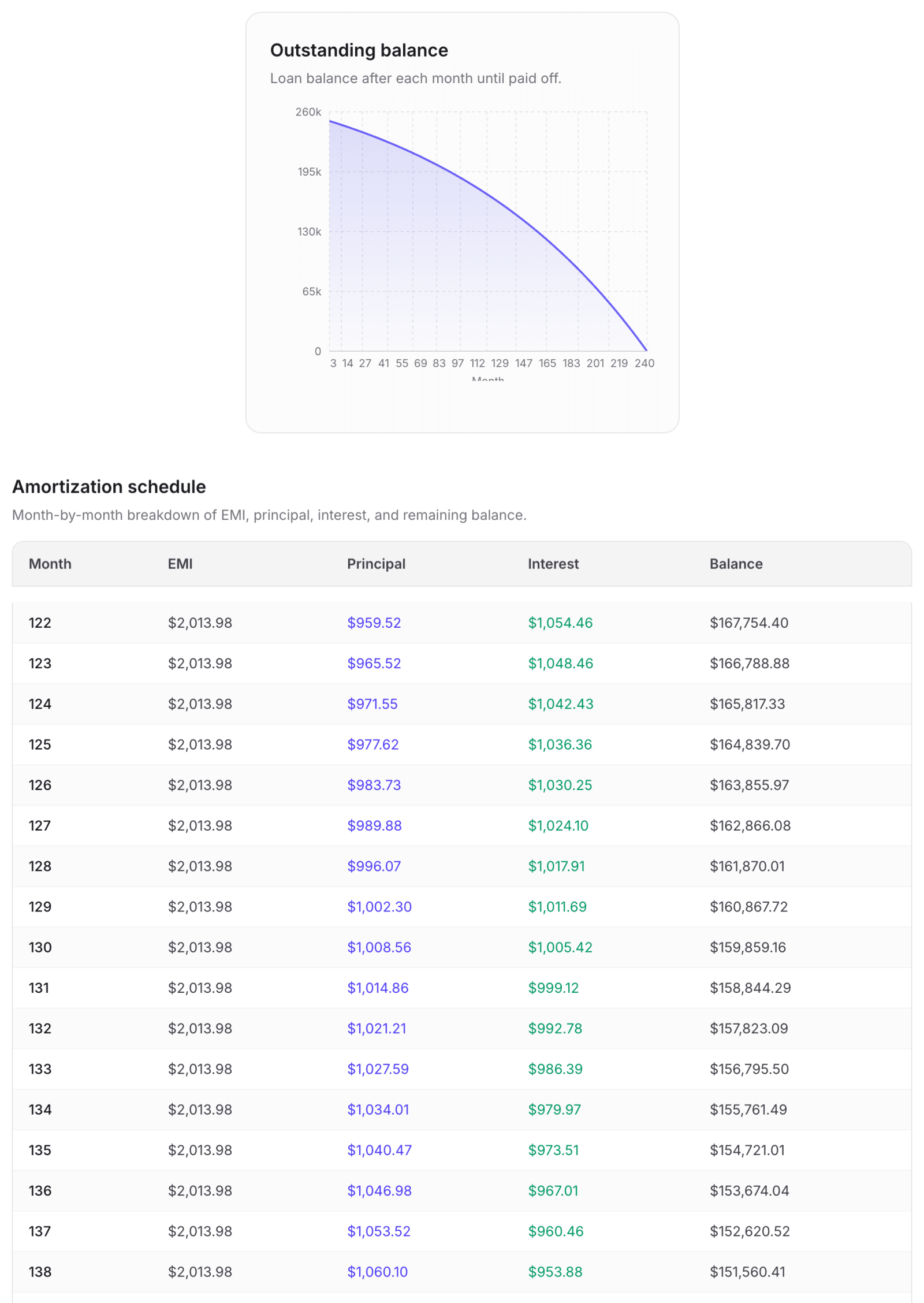
On a short loan like this, principal is already bigger than interest from month 1. On a long loan, the effect is much stronger. Take 250,000 over 20 years at 7.5%:
- Monthly payment: 2,013.98
- Month 1 interest: 1,562.50, which is 77.6% of the payment
- Principal only overtakes interest in month 130, almost 11 years in
- After 5 years you've paid 120,838.98, but only 32,744.75 of that reduced the loan. The other 88,094.23 was interest.
- You don't owe less than half the original amount until month 162, about 13.5 years into a 20-year loan
This is why the schedule matters more on long loans. It also shows why tenure has such a large effect on cost; loan tenure vs total interest walks through that comparison.
What to look for before you sign
A lender's schedule is the most honest document in the loan pack, because it shows the actual cash flows. Here's what to check.
1. Does month 1 interest match the stated rate? Multiply the loan amount by the annual rate and divide by 12. If the schedule's first interest figure is higher, ask why. A mismatch can mean the rate is quoted differently than you assumed, interest is charged from an earlier date, or fees have been added to the balance.
2. Is the starting balance the amount you asked for? If fees or insurance premiums are financed into the loan, the schedule will start from a bigger number. You'll then pay interest on those charges for the whole term. The way fees change the real cost is covered in APR vs interest rate.
3. Does the balance actually fall to zero? Check the last row. Some products end with a large "balloon" payment, or the balance barely moves for an initial interest-only period. Both change the risk you're taking on.
4. What's the balance at the point you might exit? If you think you'll sell, refinance, or pay off early in year 3 or 5, find that row. That's roughly what you'd need to clear the loan, before any prepayment charges. On the 20-year example above, the balance after 5 years is still 217,255.25.
5. Is the interest reducing balance or flat? On a reducing-balance loan the interest column falls every month, as in the tables above. If the interest figure is the same in every row, the loan is charging flat interest on the original amount, which costs considerably more for the same headline rate. See flat rate vs reducing balance interest.
6. Does a variable rate apply? If the rate can change, the schedule you see is only a projection at the starting rate. Ask how the payment or tenure is adjusted when the rate moves.
Common mistakes when reading a schedule
- Treating total payments as what you owe. If you've made 24 payments, you have not paid off 24/60 of the loan. In the 5-year example, after 24 payments (40% of the term) you still owe 16,743.12, which is about 67% of the original amount.
- Adding the interest column to the payment. Interest is part of the payment, not on top of it.
- Assuming a prepayment refunds past interest. It doesn't. Interest already paid is gone. A prepayment cuts the balance, so all future interest rows shrink. That's still valuable, especially early in the loan. Loan prepayment: reduce EMI or tenure compares the two options.
- Comparing schedules with different day-count or payment dates. Two lenders can show slightly different interest on the same rate because they count days differently. Small differences are normal; large ones deserve a question.
When a standard schedule doesn't apply
The tables in this article assume a fixed rate, equal monthly payments, and interest calculated on the reducing balance. That covers most personal loans, car loans, and fixed-rate home loans. It doesn't fully describe:
- Variable-rate loans, where the rate (and so every future row) can change
- Interest-only periods, where the principal column is zero for a while
- Loans with irregular payments, payment holidays, or step-up instalments
- Credit cards and overdrafts, which have no fixed schedule at all
For those, the lender's own statement and terms are the reference. The logic of "interest = balance × rate" still holds, but the rows won't follow a neat pattern.
Next step: generate your own schedule
Put your own loan into the Loan EMI Calculator. Enter the loan amount, the annual interest rate, and the tenure in years or months. You'll get the monthly EMI, total interest and total payment, a principal-vs-interest chart, an outstanding balance chart, and the full month-by-month amortization schedule. Then check it against the lender's version line by line, starting with month 1.
If you're still choosing between loan lengths, read loan tenure vs total interest next.
This article is general information, not financial advice.