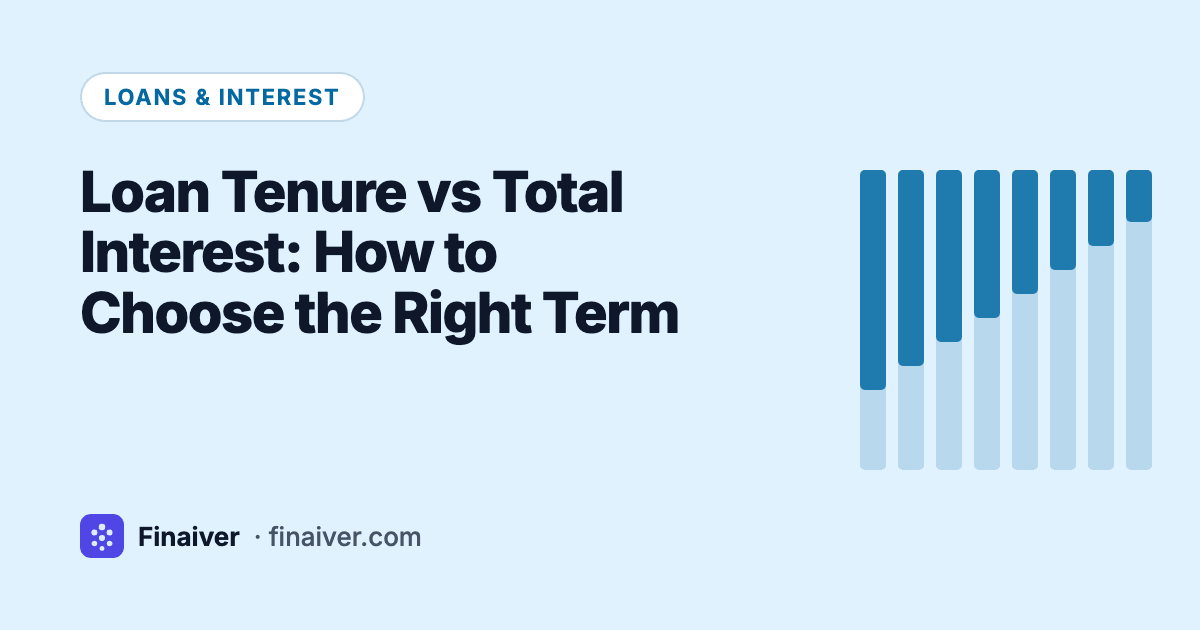
A longer loan tenure lowers your monthly EMI, but you pay interest for more months, so the total cost goes up. A shorter tenure does the opposite. The right choice is usually the shortest tenure whose EMI you can pay comfortably, with room left for savings and surprises.
The numbers below show how big the difference is. The maths works in any currency, so the figures have no currency symbol.
The same loan at 3, 5 and 7 years
Take a 500,000 personal loan at 12% a year, reducing balance. Only the tenure changes.
| Tenure | Monthly EMI | Total paid | Total interest | Interest as % of loan |
|---|---|---|---|---|
| 3 years (36 months) | 16,607.15 | 597,857.58 | 97,857.58 | 19.6% |
| 5 years (60 months) | 11,122.22 | 667,333.43 | 167,333.43 | 33.5% |
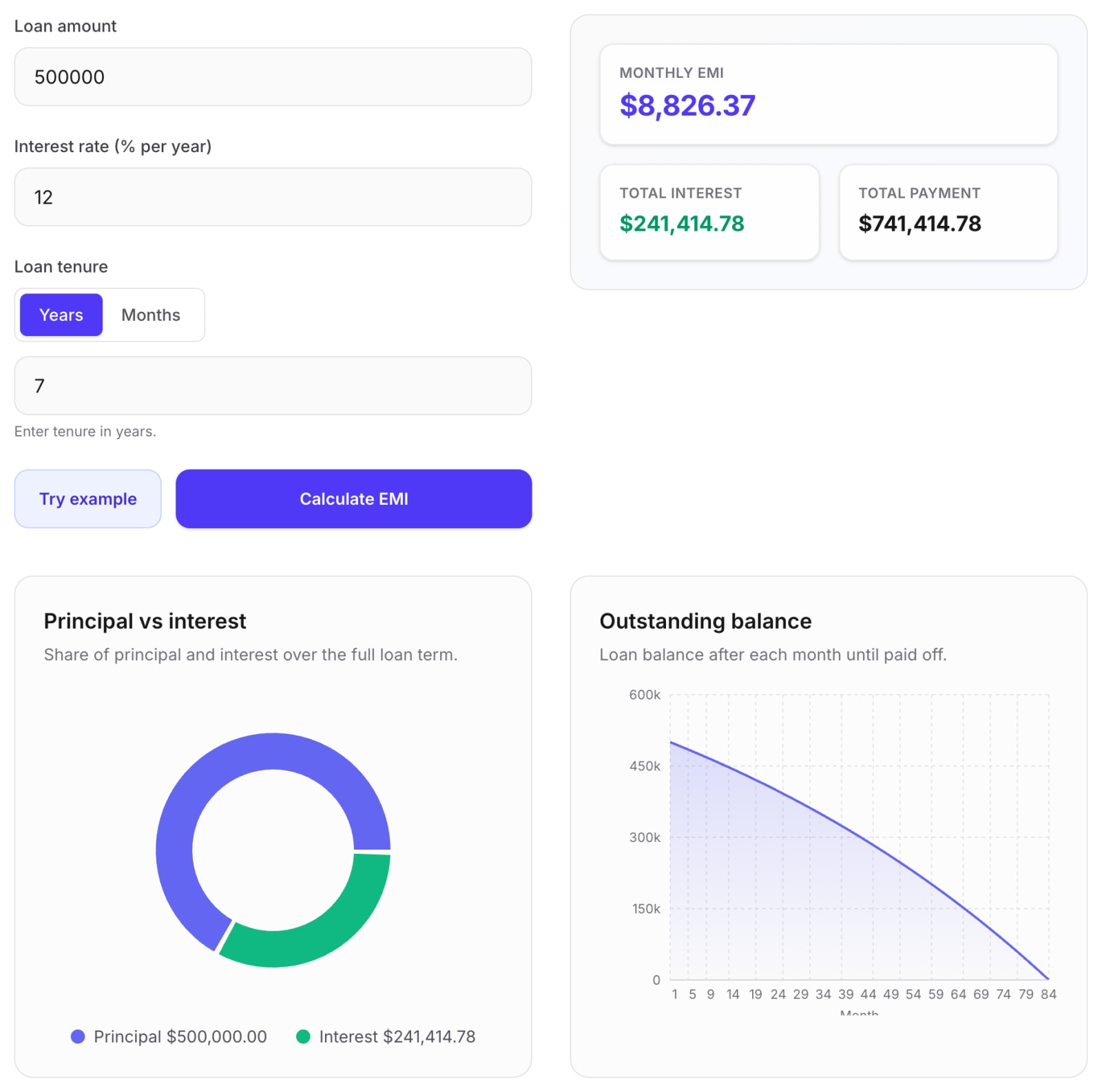
| 7 years (84 months) | 8,826.37 | 741,414.78 | 241,414.78 | 48.3% |
At 7 years you pay almost two and a half times the interest of the 3-year loan, for the same 500,000. The 7-year EMI is just over half the 3-year EMI.
If you want to see where these EMIs come from, the formula is worked through step by step in how loan EMI is calculated.
Why each extra year buys less relief
Look at what happens as you stretch the loan two years at a time.
| Change | EMI falls by | Total interest rises by |
|---|---|---|
| 3 years to 5 years | 5,484.93 | 69,475.85 |
| 5 years to 7 years | 2,295.86 | 74,081.35 |
Going from 3 to 5 years cuts the EMI by about 5,500 a month. Going from 5 to 7 years cuts it by less than half that, about 2,300, yet costs even more extra interest.
Put another way: moving from 3 to 5 years costs about 12.7 in extra interest for every 1 of monthly relief. Moving from 5 to 7 years costs about 32.3 for every 1 of relief. Each time you lengthen the loan, you get less help with the monthly budget and pay more for it.
The reason is that the EMI has a floor. Every EMI has to at least cover the first month's interest, which here is 500,000 × 1% = 5,000. However long you stretch the loan, the EMI can only creep towards 5,000, never below it. Meanwhile, every extra month adds another month of interest, charged on a balance that is falling more slowly.
Longer loans also keep you in debt longer
Total interest isn't the only cost. With a longer tenure, the balance falls more slowly, which matters if you ever want to sell an asset, refinance, or simply be debt-free.
Here's what each version of the loan still owes after 3 years of payments:
| Tenure | Balance owed after 3 years |
|---|---|
| 3 years | 0 |
| 5 years | 236,273.71 |
| 7 years | 335,172.08 |
Three years in, the 7-year borrower still owes about two-thirds of the original amount. If circumstances change and they need to close the loan, there's a lot left to pay.
The affordability side of the trade-off
None of this means the shortest loan is always right. An EMI you can't keep up with is far more expensive than a few extra years of interest: missed payments bring late fees, penalty interest, and damage to your credit record.
Suppose, as an illustration, your monthly take-home pay is 60,000. Here's what each EMI would take from it:
| Tenure | EMI | Share of 60,000 take-home pay |
|---|---|---|
| 3 years | 16,607.15 | 27.7% |
| 5 years | 11,122.22 | 18.5% |
| 7 years | 8,826.37 | 14.7% |
Whether 27.7% is manageable depends entirely on your other commitments. Someone with no rent and no other debts might handle it easily. Someone paying rent, supporting family, and repaying a car loan probably can't.
Lenders run their own affordability checks, often looking at the share of your income that goes to all debt payments. The limits they use differ between lenders, loan types, and countries. Passing a lender's check doesn't mean the EMI is comfortable for you; it means the lender is willing to take the risk.
A sensible way to choose your tenure
Step 1: Work out an EMI you can pay in a bad month, not a good one
Start from your take-home pay. Subtract essential costs (housing, food, utilities, transport, insurance), existing debt payments, and what you put into savings. What's left is the most you could put towards an EMI.
Don't plan to use all of it. Leave a buffer for irregular costs and for months when income dips. A practical budget makes this much easier; see how to make a monthly budget.
Step 2: Pick the shortest tenure whose EMI fits
With your comfortable EMI in mind, try tenures in a calculator, starting short and going longer until the EMI fits under your limit. Stop at the first one that fits. Going longer than that adds interest without solving any problem.
Step 3: Check the rate for each tenure
Some lenders charge a different rate for different tenures. Compare the EMI and total interest at the actual rate offered for each term, not one rate across all of them. If a lender quotes a flat rate, convert it first; see flat rate vs reducing balance interest.
Step 4: Consider "long tenure, short repayment", but only if prepayment is free
There's a useful middle path. Take the longer tenure for its lower required EMI, then voluntarily pay more whenever you can.
In the example, if you take the 7-year loan but pay 11,122.22 a month (the 5-year EMI) from the start, the loan clears in 60 months and the total interest is 167,333.43, the same as the 5-year loan. In a tight month you can drop back to the required 8,826.37.
This only works if your lender allows extra payments without charges and applies them to principal straight away. Many don't, or set limits. Check the loan agreement. It also only works if you actually make the extra payments; a lower required EMI makes it easy to drift. When you do have a lump sum to put in, prepayment: reduce EMI or tenure explains which option to pick.
Mistakes to avoid
Choosing by EMI alone. The lowest EMI is almost always the most expensive loan. Always look at total interest as well.
Stretching the tenure to borrow more. A long tenure can make a bigger loan look affordable. Ask whether you need the larger amount, not just whether you can afford its EMI.
Matching the loan to the wrong lifespan. A loan that outlasts the thing it paid for, such as a 7-year loan on a holiday or a gadget, means paying for something you no longer have.
Ignoring an emergency fund. A short, aggressive tenure that leaves no savings is fragile. One unexpected bill and you're borrowing again, probably at a higher rate. See how big an emergency fund should be.
Assuming the rate is fixed. On a floating-rate loan, a rate rise can lengthen your tenure or raise your EMI. Leave headroom for that.
When the trade-off looks different
For very low-rate loans, the extra interest from a longer tenure is smaller, and keeping the EMI low to free up money for other goals can make more sense. Where interest on certain loans brings a tax benefit, that changes the arithmetic too; such rules vary by country and change over time, so check current local guidance. And for a home loan, the tenure options are usually much longer than for a personal loan, but the pattern is the same: each extra year costs more and helps less.
Compare tenures for your own loan
Open the Finaiver Loan EMI Calculator, enter your loan amount and annual rate, and run it at two or three different tenures (in years or months). Compare the Monthly EMI, Total interest and Total payment for each, and use the Outstanding balance chart to see how quickly the debt falls. The calculator shows a dollar sign, but the numbers work in any currency.
Then pick the shortest term whose EMI fits your budget with room to spare.
This article is general information, not financial advice.